
If Siblings Have Different Home Addresses, Does Sibling Priority Still Apply for P1 Registration?
What Singapore parents should check when siblings live across two homes or under different caregiving arrangements.
Possibly. A different home address does not automatically remove sibling priority for Primary 1 registration, but it also does not secure it. The practical issue is whether the sibling link, the registration address, the caregiving arrangement, and any needed parental agreement can be shown clearly and consistently.
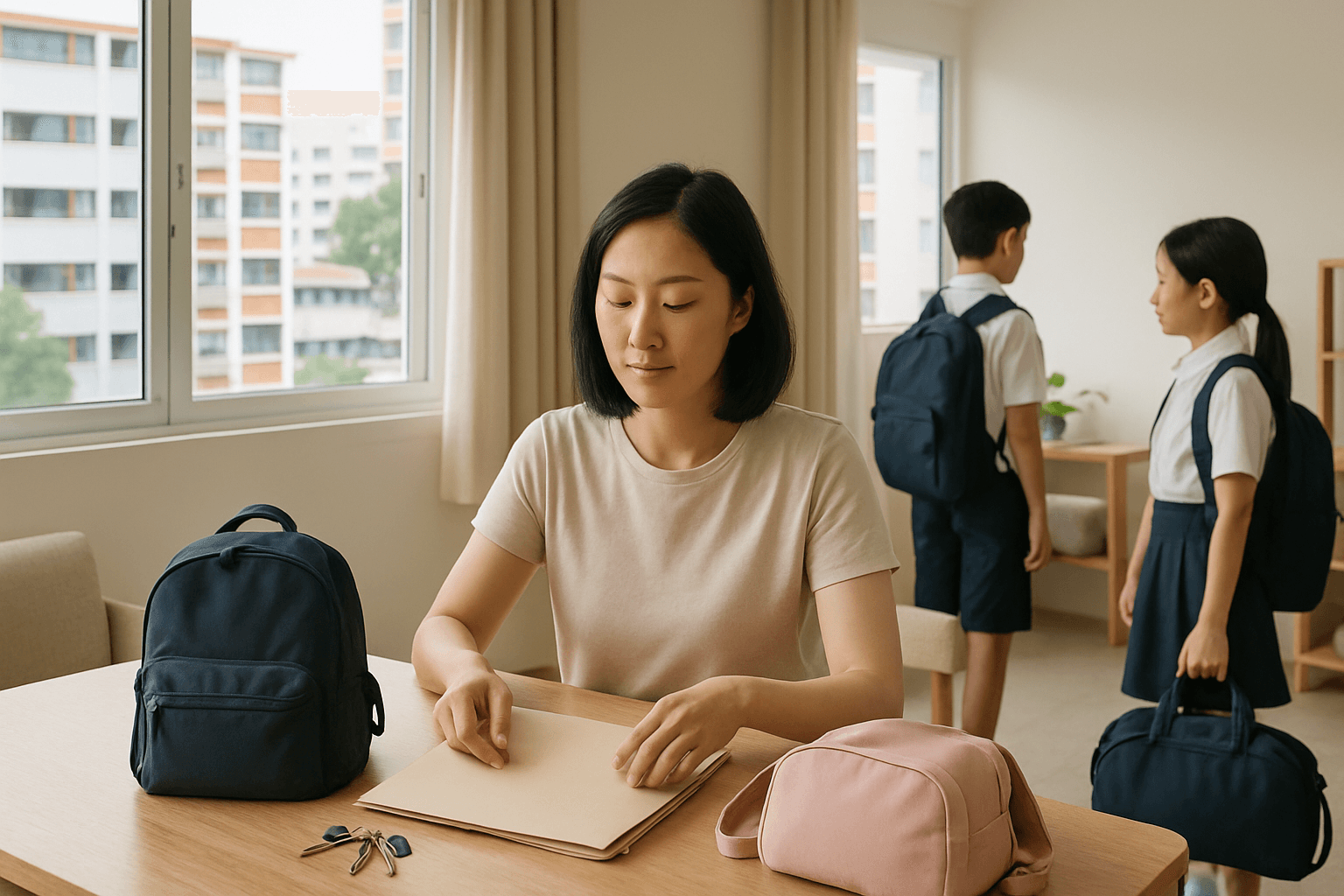
If your children are siblings but do not live in one simple household, do not treat this as a yes-or-no address question. For Primary 1 registration, the sibling relationship, the address used for registration, and the child’s actual caregiving setup are related, but not the same thing. Getting that clear early helps you avoid relying on assumptions that may not hold up once registration starts. If you need the wider process first, start with our Primary 1 Registration Singapore guide.
Can sibling priority still apply if siblings have different home addresses?
Yes, possibly. Different home addresses do not automatically cancel sibling priority, but parents should check how the sibling link, address, and caregiving setup fit together before registration opens.
Yes, it may still apply. A different address does not automatically cancel sibling priority, but it also does not prove the case by itself.
The cleanest way to think about this is to separate the family link from the registration setup. MOE’s published guidance does not state that siblings must live at the same address for sibling priority to apply. But MOE does have separate guidance for divorced or separated parents, which is a strong sign that non-standard family arrangements need clearer explanation.
For parents, the practical takeaway is simple: do not rely on the address alone, whether it matches or not. If your children live across two homes, or one child is mainly cared for by a grandparent or another guardian, sort out the registration story early. If your main question is which address is likely to matter, our guide on which home address counts for Primary 1 registration is the best next read. For a broader overview, see Primary 1 Registration in Singapore: How It Works, Balloting Risk, and How to Choose a Realistic School Plan.
Questions on new rules of P1 registration
With the announcement of the new rules of P1 registration - that citizens now have advantage over PRs, I have 2 questions: 1. Does the living distance to the school matter (ie 1 km away)? 2. If the PR has an older child in the school already, is priority given to the child’s younger sibling? Thanks!
*** READ ME FIRST !!! - P1 Registration FAQ ***
if one can't turn up : the spouse that turn up still have to produce the other spouse IC. Schools need to check the address, appearing on both ICs (father & mother) in the event the P1 Registration Officer find that the address of father / mother differ from each other on both IC: the parent have to explain the reason(s) behind. if for any reason the Registration Officer find the address(es) on both parents' IC differ, or the reason / explaination provided make them feel suspicious / fishy about
What sibling priority is meant to do in Singapore P1 registration
Sibling priority is meant to support school continuity for families. Its practical value is easier logistics, not a blanket shortcut through every registration issue.
Sibling priority is meant to help families keep younger siblings in the same school where possible. In practical terms, it supports school continuity, so parents can manage drop-offs, school communication, and daily routines with less friction.
That matters even more for households already juggling two homes, handover schedules, shift work, or weekday caregiver arrangements. One school can mean one transport plan, one calendar, and fewer chances for mixed-up information.
What parents sometimes miss is that sibling priority is only one part of the registration picture. It can help, but it does not replace the rest of the process. Think of it as a useful advantage, not a free pass. If you want the broader context, our article on whether an older child already in the school means the younger child automatically gets in explains where sibling priority helps and where it does not. For a broader overview, see Which Home Address Counts for Primary 1 Registration in Singapore?.
Give citizens priority in Primary 1 registration
Ha.ha. maybe next time the P1 registration phase can propose like that, just a suggestion: Phase 1 – Existing siblings in the Primary school except PR siblings. Phase 2A(1) – No Change Phase 2A (2) – No Change Phase 2B – No change Phase 2C – Singapore Citizenship Only. Phase 2C Supplementary - Singapore Citizenship Only Phase 3A – Permanent Residents Phase 3A Supplementary - Permanent Residents Phase 4 – Non Citizen.
All About Getting Priority Registration
http://www.straitstimes.com/BreakingNews/Singapore/Story/STIStory_579675.html \"THE current Primary 1 registration process will not be changed to give higher priority to children living very near to their school of choice - even if they live right across the street from it.\" :stupid: :stupid: :stupid: :stupid: Sad lah....
Have More Questions?
Get personalized guidance on schools, tuition, enrichment and education pathways with AskVaiser.
Try AskVaiser for Free →Why different addresses do not automatically settle the issue
Address is only one part of the picture. Parents need to think separately about the sibling relationship, the address used for registration, and the child’s actual caregiving arrangement.
Parents often mix up three separate questions: who the child is related to, which address is being used for registration, and who actually looks after the child most school days. Those three things may line up neatly, but in many families they do not.
For example, an older sibling may already be in the school and live mainly with one parent, while the younger child stays with the other parent on school days. In another family, both children are mainly cared for in one home, but one child’s records still show an older address from before the family moved. In a third case, a child sleeps at a grandparent’s home during the week because both parents work early shifts.
In each example, the sibling relationship is real. What changes is the registration picture. That is why siblings with different addresses in school registration cases are often more about clarity than about biology.
A useful rule of thumb is this: if you would need to explain the arrangement slowly to someone outside the family, assume you may need supporting documents and a consistent explanation. If you are still working through the address question, our guides on distance priority and which home address counts are the next most useful reads. For a broader overview, see If Your Older Child Is Already in the School, Does Your Younger Child Automatically Get In?.
All About Getting Priority Registration
You’re living life on the edge of a very high cliff! My kids’ primary sch journey alr surfaced parents caught :- 1. One parent leased only address thro an old lady, but what old lady didn’t realised is if there is no legitimate tenancy, both parties committed cheating sch which later surfaced as her daughter was gonna use mother’s address for P1 registration. Both sets of parents were investigated & unfortunately, the owner’s daughter was able to state her FTW status & the other family was charg
*** READ ME FIRST !!! - P1 Registration FAQ ***
Yes. You and your spouse need to be stationed in the two schools - one in the P2A1 school and the other at the P2C school. Once you have decided to register with the P2C school, the one who is at the P2A1 school needs to withdraw your child's application before the one at the P2C school is able to proceed with the registration. Depends. If the school traditionally has balloting in the distance category you are in, you will only know the result of your application on the day of balloting. Please
Common real-world scenarios: separated parents, shared custody, and children living with different caregivers
Different-address sibling cases can happen in many normal family setups. What changes from case to case is usually not the sibling link, but how clearly the living and caregiving arrangement can be shown.
One common scenario is a family with one school routine but two different recorded addresses. For example, both children may spend most weekdays in one home, but one child’s official records have not been updated after a move or a change in care arrangement. In that case, the issue is usually not whether the children are siblings. The issue is whether the registration picture still matches reality.
Another common case is separation or divorce. One child may live mainly with the mother, while the younger child stays with the father, or the younger child may rotate between homes. Here, the sibling link is straightforward, but the key questions become who is registering the child, which address is being used, and whether both parents are aligned on the plan.
A third scenario involves grandparents or other caregivers. For instance, an older child may stay with a parent near the school, while the younger child stays with a grandparent on weekdays for practical reasons. That does not automatically defeat a caregiving arrangement sibling priority claim, but it does mean parents should be ready to explain how the setup works in everyday terms.
Blended families add another layer. A child may have a half-sibling already in the school, but the household may involve different parents, different decision-makers, or different legal arrangements. These cases are often workable, but they are rarely cases where parents should assume the school will infer the full family setup from a surname or family story alone. For a broader overview, see Primary 1 Registration Documents Checklist: What Singapore Parents Commonly Prepare.
All About Getting Priority Registration
I was just wondering… Is there any priority for the child if the grandparent is from that particular school? Or only for the parents?
All About Getting Priority Registration
Yes, it is good that it is more stricter as the law requires the family to become SC. What about this coming 2012 P1 registration? Do they require both the parents and child to be SC before they are given absolute priority? I doubt so for I have found out the answer very clearly. It really bothers me. I really hope that KS parents will take action by investigating this issue.
What schools or MOE may look for when the addresses are different
Where addresses differ, clarity matters more than matching paperwork alone. Schools or MOE may need to understand who is registering, whether the caregiving arrangement is coherent, and whether both parents agree where required.
When siblings have different home addresses, the practical issue is usually whether the arrangement is clear, stable, and supported by the person registering the child. Parents should expect attention on who is making the application, whether the address used fits the family’s actual setup, whether the sibling connection to the school is easy to verify, and whether both parents or guardians are aligned where needed.
This matters especially in separated or joint-custody cases. In MOE’s FAQ for divorced or separated parents, MOE says that if a parent with joint custody cannot contact the current or former spouse to obtain consent, that parent must undertake during P1 registration that if the dispute cannot be resolved, MOE reserves the right to place the child in another school with vacancy. That does not create a same-address rule, but it does show that consent and dispute handling can affect placement.
The parent-friendly takeaway is this: a clear address helps, but a clear authority and caregiving story may matter just as much. If your case would take several rounds of explanation to make sense, clarify it before registration starts, not during a time-sensitive application window.
For Reference for P1 registration: MOE Official Letters
http://www.kiasuparents.com/kiasu/forum/viewtopic.php?p=293646#p293646 Dear Sir/Madam, Thank you for writing to us on 12 November 2010. We wish to clarify that parents using address of rented apartment will not be at a disadvantage if the school should conduct balloting. We would like to share with you that the registration is done based on the NRIC address that is reflected on the parents' NRIC at the time of registration and the address used for the registration of a child (assuming Singapore
All About Getting Priority Registration
Changing address for the purpose of P1 registration. I think the MOE should look into this matter. It is not logical at all. Imagaine the actual place of stay is in the west but just because of the branded school (top ten) in the east they can crazily spending hours traveling and troubling themselves to seek relevant authority to change the address. I am very sorry for the little boy that I know.
What documents do parents commonly prepare when siblings live at different addresses?
There is no fixed official checklist in the source material reviewed. Parents commonly prepare documents that show the sibling relationship, the address used, and the caregiving or custody arrangement as one consistent picture.
The source material reviewed does not provide a fixed official checklist for different-address sibling priority cases, so parents should treat any document list as examples rather than guaranteed requirements. Even so, families usually do better when they prepare papers that tell one consistent story.
In practice, parents often gather documents that show the sibling relationship, such as the children’s birth records or school records, together with documents that help explain caregiving or decision-making. Depending on the family setup, that may include custody or separation papers, a court order if one exists, or documents showing who is responsible for day-to-day care. Parents also commonly prepare proof tied to the address being used for registration, especially if that address does not obviously match the child’s broader family situation.
The key is not to over-prepare random paperwork. It is to prepare documents that answer three basic questions clearly: how the children are linked, which address is being used, and why that address fits the child’s actual living or care arrangement. For broader preparation, see our guide on Primary 1 registration documents parents commonly prepare.
All About Getting Priority Registration
As long as the birthcert / document reflects the relationship, it should be fine. To be safe, call up the school to check.
All About Getting Priority Registration
you can read http://www.kiasuparents.com/kiasu/forum/viewtopic.php?f=5&t=476 to find out more about using relative's address ....
Important nuance: the sibling link and the living arrangement are not the same thing
Do not confuse family relationship with registration setup. A clear sibling link does not automatically make a complicated living arrangement straightforward for P1 registration.
Being siblings is one thing; proving the registration setup is another. Parents most often run into trouble when they assume the family link will automatically answer questions about address, caregiving, or who has authority to register the child.
All About Getting Priority Registration
You are talking abt whether a pv cum registered alumni have priority over a regiatered alumni if both stay outside 2km in phase 2a1, answer is no.
All About Getting Priority Registration
Does anyone know if there's any priority for grassroots over PV parents in P2B? Or both have same priority? (assuming both are citizens and stay with 1km of the school) Thanks! :please:
What should I do if my sibling lives with the other parent, a grandparent, or another guardian?
Do not wait until registration opens. Confirm who will register the child, whether parental agreement is needed, and how you will explain the caregiving arrangement if the sibling lives elsewhere.
Start by deciding on the registration approach before the portal opens. Parents should be clear on who will submit the application, which address they plan to rely on, and whether that address matches the child’s actual school-day routine. If the sibling lives with the other parent, do not assume the school will infer consent or caregiving arrangements just because both children share a parent.
If the sibling lives with a grandparent or another caregiver, prepare to explain how the arrangement works in everyday terms. For example, who handles weekday mornings, pickups, school communication, and after-school care? These details matter because they show whether the address and caregiving setup are being presented realistically rather than just strategically.
If your family arrangement is likely to raise questions, contact the school early or refer to MOE’s guidance for divorced or separated parents before submitting the application. Parents often lose time not because their case is impossible, but because they wait too long to clarify it. If a recent move is part of the situation, our guides on which home address counts and old or new address after moving house can help you think through the address side of the decision.
*** READ ME FIRST !!! - P1 Registration FAQ ***
Just curious. Why is the P1 registration exercise for children born between 2 January 2006 and 1 January 2007 but not between 1 January 2006 and 31 December 2006? Can those children born on 1 January 2007 choose to register next year?
*** READ ME FIRST !!! - P1 Registration FAQ ***
2A need to apply at school , so withdrawal also need to be at school. Then go over to school B for registration. Consider time for travel, withdrawal take 5-10min. Buffer 1.5 hours would be safe if driving. If you can let us know your 2C choice , we can tell you the risk. It might be worth just to go 2C
When is sibling priority less straightforward than parents expect?
Do not rely on sibling priority alone if there is a dispute, an unclear residence arrangement, or missing parental agreement. In these cases, a realistic backup school plan matters just as much as the sibling claim itself.
Sibling priority is less straightforward when there is an unresolved dispute between parents, when one co-parent cannot be contacted, when the child’s actual residence does not match the registration story, or when the caregiving arrangement is still changing. In those situations, the sibling relationship may be real, but the application can still carry practical risk.
This is where many parents make the same mistake: they plan as if sibling priority is the whole strategy. A safer approach is to treat it as one advantage within a wider school plan. If your case needs explanation, prepare backup school options early and make sure you understand the wider process through our guides to P1 registration phases, dream-school versus safer nearby-school choices, and what happens if you do not get your preferred school.
The simplest insight is this: when the family arrangement is complicated, your school strategy should be more grounded, not more hopeful. Parents usually cope best when they settle the paperwork early, choose the address and explanation that best reflect reality, and build a backup plan before registration starts.
All About Getting Priority Registration
Nope. Priority for the child is applicable only if either parent was former student.
Give citizens priority in Primary 1 registration
To elaborate more, with the advantage points awarded to each child, parent will choose their top 5 preferred pri schools and let the system assign their best eligible choice. Something like choosing the sec sch if I am not wrong.
Have More Questions?
Get personalized guidance on schools, tuition, enrichment and education pathways with AskVaiser.
Try AskVaiser for Free →