
How Distance Affects Primary 1 Balloting Risk in Singapore
Living nearer usually improves priority, but it does not guarantee a place. Here is how the distance bands work and how parents should judge the risk realistically.
Home-to-school distance affects Primary 1 balloting risk by improving your child's priority when a school has more applicants than vacancies. In Singapore, homes are generally grouped into within 1km, 1km to 2km, and outside 2km. A closer band usually helps, but it does not guarantee a place because registration phase, citizenship, remaining vacancies, and competition within the same band still matter.
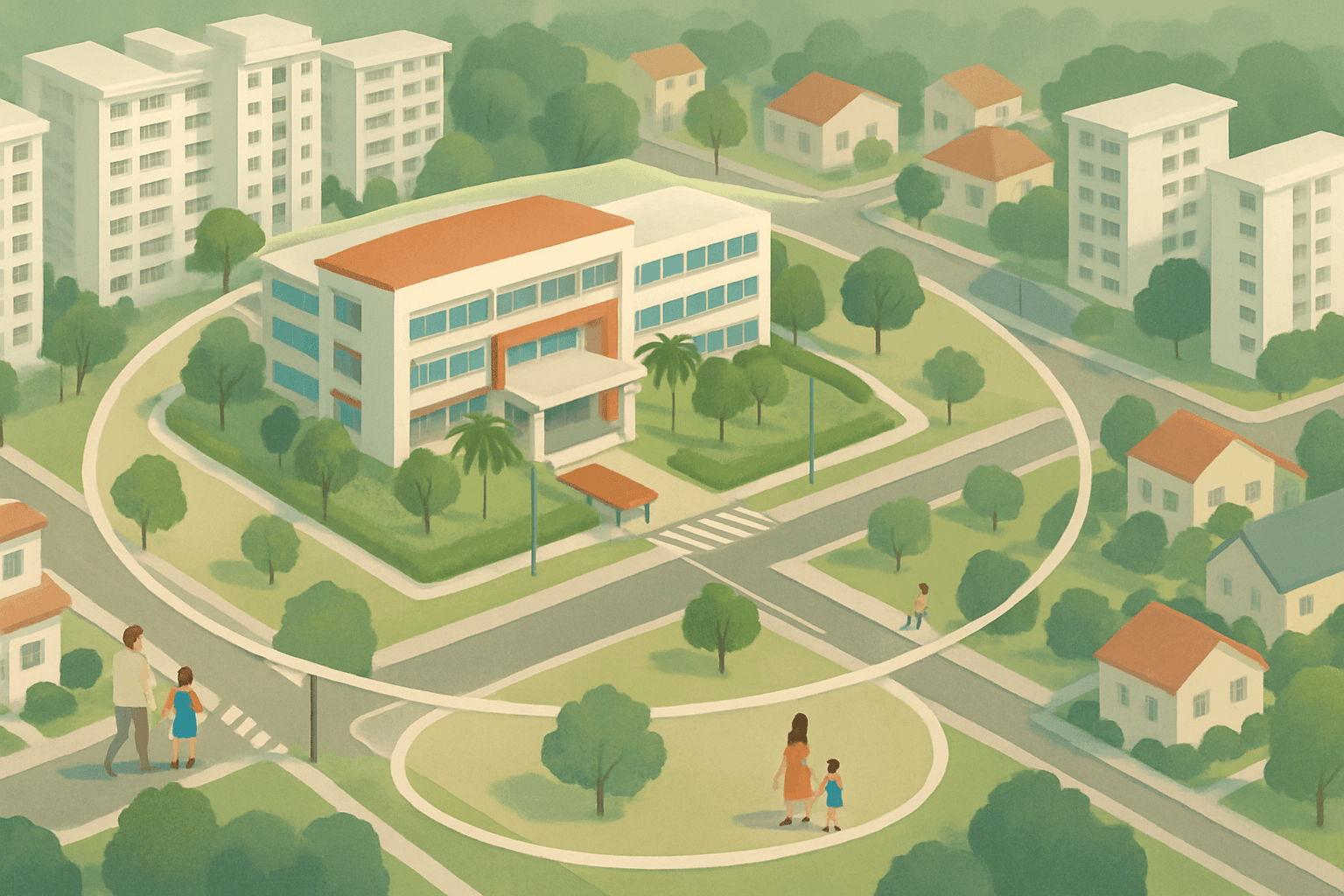
Yes, distance affects Primary 1 balloting risk in Singapore. When a school has more applicants than vacancies, MOE uses home-to-school distance as part of the priority order after broader factors such as registration phase and citizenship. A closer address can therefore improve your child's position in the queue.
But distance is not a promise. At popular schools, even families within 1km can still face a ballot. The more useful question is not “Will this address get us in?” It is “How much does this address improve our chances compared with other families in the same phase?” That is the question that leads to better school planning.
What does distance actually change in Primary 1 registration?
Distance improves your child's priority when places are tight, but it does not reserve a seat.
Distance changes priority, not certainty. Under MOE's balloting rules, the school first applies the wider registration priorities, including phase and citizenship. If there are still more applicants than vacancies, home-to-school distance helps decide who gets considered earlier.
In practical terms, a closer address gives your child a stronger place in the queue when a school is oversubscribed. That can reduce the chance of ending up in the last group competing for the final places. But it is still a queue, not a reserved seat. A child outside 2km can still get into a school with moderate demand, while a child within 1km can still face a ballot at a very popular school.
Parent takeaway: treat distance as a risk reducer, not a guarantee. It matters most when a school is close to the line between enough places and too many applicants. For a broader overview, see Primary 1 Registration in Singapore: How It Works, Balloting Risk, and How to Choose a Realistic School Plan.
All About Primary Schools' Balloting History
With the latest https://www.moe.gov.sg/news/press-releases/20210909-changes-to-the-primary-one-registration-framework-to-ensure-our-schools-remain-open-to-all announcement wef 2022 registration, you may like to know the following: Had the new changes applied to the 2021 registration: 2A would have another 16 schools joined the ballot: Yu Neng Primary School Chongzheng Primary School Fairfield Methodist School Red Swastika School Henry Park Primary School Riverside Primary School Westwood Primary
All About Primary Schools' Balloting History
This year whole new ball game. With the cap on PRs, maybe PR <1km need to ballot. Not due to lack of places, but due to the cap. “Primary 1 registration for 2021 moves online, introduces cap on intake of PR children” https://www.channelnewsasia.com/news/singapore/primary-1-registration-online-2021-cap-pr-children-12773368
How do distance bands work in Singapore Primary 1 registration?
The main bands are within 1km, 1km to 2km, and outside 2km, based on the registered home address.
MOE generally groups homes into three bands: within 1km, 1km to 2km, and outside 2km. The band is based on the address used for registration, not on what feels nearby or what a map app estimates. MOE explains the framework on its distance page.
One detail parents often miss is how the distance is calculated. MOE updated the method from the 2022 exercise to use the school land boundary, as set out in its 2021 framework changes. That means two homes in the same estate can still fall into different bands even if both seem equally close.
The practical move is simple: confirm the address classification before you build a school plan around it. Do not assume you are safely within 1km just because the route looks short. If you want a fuller explanation of how the banding works, see our guide on Primary 1 distance priority and our article on which home address counts for Primary 1 registration.
All About Primary Schools' Balloting History
https://www.kiasuparents.com/kiasu/article/singapore-primary-1-registration-school-balloting-history/
All About Primary Schools' Balloting History
end of Phase 2B , as at Wednesday, 24 July 2013 (for 2014 P1 intake - born 2007, year of golden piggy) Balloting at Phase 2B - will be conducted on Friday, 26 July 2013. \t30 schools conducting Balloting (as at 24 July 2013)\t 1.\tAi Tong School \tBalloting will be conducted for SC children residing within 1km of the school. 2.\tAnglo-Chinese School (Junior)\t The school has places for only SC children residing within 1km of the school. No balloting will be conducted. 3.\tAnglo-Chinese School (P
Have More Questions?
Get personalized guidance on schools, tuition, enrichment and education pathways with AskVaiser.
Try AskVaiser for Free →Why does being in a closer band reduce balloting risk?
Nearer applicants are considered earlier, so a closer home usually means fewer competitors ahead of your child.
A closer band reduces risk because nearer applicants are considered ahead of farther ones within the same broader priority grouping. If places run out early, families in later bands may not even reach a realistic chance.
Think of a school that has only a small number of places left after earlier priority groups are admitted. If many applicants are within 1km, those places may be filled before the school even reaches families living 1km to 2km away. If the school still has demand after that, the farther group faces a much steeper fight for fewer places.
The key insight is this: distance does not win the place, but it moves you closer to the front of the line. That is why a small address difference can matter more than parents expect. Being just inside 1km is usually materially stronger than being just outside it, even if the homes are only a few minutes apart. For a broader overview, see Primary 1 Registration Phases in Singapore: What Each Phase Means for Your Chances.
All About Primary Schools' Balloting History
As said all along, not all schools will call up applicants greater than balloting distance. It largely depends on whether the school has the manpower and ability to do so (p/s: people should stop imaging that someone will alert them if there's balloting... hello, you are on your own). Also, do note that there's a \"cut off time\" for schools that do call to do so. If the staff login at 12pm and call up those presently in the system, those who register after 12pm would not have received any call.
All About Primary Schools' Balloting History
Taking past 10 years data, there were balloting for SC < 1km in Phase 2B for every year except 2017, 2016 and 2009. In 2016, it was SC < 1km filled exactly, thus a close shave. 7 (or 7.5) out of 10 means SNGS is definitely high risk for balloting < 1km for SC in Phase 2B. Given the historical data and trending, with Phase 1 not much of a drop off vs last year, and Phase 2A1/2 still to come, best to get yourself mentally prepared with backup in Phase 2C, especially if the school is left with only
When does distance stop helping as much as parents expect?
Distance helps least when a school is either heavily oversubscribed or not very competitive in the first place.
Distance helps less in two opposite situations: when a school is so popular that even the nearest band is crowded, and when a school is calm enough that distance may not matter much at all.
At a high-demand school in a dense estate, many families may already live within 1km. In that situation, the real question is not whether you are in the strongest band. It is how many other families are in that same band and applying in the same phase. A within-1km address still helps, but it may only move you into a crowded pool rather than into safety.
At the other end, some schools do not reach the point where distance meaningfully separates applicants. A child living farther away can still be admitted if the school has enough places.
Phase matters too. In later phases, fewer vacancies may remain, so the protection offered by a strong distance band can feel thinner than parents expected. If you need a clearer view of that interaction, our Primary 1 Registration in Singapore guide and this explainer on Primary 1 registration phases are useful next reads.
Simple rule of thumb: distance is most valuable when demand is close to the vacancy line. It is less decisive when demand is either very low or very high. For a broader overview, see How to Read Past Balloting Data Before Chasing a Popular Primary School.
[Pasir Ris] Primary Schools
Schools Conducting Balloting (as at 4 August 2014) Source : http://www.moe.gov.sg/education/admissions/primary-one-registration/balloting/ Elias Park Primary School: \tAll SC children are admitted to the school in this phase. Balloting will be conducted for PR children residing between 1km and 2km of the school. Pasir Ris Primary School: \tBalloting will be conducted for SC children residing within 1km of the school. White Sands Primary School: \tBalloting will be conducted for SC children resid
All About Primary Schools' Balloting History
Have you check out this http://www.kiasuparents.com/kiasu/content/singapore-primary-1-registration-school-balloting-history ?
What happens if too many applicants are in the same distance band?
If too many families are tied in the same priority group and distance band, MOE can still ballot within that band.
A ballot can still happen within that band. This is the part many parents underestimate. Being within 1km is helpful, but it is not an automatic pass.
If too many applicants are tied on the higher-priority factors that MOE uses and they are also in the same distance band, the school may need to ballot within that group. For example, if two families are competing within the same priority grouping and there is only one remaining place, living nearby does not let both in.
The practical takeaway is that your real competition is often not the family living farther away. It is the families in the same phase, with the same higher-priority standing, and in the same distance band. That is why parents should not stop at the headline of “within 1km.” The better question is: how crowded is this band likely to be at this school and in this phase? For a broader overview, see Which Home Address Counts for Primary 1 Registration in Singapore?.
All About Primary Schools' Balloting History
Basically if the no. of registrants do not exceed that of the no. of spaces available, they would take all the registrants into the school. Proximity to the school will only be taken into consideration when balloting is required. Sorry, I'd posted the wrong link. The one I'd posted was for balloting info under 2B last year. Go to this link instead. http://www.kiasuparents.com/kiasu/content/2006-2007-primary-1-balloting-history
All About Primary Schools' Balloting History
Yes, we are aware. A quick eyeball shows that if balloting is <1km, then it is most likely that all players involved are <1km, like we have all along suspected. Good luck for this year's P1 registration!
What are the realistic scenarios where distance matters most?
Distance matters most when it clearly improves your odds between two realistic school options, not when it only makes a risky plan feel better.
Distance matters most when it changes your decision, not just your confidence level.
One common scenario is a family comparing two schools: School A is less famous but the child is within 1km, while School B is more sought-after and the child is outside 2km. Even if the parents prefer School B, School A may be the option that gives them a genuinely workable risk profile.
Another scenario is the opposite. A family moves into the within-1km band of a well-known school and assumes the problem is solved, only to discover that many nearby families are applying too. In that case, the stronger band helps, but it may only turn a very weak plan into a still-uncertain one.
A third scenario is a school with steadier demand, where being within 1km can make the school feel realistically attainable without the stress of chasing a high-pressure option. This is where distance often delivers the most practical value: not by getting you into the most competitive school, but by helping you choose a school with better odds and manageable daily logistics.
Past demand patterns can help you judge which situation you are in. They are not a promise, but they are useful context. Our guide on how to read past balloting data shows how to use that history without overreacting to a single year.
All About Primary Schools' Balloting History
hi all, i’m very new in this forum… I hav a yr 2005 boy whom we going to register him for P1 next year so i’m very stress now coz i’m SPR & not really know the education system here in SG… ok, wat i wan to know is if we register under phase 2C in a very popular school, will we stand a higher chance if we stay within 1km? how the balloting actually takes place for 2C? i heard tat if the application (for 2C) for those who stays within 1km is already exceed the vancancies, then the balloting will b
All About Primary Schools' Balloting History
On the contrary, not providing distance breakdown IS THE FAIREST method. An informed choice and the concept of not wasting the 2C chance are the by-product of an unfair system. The whole idea is if you want to apply, go ahead and take the risk. However, if you take the risk, you may lose a shot at another school where another parent / family may get it. Having the luxury of picking / choosing is inherently unfair.
What should parents check before choosing a school mainly because of distance?
Use this quick check before shortlisting a school or considering a move.
- ✓Confirm which distance band your current address is likely to fall into for each shortlisted school.
- ✓Match that band to the phase you are likely to enter, because distance only helps within the wider priority order.
- ✓Look at recent demand or balloting patterns as a pressure signal, not as a forecast.
- ✓Ask whether the school still works for daily transport, caregiving, and after-school arrangements if your child gets in.
- ✓Keep at least one backup school that you would genuinely accept, not just one popular choice and several schools you have not properly considered.
- ✓If a move is being considered, separate a genuine family move from a short-term registration tactic before making any commitment.
Should parents move nearer to a school to improve their chances?
Move only if it makes family sense on its own. A closer address can help, but it does not guarantee admission.
Sometimes, but only if the move makes sense even without a perfect school outcome. Moving closer can improve your distance band, but it does not remove ballot risk.
The right question is not just whether the move increases your chances. It is whether the move still works for your family if the result is uncertain. A genuine long-term move for housing, work, or caregiving reasons may be reasonable. A short-term arrangement made mainly to gain registration priority is much harder to justify and much riskier.
MOE's home address rules are strict, and MOE has said it takes misuse seriously. In some cases, continued residence at the registered address may be required after a successful registration, as reflected in MOE's FAQ guidance. That is why parents should treat the address as a real living commitment, not a paperwork tactic.
A useful test is this: if the school outcome were still uncertain, would we be comfortable living here and arranging our daily life around this move? If the answer is no, the move may be too expensive and disruptive for the level of certainty it actually buys. If this is relevant to your family, our guide on Primary 1 registration after moving house goes deeper.
[Bedok] Primary Schools
For Temasek Primary, there were some years where P2C <1km no need to ballot. Now that SC have priority over PRs, the odds are quite good if <1km. Blk 46~50 enbloc and many residents left. Now these are mostly rented to PRs and S Pass holders. Plus a big part of the area ard TP is not very populated with few HDBs.. Further up north, these HDBs are within 1km of Red Swastika and yu neng, and these pple may prefer the other 2 primary schools. So, for <1km, chances is pretty good, but Not w/o risk.
All About Primary Schools' Balloting History
Read this KSP article: https://www.kiasuparents.com/kiasu/article/p1-registration-2020-for-2021-phase-2a1-2/ Those are the popular primary schools which go into balloting at phase 2A1. If you are not from those schools, then don’t need to move closer lor.
How should parents choose between a dream school and a safer school option?
Use your phase, distance band, and likely competition to judge whether a school is a realistic plan or just a hopeful one.
Compare trade-offs, not labels. A school is not realistic just because you love it, and it is not second-best just because it is less famous.
Start with the basics: your likely phase, your distance band, and what recent demand suggests. If the dream school only works when several assumptions all break your way, such as a favourable phase, a strong band, and lighter competition than usual, treat it as a stretch option rather than your whole plan.
Then compare that with a safer option. A nearby school that offers acceptable fit, easier logistics, and a steadier admissions profile may be the stronger family decision even if it feels less exciting at first. This is especially true when parents are balancing transport, childcare pickups, grandparents' support, or multiple children in different schools.
MOE's guidance on choosing a school is a useful reality check, alongside our articles on dream school versus safer nearby school, popular versus neighbourhood school, and what happens if you do not get your preferred school.
Choose with a backup plan, not with hope alone. That is usually what keeps the process calmer.
[Bedok] Primary Schools
Phase 2B balloting on Wed, 25 July (for 2013 P1 intake: kids born 2006, year of puppy) http://www.moe.gov.sg/education/admissions/primary-one-registration/balloting/ Bedok Schools 1.\tRed Swastika \tBalloting will be conducted for SC children residing between 1km and 2km of the school. 2.\tTemasek \tBalloting will be conducted for SC children residing outside 2km of the school.
All About Primary Schools' Balloting History
http://www.moe.gov.sg/education/admissions/primary-one-registration/balloting/ If there are no withdrawals, these 24 schools listed below will be conducting balloting at Phase 2B on Wednesday, 28 July 2010. The schools have informed parents concerned of the balloting time. Parents are welcome to witness the conduct of the balloting.
What do parents most often misunderstand about distance and balloting?
The nearest address does not guarantee a place. It only improves priority if the school is oversubscribed.
The biggest misunderstanding is thinking the nearest address automatically wins. It does not. Distance matters only within MOE's wider priority order, and even the closest band can still face a ballot at an oversubscribed school.
The second mistake is treating any convenient address as usable. The registered address must be genuine, and getting this wrong can have serious consequences. The simplest rule to remember is this: closer helps, but it is not a promise.
All About Primary Schools' Balloting History
Phase 2C Supplementary , for 2016 P1 intake (born 2009) Schools Conducting Balloting, at P2C (Supp) (as at 14 August 2015) 1) CHIJ (Kellock) Balloting will be conducted for SC children residing outside 2km of the school. 2) Clementi Primary School Balloting will be conducted for SC children residing outside 2km of the school. 3) Concord Primary School Balloting will be conducted for SC children residing between 1km and 2km of the school. 4) Corporation Primary School Balloting will be conducted
All About Primary Schools' Balloting History
san20sg: Yes, 2A1 has never been \"spared\" from balloting based on proximity since the beginning of time. It's just that prior to the \"40-seat\" rule, 2A1 & 2A2 had never been subjected to balloting. But proximity as the next important criteria has always been on MOE website under \"Balloting\": http://www.moe.gov.sg/education/admissions/primary-one-registration/allocation/
Have More Questions?
Get personalized guidance on schools, tuition, enrichment and education pathways with AskVaiser.
Try AskVaiser for Free →