
How to Choose a Backup School for P1 Registration When Your Address or Family Setup Is Complicated
A practical guide for Singapore parents dealing with one-parent living arrangements, caregiver addresses, missing paperwork, or a new home that is not ready yet.
Choose a backup school that is easier to support on paper and easier to manage in daily life. If your P1 registration case involves a one-parent living arrangement, caregiver care, or documents that do not clearly support the address used, avoid making Plan B another high-risk choice. Check whether your address basis fits MOE’s published rules, prepare consistent evidence early, and shortlist a school that matches the child’s real care base.
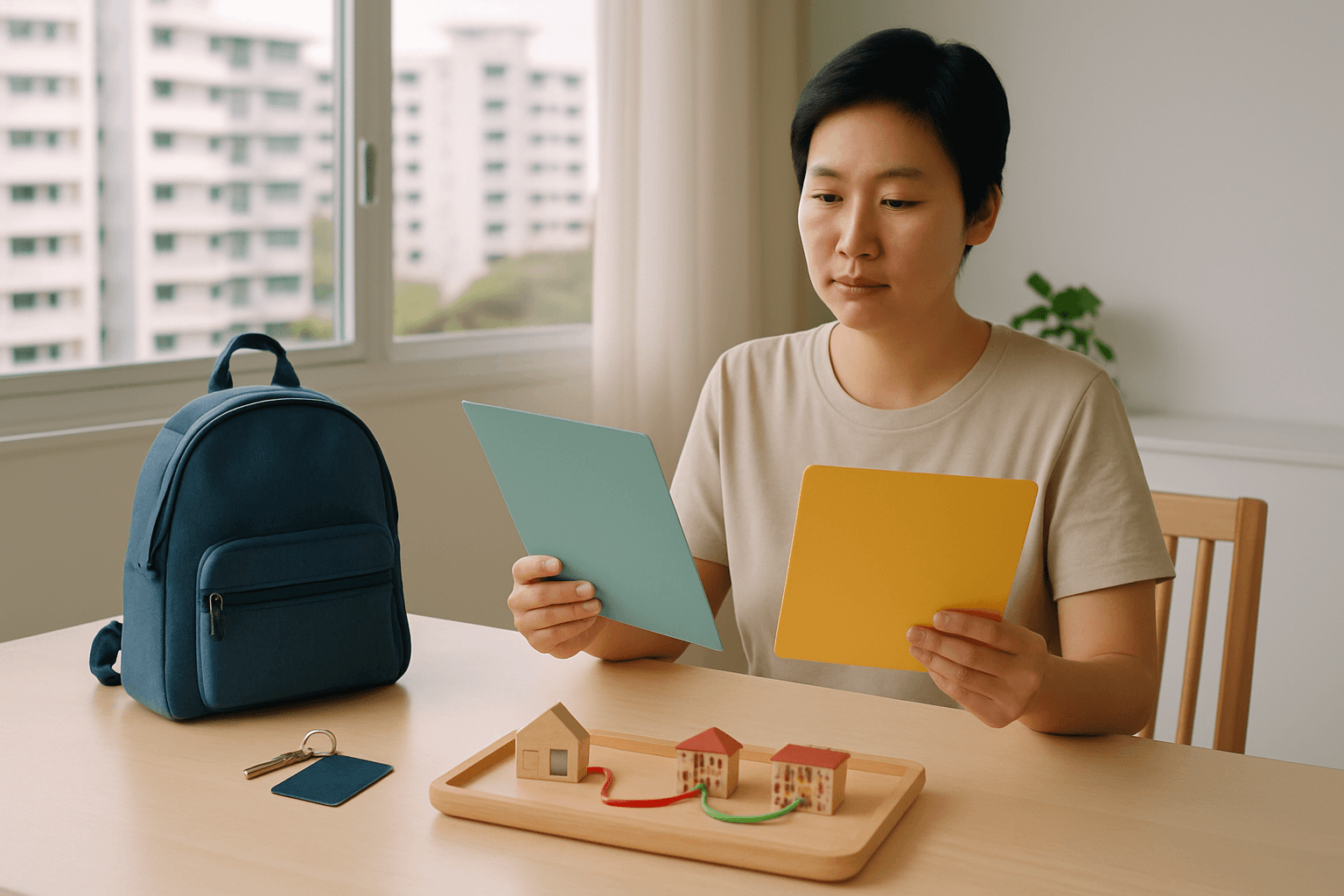
If your P1 registration case is not straightforward, do not choose a backup school by reputation alone. Choose one that still works if your address basis is questioned, your preferred school is hard to secure, or your supporting proof takes more effort than expected.
A sensible backup plan starts with three checks. First, be honest about how strong your registration basis really is. Second, prepare a clear and consistent set of documents early. Third, shortlist schools your family can actually manage every weekday. Your backup school is not just your second choice. It is the school that protects your family from a last-minute scramble.
What makes a P1 registration case not straightforward?
A P1 case is usually not straightforward when the child’s address or daily care arrangement is harder to prove clearly, even though the child is otherwise eligible to register.
A P1 registration case is usually not straightforward when the child can register, but the address or caregiving setup is harder to explain or prove cleanly. The problem is often not eligibility itself. It is whether the address used for registration clearly matches the child’s real living or care arrangement if MOE asks for support.
Common examples include a child who mainly lives with one parent while some records still show another address, a child who stays with grandparents or another caregiver on weekdays because both parents work long hours, or a family that has bought a new home but has not moved in yet. Another common issue is a paper trail that points in different directions, such as one address on official records and another in day-to-day care arrangements.
These are risk areas, not automatic disqualifications. A simple way to think about it is this: when the child’s real care base and the paper trail do not line up neatly, treat the case as higher-risk and plan your backup school more conservatively. For a broader overview, see Primary 1 Registration in Singapore: How It Works, Balloting Risk, and How to Choose a Realistic School Plan.
*** READ ME FIRST !!! - P1 Registration FAQ ***
2A need to apply at school , so withdrawal also need to be at school. Then go over to school B for registration. Consider time for travel, withdrawal take 5-10min. Buffer 1.5 hours would be safe if driving. If you can let us know your 2C choice , we can tell you the risk. It might be worth just to go 2C
*** READ ME FIRST !!! - P1 Registration FAQ ***
if one can't turn up : the spouse that turn up still have to produce the other spouse IC. Schools need to check the address, appearing on both ICs (father & mother) in the event the P1 Registration Officer find that the address of father / mother differ from each other on both IC: the parent have to explain the reason(s) behind. if for any reason the Registration Officer find the address(es) on both parents' IC differ, or the reason / explaination provided make them feel suspicious / fishy about
What is the real goal of a backup school plan?
A backup school is the school that still works if your preferred option becomes difficult to secure or your registration basis needs more proof.
The real goal is not just to name a second-choice school. It is to make sure your family still has a school option that works if Plan A becomes hard to secure or hard to support.
Parents often focus only on admission chances. That is only half the job. A proper backup school must also work in daily life if your preferred school falls through. That means the commute is manageable, drop-off and pickup are realistic, and the adults helping the child can sustain the routine for years, not just for registration week.
Think in two layers. First, how likely is the school plan to hold up under your address and document situation? Second, if that school becomes the final outcome, can your family genuinely live with it every weekday? That is why a practical nearby school is often a better backup than a second school that is only slightly less competitive but depends on the same fragile setup.
If you want a broader refresher on the process, start with our main guide to Primary 1 Registration in Singapore. It also helps to compare this issue with the trade-offs in dream school versus safer nearby school choices. For a broader overview, see Which Home Address Counts for Primary 1 Registration in Singapore?.
Share with us your kid's P1 registration experience
Pardon me if this question has been answer before. If we registered in P2B and given a place, can we still withdraw at P2C to register at the 1st choice school if chances are very high? :?
Share with us your kid's P1 registration experience
Sorry, I thought this thread is suppose to discuss on the experience of P1 registration, but I think it had somehow been drifted away by some of the discussions. Anyway, I had gone through the P1 registration last year. Being a P2C applicant, it was extremely stressful and unpleasant. Pre-registration, was worry-some and many sleepless nights After registration, was tough and sleepless due to the balloting wait Post-balloting, for me & spouse … was a total breakdown (balloted OUT) My spouse and
Have More Questions?
Get personalized guidance on schools, tuition, enrichment and education pathways with AskVaiser.
Try AskVaiser for Free →How should parents assess whether an address or family setup is risky?
An address setup is risky when the care arrangement is unclear, recently changed, thinly documented, or dependent on a property timeline that does not clearly meet MOE’s conditions.
Start with three plain-English questions. Can you explain why this is the child’s real care base? Can you show that the arrangement is ongoing rather than temporary? Do your documents tell the same story without needing a long verbal explanation? If any of these answers feels weak, treat your preferred-school plan as less secure and make the backup school more conservative.
This matters especially when the address used is linked to a childcare arrangement. MOE’s home address guidance for P1 registration states that if parents use an address tied to a childcare arrangement for priority admission, the child must continue with the same arrangement at the same address for at least 30 months from the start of the P1 Registration Exercise. MOE also states that if parents cannot provide evidence to its satisfaction, or if that arrangement is not maintained, the child may be transferred to another school at MOE’s discretion.
A new property creates a different kind of risk. MOE allows parents to use the address of a purchased property only if its vacant possession date or delivery possession date falls within 2 years of the child’s entry into P1. MOE does not accept a probable completion date. So if your plan depends on “the flat should be ready by then,” that is not a firm registration basis.
A useful rule of thumb is simple: if your address story needs too much explaining, your backup school should be simpler, nearer, and easier to defend. For a deeper look at address rules, see which home address counts for Primary 1 registration and what to consider after moving house.
For Reference for P1 registration: MOE Official Letters
http://www.kiasuparents.com/kiasu/forum/viewtopic.php?p=293646#p293646 Dear Sir/Madam, Thank you for writing to us on 12 November 2010. We wish to clarify that parents using address of rented apartment will not be at a disadvantage if the school should conduct balloting. We would like to share with you that the registration is done based on the NRIC address that is reflected on the parents' NRIC at the time of registration and the address used for the registration of a child (assuming Singapore
*** READ ME FIRST !!! - P1 Registration FAQ ***
All P1 registration phases are held consecutively, ie. one after the other. So Phase 2A(2) is held after Phase 2A(1), and not simultaneously. You are allowed to participate in any Phase, and apply for any school in any Phase, subject only to citizenship, distance, and other Phase-specific criteria (eg. PV, alumni, etc). You can always apply to the same school in later Phases even if you failed in earlier Phases. As for your address, there is no requirement on the length of time you stay at the a
What kinds of documents are commonly useful to prepare?
Prepare documents that support the address and caregiving arrangement you plan to rely on, and focus on consistency rather than just collecting more papers.
Prepare documents that make the overall arrangement look consistent and believable. MOE does not publish a single official checklist for every unusual family situation, so parents should treat document examples as examples only, not as guaranteed acceptance.
In practice, parents often gather proof of residence, tenancy or ownership records, purchase documents for a new home, documents showing the official vacant possession or delivery possession date where relevant, preschool or childcare correspondence, and other records that help show who is actually caring for the child day to day and from which address. In more sensitive cases, some parents also prepare documents that explain one-parent living arrangements or formal care arrangements if those details are central to the address basis.
What many parents miss is that consistency matters more than volume. A thick file does not help much if one document points to one home, another points elsewhere, and the caregiving explanation appears only at the last minute. A smaller set of records that tells one clear story is usually more useful than many papers that raise new questions.
If you want a practical planning guide, see our P1 registration documents checklist. Use it as a preparation tool, not as an official acceptance list.
*** READ ME FIRST !!! - P1 Registration FAQ ***
Yes. You and your spouse need to be stationed in the two schools - one in the P2A1 school and the other at the P2C school. Once you have decided to register with the P2C school, the one who is at the P2A1 school needs to withdraw your child's application before the one at the P2C school is able to proceed with the registration. Depends. If the school traditionally has balloting in the distance category you are in, you will only know the result of your application on the day of balloting. Please
*** READ ME FIRST !!! - P1 Registration FAQ ***
For Singaporean - The child’s Singapore Birth Certificate - The child’s Singapore Citizenship Certificate for those who are not Singapore Citizens at the time of birth - Singapore NRIC of both parents or Entry / Re-entry Permits of parents if they do not possess Singapore NRIC - The child’s Immunisation Certificates For PR - The child’s Birth Certificate - The child’s Entry/Re-entry Permit - Singapore NRIC of both parents or Entry/Re-entry Permits of parents if they do not possess Singapore NRIC
How do you choose a backup school when your preferred school is near the cutoff?
When your preferred school is near the cutoff, choose a backup school that is clearly more workable and less risky, not one that is only slightly easier to get into.
The closer your preferred school is to being uncertain, the more your backup school should favour certainty over ambition. If Plan A is already fragile because of competition and a complicated address basis, Plan B should not carry the same risks.
A common mistake is choosing a backup school that is only slightly less competitive than the first choice. That may feel emotionally easier, but it may not lower much real risk. A stronger backup is often a school that is easier to reach from the child’s actual care base and easier to support under the address you can clearly document.
For example, if a parent is trying for a highly sought-after school while relying on an address arrangement that still needs careful explanation, a second school with similar balloting pressure does not solve much. A more realistic backup might be a school with a calmer admission profile, manageable distance, and a route that a parent or grandparent can handle every day.
When comparing options, look at three things together: likely competition, how distance priority may affect you, and how comfortable you are defending the address basis. Our guides on P1 registration phases, distance priority, and how to read past balloting data can help you compare schools more calmly.
Questions on new rules of P1 registration
With the announcement of the new rules of P1 registration - that citizens now have advantage over PRs, I have 2 questions: 1. Does the living distance to the school matter (ie 1 km away)? 2. If the PR has an older child in the school already, is priority given to the child’s younger sibling? Thanks!
Share with us your kid's P1 registration experience
First thing to do after being balloted out, is to put your child's name under the school's wait list. After then, I've wrote in to MOE, called/met the school's Principal for discussion. Telling them all my problems and how the registration system had affected us (because I have only 1 school within 2km and NO school within 1km). With this factual, MOE has verified and consulted the school. My son was then placed on the highest priority in the waiting list .. and fortunately by early Nov, we were
What should parents prioritise in a backup school?
In a backup school, daily logistics should come first: commute, pickup and drop-off burden, after-school care, and whether the adults involved can keep the routine going.
Prioritise what your family must sustain every weekday, not what sounds best in conversation. For most families dealing with a complicated P1 case, the first filter should be daily logistics: travel time, who handles drop-off, who manages pickup, whether after-school care is still possible, and whether sibling routines break if Plan A fails.
This matters even more when care is shared across more than one adult. If a child lives with one parent but a grandparent regularly handles afternoons, a backup school that both adults can realistically support is usually stronger than a more attractive school that works only if one person’s work schedule never changes. If the backup school only works when one adult can leave work early every day, it is not really a backup.
A practical school can still be a good school. Parents who want to think through the broader fit question often find it helpful to compare popular primary school vs neighbourhood school alongside this issue.
P1 Tution -- Necessary?
With the commencement of p1 registration, I realized there are few articles on tuition in Asia one…‘tuition nation’, ‘happy childhood’ etc. if parents are working long hours and really have no time/too tired to coach, then tuition is necessary unless child attends after school care.
PV after P1 Registration?
My kids school only accept PV of existing students. I did “short term” PV with them during the 1st 5 days of P1 this year. I did that so that I can get “close” to my son. Eg. they don’t allow parents to crowd around the P1 during recess and only those PV parents can help out. I didn’t realise that it can be so satisfying. Kids feel proud to see mummy around and helping out in school. They kept asking me if I am going to their school to help out again. I also get to see their classmates,etc… Due
What mistakes do parents make when they choose a fallback school too late?
Parents who choose too late often end up with a fallback school that is still risky on address, too hard to commute to, or based on assumptions MOE may not accept.
The biggest mistake is waiting until the documents are already under pressure. By then, parents tend to choose reactively. That usually leads to a school that looks acceptable on paper but has not been tested against the actual commute, caregiver routine, or address basis.
One common mistake is picking a backup school that still depends on the same uncertain address arrangement as the first choice. Another is assuming a new property will be ready in time even though MOE does not accept a probable completion date for registration purposes. Parents also often underestimate how much friction a long commute creates once school actually starts, especially when work schedules, younger siblings, transport changes, or after-school care are involved.
A backup school chosen in a rush is often not a real backup. The better approach is to shortlist fallback schools while your documents still feel calm, not after the first plan starts wobbling. If you want to think through the downside scenario early, our guide on what happens if you do not get your preferred school can help you prepare without panicking.
If your plan involves a childcare-related address or a not-yet-completed property, it is also worth reading MOE’s home address guidance directly, because that is where many late assumptions go wrong.
*** READ ME FIRST !!! - P1 Registration FAQ ***
Hi ppl thanks for the prompt reply, that means its a very risky choice, cause I'm staying in Changi side, there's no primary school around that area, and Pasir Ris schools are my only hope (more than 2KM).. went to two pri schools most of them are filling up fast and they kinda of asking me to give up coz of the distance. I went to this school just now, there's like totally no one for registration, feeling abit weird, totally different from the other two schools I went previously.Registered with
Share with us your kid's P1 registration experience
Funtastic4, RGPS finally had 117 applicants >2km fighting for 51 places under phase 2C (after 26 applicants <2km admitted). For my case, I had a daughter borned in year 2002. From 2005 onwards, we were closely monitoring the P1 registration stats, keeping all the records ourselvs as MOE dont retain them. Since my mil stayed near HPPS, we decided to enrol our child there. We were prepared to move <1km of the school. However after studying the stats, we discovered that HPPS needs balloting under p
When should parents get clarification before registration instead of guessing?
Seek clarification early if your address basis, caregiving setup, or property timeline is borderline, because a wrong assumption can affect both school choice and placement.
Get clarification early if your child mainly lives with one parent, spends much of the week with a caregiver, relies on a childcare-related address for priority, or if your plan depends on a new home whose official possession date is close to the line. In these cases, guessing can cost you twice: you may choose the wrong school strategy, and if MOE is not satisfied with the evidence for a childcare arrangement used for priority admission, MOE states that it may transfer the child to another school in its sole discretion. Start with MOE’s P1 home address guidance and relevant FAQ page, then approach the school or MOE directly before you lock in a weak fallback plan.
*** READ ME FIRST !!! - P1 Registration FAQ ***
hi kiasu parents, newbie here, got some newbie questions here. 1) if i have a set of boy girl twins, volunteering in 2 schools, can i register 1 child at each school in 2b? 2) in P2C, can i register in 2 schools?in the event, any of the child is in, the other also automatically in? pls advise, thanks all
Anyone else stressed about P1 registration? Made something that helped me
Started looking into P1 registration for my kid and realised the data is all over the place. Put together a simple site that lets you key in your postal code and see nearby schools with their balloting history from 2022-2024. https://p1buddy.com Free, no login. Curious if other parents find it useful.
What is a practical backup-school planning checklist for families with complicated registration cases?
Confirm your address basis, prepare supporting evidence, shortlist realistic schools, and test the fallback routine before registration pressure starts.
- ✓Decide which address you are actually relying on for registration, and check whether that basis clearly fits MOE’s published conditions.
- ✓Gather a small but consistent set of documents that supports the address and day-to-day care arrangement you want to rely on.
- ✓Shortlist at least one backup school that is genuinely manageable for commute, pickup, and after-school care, not just one that feels acceptable on paper.
- ✓Compare your preferred and backup schools through two lenses at the same time: admission uncertainty and daily-life practicality.
- ✓If a new property is part of the plan, verify the official vacant possession or delivery possession date and do not build your backup plan around an estimated completion timeline.
- ✓If your child’s weekday care arrangement is central to the address used, make sure it is an arrangement your family can realistically maintain for the required period.
- ✓Test the fallback routine in real life by checking travel time, transport options, and which adult will handle each part of the school day.
- ✓Keep your backup plan flexible until registration is completed, because the strongest school plan is the one your family can actually carry through.
Have More Questions?
Get personalized guidance on schools, tuition, enrichment and education pathways with AskVaiser.
Try AskVaiser for Free →