
How to Choose Between a Dream School and a Backup for Primary 1 Registration
A practical framework for Singapore parents weighing chances, commute, child fit, and family stress.
To choose between a dream school and a realistic backup for Primary 1 registration, assess the dream school on two things first: whether your chances are realistically grounded under the current MOE framework, and whether the daily commute is sustainable for your child and family. If the school is highly competitive, far away, and likely to create daily strain or registration stress, the better choice is usually the backup school your family can comfortably accept for the full primary school journey.
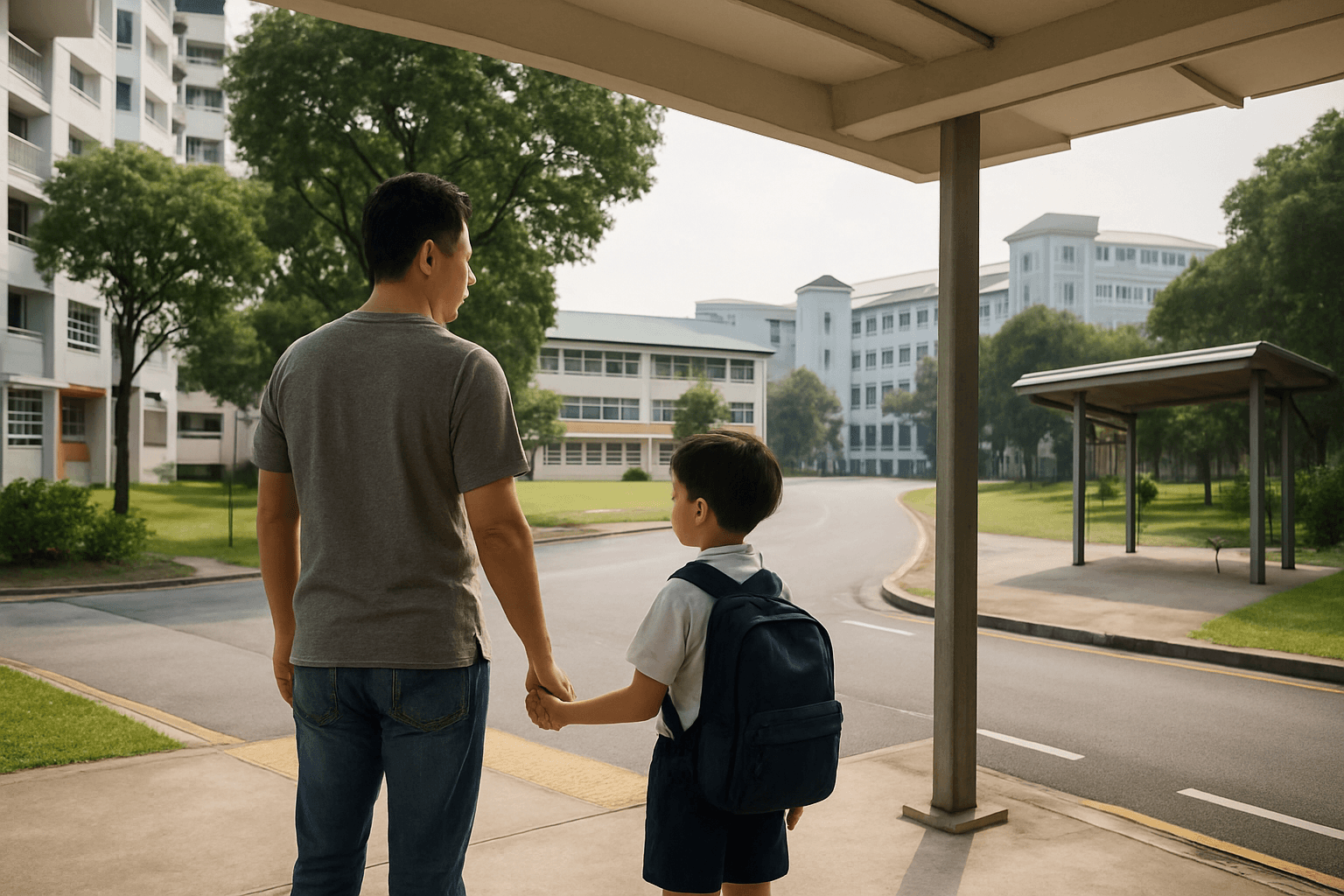
If your dream school is heavily oversubscribed, far from home, and you do not have a meaningful advantage under the current framework, do not build your whole plan around it. For many families, the better move is to treat that school as a stretch and choose a backup you can genuinely accept if it becomes the final outcome.
This guide gives you a practical way to decide. It focuses on four questions: how realistic are your chances, what will the commute feel like on ordinary school mornings, does the school fit your child and family routine, and can you live with your backup for six years if the dream school does not happen. If you want the wider process first, start with our Primary 1 Registration in Singapore guide.
What does it really mean to choose between a dream school and a backup for Primary 1?
This is a trade-off between aspiration, realistic chances, and everyday family life, not just school reputation.
It means balancing aspiration, probability, and daily practicality, not choosing between a “good” school and a “bad” one. In most cases, parents are deciding between a preferred school that may be harder to secure and a backup school that is easier to live with every day.
A useful frame is to test both schools through three questions. First, how realistic is entry based on current demand patterns and any priority factors that may apply to your child. Second, what will the school run look like on normal weekdays, not just on registration day. Third, if the dream school does not happen, can you genuinely settle into the backup without spending the next year regretting it.
The right school is usually the one your family can sustain, not just admire. Many parents spend too much time on school reputation and too little time imagining a rainy Tuesday morning in Term 2. That is often where the real answer appears. For a broader overview, see Primary 1 Registration in Singapore: How It Works, Balloting Risk, and How to Choose a Realistic School Plan.
All About Preparing For Primary One
My son is going primary 1 next year and I am eligible for phase 2b under a good school but it took two hours of time of bus transport to n fro from home. The kid have to be at the bus stop at 6am waiting for bus. That school have proven track record for the past many years because of it’s strict standards. Now, my headache is there Is a relatively new school which is only a few years old n has not proven track records n the highest psle scores is 230plus. This school is just downstairs my home b
What goes into choosing a suitable Secondary School
Saw this being shared in the parents groupchats. https://www.thewackyduo.com/2022/11/how-to-choose-secondary-school-guide.html https://i.imgur.com/fDkJSy6.png\"> https://www.thewackyduo.com/2022/11/how-to-choose-secondary-school-guide.html It's time to choose a secondary school. Choosing a secondary school is a completely different process than primary school. One tends to choose a primary school based on distance or affiliation. Picking a secondary school is a different ball game. Grades play a
How realistic is the dream school based on your child's chances?
Use recent demand, current priority factors, and home location to judge whether the dream school is a real possibility or a long shot.
Start by asking whether the dream school is a genuine possibility or a long shot. A practical assessment comes from three things together: whether the school is often oversubscribed, whether your child has any meaningful current priority under the registration framework, and whether your home location helps or hurts. The official process matters more than school buzz, so it is worth reviewing MOE's Primary 1 registration guidance alongside our explainers on registration phases, distance priority, and how to read past balloting data.
A simple parent rule helps. If the school is popular, you live farther away, and you do not appear to have a strong advantage under the current framework, treat it as a stretch rather than your core plan. If the school is still competitive but it is near home and your position looks stronger, it may still be worth trying.
This is where parents often get misled by anecdotes. Hearing that “someone got in last year” is not the same as having a realistic chance this year. Pieces such as Are top schools inaccessible to Phase 2C applicants? can give context, but they should support, not replace, your own reading of recent demand and your family's specific position. If your case involves extra conditions for your applicant type, check those early and use MOE SchoolFinder to compare nearby alternatives before you get emotionally locked into one school.
Choosing Secondary school
Hi, Wonder if anyone knows what happens in this Secondary School selection scenario : If there are 10 places left in School A and 20 pupils with EXACTLY the same PSLE score apply, how does MOE decide which 10 to take into the school. Does it matter in this case whether the child had put School A as the first choice? This impacts what schools to put as 1st and 2nd choice - whether the common advise of putting the dream school which is just out of range of the child’s mark is a wise thing to do. P
All About Preparing For Primary One
For me, two hours is just too long. Your child will need to wake up at 5:30am meaning that he should be in bed by 7:30pm every evening if he won't nap in the afternoon. Are you able to do that? As he gets older, there will be more after-school activities so he will be coming back very late. You say that the new school is not results-oriented. I think what you mean is that they don't make exam results the be all & end all. Isn't that a good thing? Your child will be able to enjoy school and not b
Have More Questions?
Get personalized guidance on schools, tuition, enrichment and education pathways with AskVaiser.
Try AskVaiser for Free →How much should distance and commute time influence the decision?
Distance should matter a lot because commute affects your child’s routine and your family’s daily energy for six years.
A lot. Distance is not a small detail in Primary 1. It becomes part of your child’s routine and your family’s energy every weekday for years.
A school that is one direct bus ride away can feel very different from one that requires two transfers, a car ride in traffic, or daily handover with another adult. The longer route often means earlier wake-ups, more rushing, harder after-school care coordination, higher transport cost, and a child who gets home more tired. None of that shows up in a school brochure, but it shapes real school life.
Parents often underestimate how valuable a simple commute is. Nearer schools give you more margin when a child is unwell, a parent is delayed, or pick-up plans change at the last minute. That does not mean a farther school is always the wrong choice. Some families can manage it because work hours are flexible or grandparents help daily. But if your imagined school routine already feels fragile, take that seriously. Our guide on how home-school distance works is useful here, and broader parent thinking on how to evaluate primary schools can help you compare real-life trade-offs rather than school names alone.
All About Preparing For Primary One
Was surfing around on understanding if I am well prepared on behalf of my DD1 for Primary 1 Chanced upon a few websites, thought to share though it could have been mentioned before Tips For Parents ◦Work on independent reading skills. ◦Set up a study area and regular study times that are not interrupted. ◦Learn to follow a routine with a lot of sleep and early mornings. ◦Practice organisation and planning by packing a daily bag with essentials for the day. ◦Talk about social skills and communica
All About Preparing For Primary One
Starting primary school? This is a big milestone. Do enjoy the journey with your child! :rahrah: https://www.straitstimes.com/singapore/education/the-st-guide-to-preparing-your-child-for-primary-1 Parents often confuse being ready for school with being academically capable in skills like reading and counting. Instead of focusing solely on academic progress, it is more important to make learning an enjoyable process, and help your child have a swift and happier adjustment to primary school. Here
What makes a backup school truly realistic?
A real backup is a school your family can comfortably accept as a final six-year outcome, not a token option.
A real backup is a school you can accept as a final outcome, not just a placeholder while you keep hoping for the dream school.
A good test is both emotional and practical. If this became the final result, would you feel mostly relieved or mostly trapped? Can your child manage the daily journey? Do the location and routine work for the adults who will actually handle drop-off, pick-up, and after-school care? If the answer is mostly yes, that is a realistic backup.
Many parents make the mistake of choosing a backup only because it looks easier to enter, then realise later that they never truly wanted it. That is where regret usually starts. A stronger approach is to shortlist only schools you could genuinely live with, then compare them calmly. It also helps to understand the downside of not planning early: if a child is unsuccessful in Phase 2C Supplementary, MOE states that the child will be posted to a school with available vacancy, as noted in the relevant MOE FAQ. That is one reason to take backup planning seriously before registration, not after. For the wider process, see what happens if you do not get your preferred school. For a broader overview, see How to Read Past Balloting Data Before Chasing a Popular Primary School.
Popular, far away, and no meaningful priority? Treat the dream school as a stretch, not a plan.
Do not build your family plan around hope alone when the school is highly competitive and daily logistics are heavy.
Hope is not the same as a school plan. If the school is heavily sought after, the daily journey is long, and your family has no clear edge under the current framework, build your decision around a backup you can genuinely live with. A backup is not a consolation prize. It is your stability plan. For a broader overview, see Primary 1 Registration Unsuccessful: What Happens If You Do Not Get Your Preferred School.
All About Preparing For Primary One
Here's the thing: most of them do not add any real value. Teaching in advance doesn't help in preparation, it's just... learning in advance. And when P1 comes, they get distracted or bored or worst, a disturbance in class because none of the lessons interest them (because they already know them). Notwithstanding, there are some courses / programmes that may be beneficial but they are not compulsory and may not benefit everyone equally. Examples of such programmes are English / Chinese reading /
All About Preparing For Primary One
hey hi everyone, my DD will be entering Primary 1 next year and it seems like more and more students are now enrolling in some form of preparations for primary education. It comes in the form of teaching maths and english in advance http://sg.mpmmath.com/ , cognitive improvements http://cce.education/p1prepclass/ , and some even learn things like packing bag and being organised https://www.thelearninglab.com.sg/programme/preschool/ The kindergarten my DD attends do teach them maths and english.
How should you weigh prestige against everyday family stress?
Prestige matters less if it creates a daily burden your family has to pay for every school morning.
Do not pay a daily stress tax for prestige unless the trade-off is genuinely worth it to your family. A school lives in your weekdays, not just your shortlist.
The hidden costs of chasing a high-profile school are usually practical, not academic. One family may cope well because a parent works from home and can handle transport reliably. Another family may struggle because both parents leave early, public transport is long, and there are younger siblings to manage. A third family may survive registration uncertainty but find that after-school care, CCA timing, and pick-up logistics become the real burden.
A useful way to think about it is this: prestige is occasional, but logistics are daily. If the dream school adds hours of transport, constant rushing, or repeated handover stress, the family may be less happy even if the school name feels impressive. For a wider comparison, our piece on popular primary school vs neighbourhood school in Singapore can help. The better question is not whether the school sounds better. It is whether life becomes better with that school in it.
Top Primary school?
in my opinion, I do not believe in ranking primary schools as these are totally nonsense… Primary school is an early stage of education for young kids especially from P1-P3. We should not emphasis too much on academic results. By ranking schools, it put pressure to the principals to emphasis on results & thus favours better students than the average students. This will have negative effect on the average students… Education have to be fair to ALL students… this is just my opinion and i hope pare
Top Primary school?
Honestly I am not sure if there is such a thing as a top primary school based on the efforts of the school. All schools have the same mission set by MOE to deliver the same thing. If you hear from them, even teachers they have no control, it's all from MOE. So what then would you consider as top primary school? It definitely cannot be results alone because results are typically parents-driven in today's context in some schools. Every school has the best cream of the crop and the worst performers
When is it better to prioritise certainty over ambition?
Prioritise certainty when your family needs routine, lower stress, and a reliable daily plan more than the possibility of a more competitive school.
Certainty is often the better choice when your family needs routine more than possibility. This is especially true when your child is sensitive to change, your work hours are inflexible, the commute would be heavy, or the household is already stretched by care responsibilities.
For example, a child who tires easily or struggles with transitions may do better with a shorter, steadier school day than with a more prestigious but demanding setup. A family with younger siblings may value a simpler route and predictable pick-up arrangements far more than a marginally more desired school. Parents doing shift work or relying on grandparents often need a plan that still works on ordinary days, not only on ideal days.
Choosing certainty is not giving up. It is often a disciplined decision to protect the child’s daily experience and the family’s mental bandwidth. A useful sense-check is to ask: are we choosing this school because it suits our child and routine, or because it is hard to let go of the idea of it? That distinction matters more than many parents realise.
All About Preparing For Primary One
You should have seen the way the mum drilled the poor child, depriving him of food till he completed his revision. Obviously, an uninterested child will only retain the information into his short term memory. Preparing a child for primary 1 is more than just the academics. There are several areas that parents have to take note of. Does your child know how to clean up after himself if he does a big business in the toilet? Does your child know how to wash his hands correctly and rinsed his hands p
All About Preparing For Primary One
I agree with you that decision making skills to balance work and play and ability to delay gratification are important skills to have when entering P1. Looking back at my son when he was in P1 last year, most of the time spent on coaching him is not so much on the academic work but more on teaching him how to make decisions such as to stay focus on homework so that he finish them in shorter time. Then he will have time for himself. And how not to give up and keep trying when he encounter a diffi
What are the most common mistakes parents make when choosing a dream school or backup?
The biggest mistakes are overvaluing school brand, underestimating commute, and failing to take the backup school seriously.
The first mistake is overvaluing school brand and underchecking whether entry is actually realistic. Parents sometimes fall in love with a school story, then ignore weak odds, distance, or the lack of a meaningful advantage.
The second mistake is treating the backup as an afterthought. If your backup is a school you secretly dislike, you have not really made a plan. You have only delayed the hard decision.
The third mistake is underestimating commute. What sounds manageable during registration can feel very different after months of early mornings, tired children, traffic, and schedule clashes. This is especially common when families assume they will “figure it out later.”
The fourth mistake is making assumptions about address or priority without checking the details early. Parents who are moving, using a different home address, or relying on distance should compare those scenarios before registration, not after. Our guides on which home address counts, what happens after moving house, and whether an older child already in the school guarantees entry can help prevent avoidable surprises.
Most regret does not come from choosing a backup. It comes from choosing blindly and only discovering the trade-offs after the place is secured.
All About Preparing For Primary One
:goodpost: Thanks so much for your great sharing! It really helps us as P1 parents from 2012! :lovesite:
What goes into choosing a suitable Secondary School
Hi there, Recently a relative asked me how I choosed my kid’s Secondary School and I kind of got a shock, I had no answer. It was simply just based on the results. My relative came then with a list of important factors that he thought would be helpful to help his kid cope with the stresses of school. I thought that I would help him make this post to help him make a better decision (the kid will be going into the Secondary School in next year). So here goes, considering grades what else should he
What quick test can help parents decide without second-guessing?
Use a short yes-or-no test on chances, commute, child routine, and backup acceptability before you decide.
- ✓Ask whether the dream school is realistically within reach under the current framework, not just emotionally appealing.
- ✓Ask whether the daily journey would still feel manageable in a normal week, not only in your best-case scenario.
- ✓Ask whether your child can cope with the wake-up time, transport routine, and fatigue that may come with the school.
- ✓Ask whether the backup school would still feel acceptable if it became the final outcome for all six primary years.
- ✓Ask whether your work schedules, transport support, and care arrangements are strong enough to sustain the choice every weekday.
- ✓If the dream school feels like a stretch and the backup feels acceptable, plan around the backup and treat the dream school as a bonus outcome.
- ✓If both the dream school and the backup feel wrong for different reasons, widen your shortlist before registration rather than forcing a weak choice.
If the dream school looks too hard to get, should I just choose the nearest school?
Not automatically. But if the dream school is a long shot and the commute burden is high, a nearby school is often the more sensible choice.
No. The nearest school is often a strong option, but it is not automatically the right one for every family.
Proximity matters because it usually improves both daily logistics and, in some situations, your practical position in the registration process. But “nearest” only works well if it is also a school your family can genuinely accept. If the nearest school is manageable, suitable, and would make school life much easier, it may be the smartest choice. If it is near but clearly feels wrong for your child or family, widen your shortlist instead of letting distance alone decide everything.
A useful rule is this: if the dream school is close enough, the family can handle the uncertainty, and the choice still makes sense after you factor in daily life, it may still be worth trying. If the dream school is both highly competitive and hard to reach, a sensible nearby school is often the better call. Choose the school your family can actually live with, not just the one that sounds best on paper.
Have More Questions?
Get personalized guidance on schools, tuition, enrichment and education pathways with AskVaiser.
Try AskVaiser for Free →