
How to Choose Realistic Backup Schools After Moving for P1 Registration
Pick nearby options that are not just possible on paper, but workable for six years of daily family life.
Choose backup schools using two tests at the same time: admission realism and daily practicality. The best backup is usually not the most famous nearby school, but the one that your child could plausibly enter from the new address and that your family can manage calmly on ordinary mornings, rainy days, and late-work days. For most families, one strong backup plus one or two nearby alternates is enough.
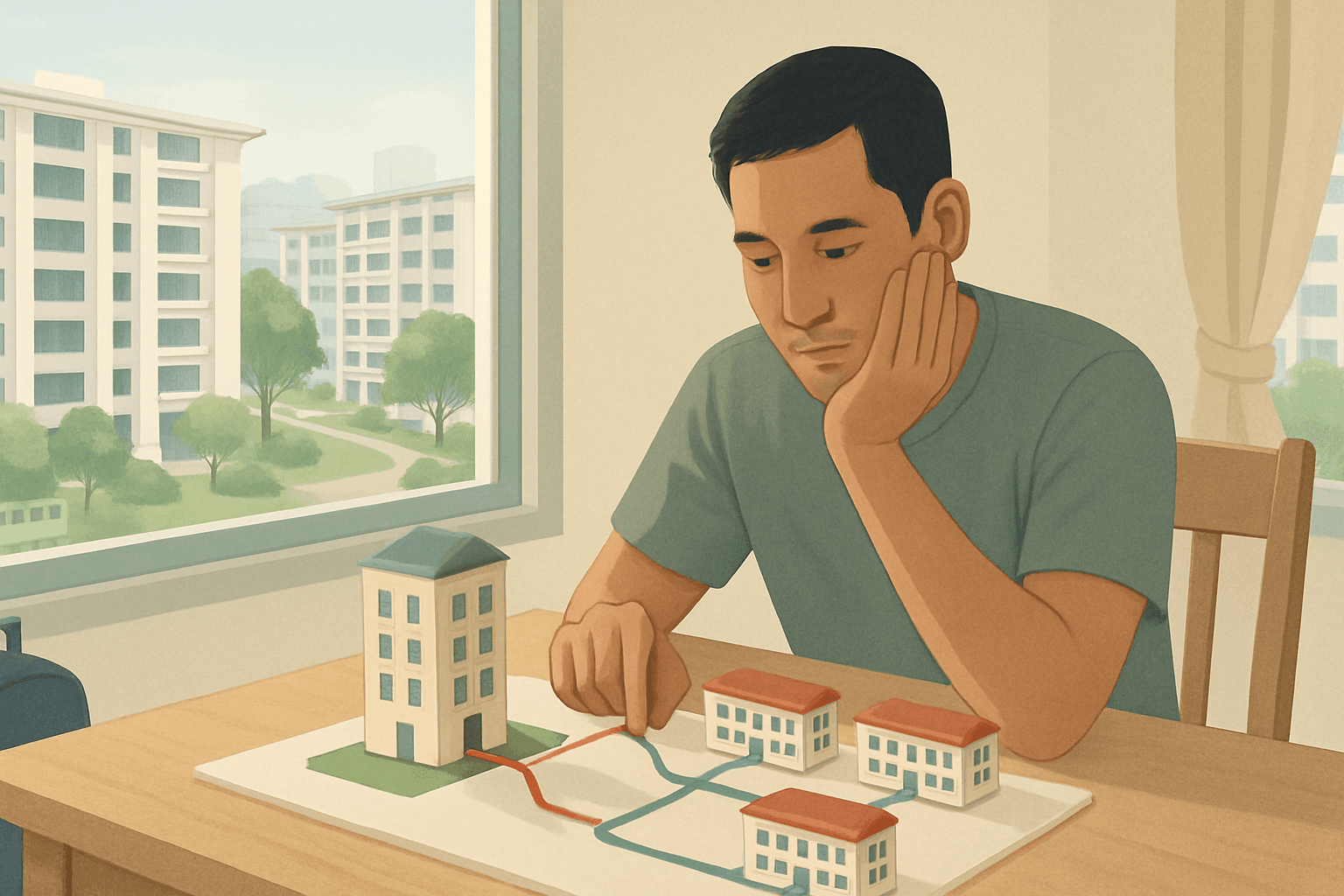
If you move for Primary 1 registration, do not choose backup schools by reputation alone. The safer approach is to shortlist schools that are realistic from your new address and still manageable for commuting, pickup, student care, and family routines if your first-choice school does not work out.
What counts as a realistic backup school after you move for Primary 1 registration?
A realistic backup school is one your child could plausibly get into from the new address and one your family can manage every school day.
A realistic backup school is one that passes two tests together: your child has a plausible way to enter from the new address, and your family can live with the school day after day if it becomes the final outcome.
That is different from a second-favourite school. Many parents call something a backup when it is really just another aspirational choice. If the school is still heavily contested, still awkward to reach, or still depends on both parents being free every morning, it is not a strong fallback.
A more realistic example is a school that may be less talked about but is close enough for one parent, a grandparent, or a helper to manage without difficulty. If the route is simple, the routine is sustainable, and the school feels acceptable for your child, that is often a better backup than a higher-profile school with weaker odds and harder logistics.
A useful rule of thumb is this: a backup is only real if you can picture saying yes to it without panic. For a broader overview, see Primary 1 Registration in Singapore: How It Works, Balloting Risk, and How to Choose a Realistic School Plan.
All about Transferring to Other Primary Schools
I suppose before august, u will still be living in Punggol? Perhaps you still need some time to renovate, move/pack or settle down. Think it’s easier to transfer to TPY schools when your new premise is ready and settled.. perhaps register your child where your p2 is first and apply for transfer later. Better to start in a fresh year, say p3 and p1. If you have a caregiver for your p1 near TPY, u can try register p1 under that address...
All about Transferring to Other Primary Schools
The best reason would be that you are moving house and the school is nearest to the home. You will need to convince the staff that your child is a good student (both academically and socially), and is likely to be a good asset for the school. But your child is still in P1, so, that is tough. Try this https://www.moe.gov.sg/primary/transfers for more information.
How much should you rely on the new address for P1 registration?
Use the new address as a helpful factor, not a guarantee. Plan your backup schools on the assumption that your preferred school could still be out of reach.
Treat the new address as one advantage, not a promise. Moving may improve convenience and may matter within the registration process, but it does not remove competition or balloting risk.
The practical implication is simple: build your plan as if the preferred school may still not happen. If you move near School A and School A remains highly sought after, your backup should not be another equally uncertain choice just because it is also nearby. A stronger setup is often School A as the stretch option, School B as the realistic nearby backup, and School C as the alternate that still works for transport and care arrangements.
If you are still sorting out which address can be used and how home-school distance is assessed, these AskVaiser guides on which home address counts for Primary 1 registration, moving house before registration, and how home-school distance works are the best starting points. For current official clarification, refer to MOE's Primary 1 registration FAQ.
All about Transferring to Other Primary Schools
You don't get to decide when you can transfer. It depends on whether there's vacancy in the school you want, and whether the school accepts your child. You can start by waitlisting your child in the school you want after P1 registration closes. If you are lucky, transfer can happen before P1 starts, or you can wait indefinitely.
All about Transferring to Other Primary Schools
I have managed to register my daughter for P1 2022 at Tampines primary school, however, we are going to move to Seletar area this year end. May I know if I can still initiate the primary school transfer before Jan 2022? Or do I need to let my girl to attend at least 1 term in Tampines Primary? Many thanks for the kind advice here.
Have More Questions?
Get personalized guidance on schools, tuition, enrichment and education pathways with AskVaiser.
Try AskVaiser for Free →What should actually decide your backup school shortlist?
Prioritise daily practicality and a plausible registration path first, then ask whether the school is a good enough fit for your child.
Start with practicality, then admission realism, then school fit. Parents often reverse this and end up with backups that look attractive on paper but are weak in real life.
A useful shortlist usually comes from asking the same questions of each school. Is there a believable registration path from the new address? What is the real morning journey, not the app estimate at a quiet hour? Can one adult manage drop-off and pickup alone when work gets busy? Can grandparents, a helper, or student care support the routine without extra complexity? If this school became the actual outcome, would your child and family settle into it reasonably well?
For example, one school may have a stronger name but require a car every day and create a fragile pickup routine. Another may be slightly less popular but reachable on foot or via one direct bus. The second school is often the better backup because it lowers both admission risk and daily stress.
If you are stuck between reputation and practicality, these related reads on popular versus safer nearby schools and popular primary schools versus neighbourhood schools can help you compare the trade-offs more clearly. For a broader overview, see Primary 1 Registration Distance Priority: How Home-School Distance Works.
All about Transferring to Other Primary Schools
It is not surprising to hear that the top students in some primary schools are aiming to go to better-name schools. Nothing wrong with transferring school but must bear in mind that there is a 1% risk that the child will not fit into school culture. Usually, those who get the first few positions in class or are in the so called best class for high ability learners will tend to transfer out. With this cycle, the more famous primary schools will have no lack of top potential students to bring glor
All about Transferring to Other Primary Schools
Wow, if offer some antiques to the school to display & get the kid into the school is like bribery right? I would like to know when is the best time to apply for the transfer of primary school? After primary 2 school result release or during primary one? My daughter is going to P1 next year but since both of us do not have any alumni with any school - we can only send her to a nearby school within 1 km which require to ballot too. I hope to transfer her to another school which is 1-2km away from
How many backup schools should you keep in mind?
Keep a small shortlist. One strong backup and one or two alternates is usually enough.
Most families do best with a short, deliberate list rather than a long collection of maybes. In practice, that usually means one main backup and one or two alternates.
That is enough to reduce pressure without creating confusion. If you keep too many schools in play, it becomes harder to compare them properly and easier to rely on vague impressions like "this school sounds better." If you keep only one backup, your plan becomes brittle if that school turns out to be less realistic than expected.
A workable structure is simple. Your preferred school is the reason you moved. Your main backup is the school that best balances admission realism and daily convenience. Your alternate is a slightly less ideal but still workable option, perhaps because it is near grandparents, closer to student care, or easier to pair with a sibling's routine.
A shortlist is not a dream list. Every school on it should be a school you can genuinely accept. For a broader overview, see How to Read Past Balloting Data Before Chasing a Popular Primary School.
All about Transferring to Other Primary Schools
Primary schools normally have a class size of maximum 30 for P1 and P2 (I think it's MOE policy) so unless there are parents who give up their confirmed places, it is unlikely there will be any vacancy until P3, where schools are allowed to have 30++ for each class. I do know of a case where a student did not turn up since first day of P1. Around Term 2, a student from another school was transferred. This student was balloted out from earlier phase (parent volunteer). For normal transfer (P3 and
All about Transferring to Other Primary Schools
Put your kid on waitlist in all the schools first. There is no limit. make a copy of the waitlist (take pic etc) and email to principal cc school admin to tell them you waitlisted and really really hope to join them because of distance. Anywhere in punggol is still nearer than her current school. Explore neighboring towns too. you may need to register on waitlist yearly. movement may only take place in end p3 when students move on to gep and p4 class size increased then have vacancies. Important
How close should a backup school be to your new home?
Your backup school should be close enough that the commute still works on difficult days, not just on an ideal map estimate.
Close enough that the route still works on rushed mornings, rainy afternoons, and days when only one adult is available. That is the standard that matters most.
Map distance by itself can be misleading. A school that looks near by car may be awkward on foot, involve multiple transport changes, or be difficult for a grandparent or helper to manage. Another school that is slightly farther away may actually be easier because the walk is straightforward or the bus ride is direct.
Before calling a school a realistic backup, test the route the way your family would actually use it. Try the morning trip at school-run time. Picture pickup in heavy rain. Ask whether one adult could manage it with a younger sibling in tow. If the route only works when everything goes smoothly, it is not a strong fallback.
A good way to remember this is: proximity helps, but usable proximity matters more. For a broader overview, see Primary 1 Registration Unsuccessful: What Happens If You Do Not Get Your Preferred School.
All about Transferring to Other Primary Schools
Transfer is *never* guaranteed, so you should just secure a school that is located near your new home. And your elder gal has to simply deal with the extra travel distance for that 1 year i.e. 2019. That is the most straightforward way to solve this problem. You do not name the schools, so I assume it is easy to get a place in Phase 2C there this year.
All about Transferring to Other Primary Schools
Hi everyone, I need some advice. Currently I’m staying in Jurong and will be shifting to Yishun in April/May next year. My son is in P1 now. I checked the schools nearby our new place and Chongfu is the nearest within 1km but I understand that that is a popular school so chances of getting a transfer there are very slim. There are several other schools within 1-2km but the walking distance is quite far and I would like to avoid having to take the school bus if possible. My main priority when cho
How do registration phases affect whether a backup school is really realistic?
Distance matters, but a backup school is only realistic if your family also has a plausible phase-based path into it.
A school is only realistic if your family has a believable path through the phase that matters to you. Being nearby does not automatically make a school safe.
Some schools fill up much earlier than others, and places are not evenly available across the entire Primary 1 registration process. That means two schools that are equally close to your new home may not be equally realistic. One may still be accessible in the phase your family can use, while another may already be under heavy pressure by then.
The practical move is to use phase access and past demand as a filter, not as a prediction. Start with our guides on how the registration phases work and how to read past balloting data. If you want extra community context on how parents look at demand patterns, this KiasuParents Phase 2A example can be useful background, but it should not be treated as current rules or a forecast of your child's intake year.
A helpful parent rule is this: if two schools are both workable, lean toward the one with the calmer demand history in the phase you can actually access.
All about Transferring to Other Primary Schools
My son is P1 next year. So registration this year. However he is foreigner status so won’t qualify till phase 3. I will be applying for pr for him as I am Singaporean. Hubby is old boy of acs too, but again we don’t qualify for 2a as not SC or PR. Wondering if we can start off in international sch (P1) and then transfer later (maybe p2).[/quote] Transfer from International schools to local schools happen quite frequently. However, transfer tend to be for less popular local schools since they hav
All about Transferring to Other Primary Schools
just checking for advise on a confusing situation We are moving from old to new location in 2020 Gal1 applying for P1 school start in 2019 (current Registration) Gal2 applying for P1 school start in 2020 (2019 Registration) Situation: Gal1 applying old location school Start school at 2019 at old location school Transferring to new location school at 2020 In this case, Gal2 should be applying at old school and transfer to new sch even before starting at P1? or should Gal2 applying for new school
What school-fit factors should still matter for a backup school?
School fit still matters, but only after you know the school is realistic to enter and realistic to live with.
Fit still matters, but it should come after feasibility. A backup school should be a place your child can settle into, not just a school that seems easier to enter.
For most parents, the most useful fit questions are practical. Is your child likely to handle the pace and routine well? Would a shorter, calmer commute make a bigger difference than chasing a more prestigious name? Are there support needs, language needs, or caregiving needs that make one school setup easier than another? Will your family be comfortable with the school's expectations over several years?
For example, a child who gets tired or overwhelmed easily may do better with a simpler commute and steadier daily rhythm, even if another school sounds more impressive. On the other hand, a child who adapts easily and has strong home support may be fine in a busier environment if the route and routine are still manageable.
The key mindset is simple: a backup school should be acceptable for six years, not just acceptable for one registration cycle. Although it is written more broadly about school choice, Schoolbag's article on school choice considerations is a useful reminder to look beyond school name and think about lived fit.
All about Transferring to Other Primary Schools
Within 6 years of primary school education, from (P1 to P6), note that u can only Transfer schools from (P1 to end of P4). Reason being, after end of P4, there is streaming, into P5 classes. End of P4 is the last whistle calling (blowing), for Transfer students to board (hop onto) another new train journey. Schools do not allow Transfer once start P5, in Upper primary years (P5 / P6). Schools consider these last 2 years as key PSLE preparatory years, won't allow Transfer. At what level, is your
All about Transferring to Other Primary Schools
Primary schools normally have a class size of maximum 30 for P1 and P2 (I think it's MOE policy) so unless there are parents who give up their confirmed places, it is unlikely there will be any vacancy until P3, where schools are allowed to have 30++ for each class. For normal transfer (P3 and above), from my observation of popular primary schools, priority is usually given for students with very good academic and/or CCA achievements. All the best to your child!
What practical checks should you do before settling on a backup school?
Do a final reality check on commute, caregivers, after-school arrangements, and whether the school still works if it becomes the final outcome.
- ✓Test the real morning route from your new home at school-run time instead of relying on a map estimate.
- ✓Check whether one parent can handle drop-off and pickup alone if the other parent is unavailable.
- ✓Plan who takes over on difficult days, such as heavy rain, late meetings, or a younger sibling needing attention.
- ✓See whether grandparents, a helper, or another caregiver can manage the route without long walks or multiple transfers.
- ✓Think through student care, after-school pickup, enrichment, and whether those arrangements are near the school or near home.
- ✓Compare how each school fits with sibling routines, especially if another child is in preschool or a different primary school.
- ✓Look at recent demand patterns and your likely registration phase before assuming that a nearby school is a safe fallback.
- ✓Ask the final reality-check question: if this becomes the actual school, would our family still feel comfortable with the daily routine?
What is the biggest mistake parents make when choosing backup schools after moving?
The biggest mistake is picking a backup that looks good on paper but is still too uncertain or too hard to manage in daily life.
The biggest mistake is choosing a backup for prestige instead of reliability. Parents sometimes move near one preferred school, then pick backup schools that are still highly contested, still inconvenient, or only manageable when both parents are always available. If the route, timing, and care plan fall apart under ordinary stress, it is not a real backup. If you want to think through the downside clearly, read what happens if you do not get your preferred school.
All about Transferring to Other Primary Schools
Just call up those schools that u are interested in to transfer your kid to, ask them to send you the \"Transfer Application \" form by email, assuming that the form is not found available on the school website. ( If the Form is already available on website, then no need to call lah ) Fill up the Transfer Application form and submit to the school Admin, after Admin tell you that got vacancies arise for your P3 level. If Admin say Sorry, no vacancy arise for P3 currently at this time of the year,
Share with us your kid's P1 registration experience
First thing to do after being balloted out, is to put your child's name under the school's wait list. After then, I've wrote in to MOE, called/met the school's Principal for discussion. Telling them all my problems and how the registration system had affected us (because I have only 1 school within 2km and NO school within 1km). With this factual, MOE has verified and consulted the school. My son was then placed on the highest priority in the waiting list .. and fortunately by early Nov, we were
How should you judge the move if your child ends up in the backup school instead?
Your move should still make sense even if your child lands in the backup school rather than the one you moved for.
Judge the move against plan B, not just plan A. That is the clearest way to tell whether the move truly helps your family.
Ask the uncomfortable question early: if the preferred school does not happen, would we still be reasonably satisfied with the backup school and the routine around it? If the answer is yes, the move may still make sense because it improves daily life, shortens travel, or places the family closer to support. A family may miss out on its first-choice school and still feel the move was worthwhile because the backup is walkable, grandparents are nearby, and mornings become less rushed.
If the answer is no, that is useful information too. It often means the move is too tightly tied to one uncertain outcome. In that case, you may need a stronger nearby shortlist, a more realistic definition of a good school outcome, or a rethink of whether moving mainly for registration is worth it.
For the wider picture, see our full Primary 1 registration guide. The calmest plans are usually the ones where more than one outcome still works.
All about Transferring to Other Primary Schools
Parents, do take note of which primary school, u are attempting to seek Transfer into, for your P2 kid. 1) if is not a popular, just an ordinary neighbourhood school, vacancies may still arise at end of P2, for those seeking Transfer. 2) But, if is a highly popular GEP school like Raffles Girls' Primary (for example), If any vacancies (if any) were to arise during the course of entire P2, the school will rather \"keep\" or reserve these vacancies, wait until ... the end of P3, before start to co
All about Transferring to Other Primary Schools
For parents looking to transfer their children to another primary school, the best time (year) would be when the child is in P3. Call up the school you wish to transfer to and put in your child’s name in the waiting list. The transfer could take place for the next academic year of P4 where schools would have some movement of existing pupils due to being selected for GEP. (for non GEP primary schools) Of course, the academic results of your child matters alot for a successful transfer.
Have More Questions?
Get personalized guidance on schools, tuition, enrichment and education pathways with AskVaiser.
Try AskVaiser for Free →