
Is 1km to 2km Good Enough for P1 Registration in Singapore?
Sometimes. But for popular schools, 1km to 2km is usually a middle position, not a safe one.
Living 1km to 2km from a primary school can be enough for P1 registration in Singapore, especially if the school is not heavily oversubscribed. But for popular schools, families in this band should treat the school as a realistic maybe, not a safe yes.
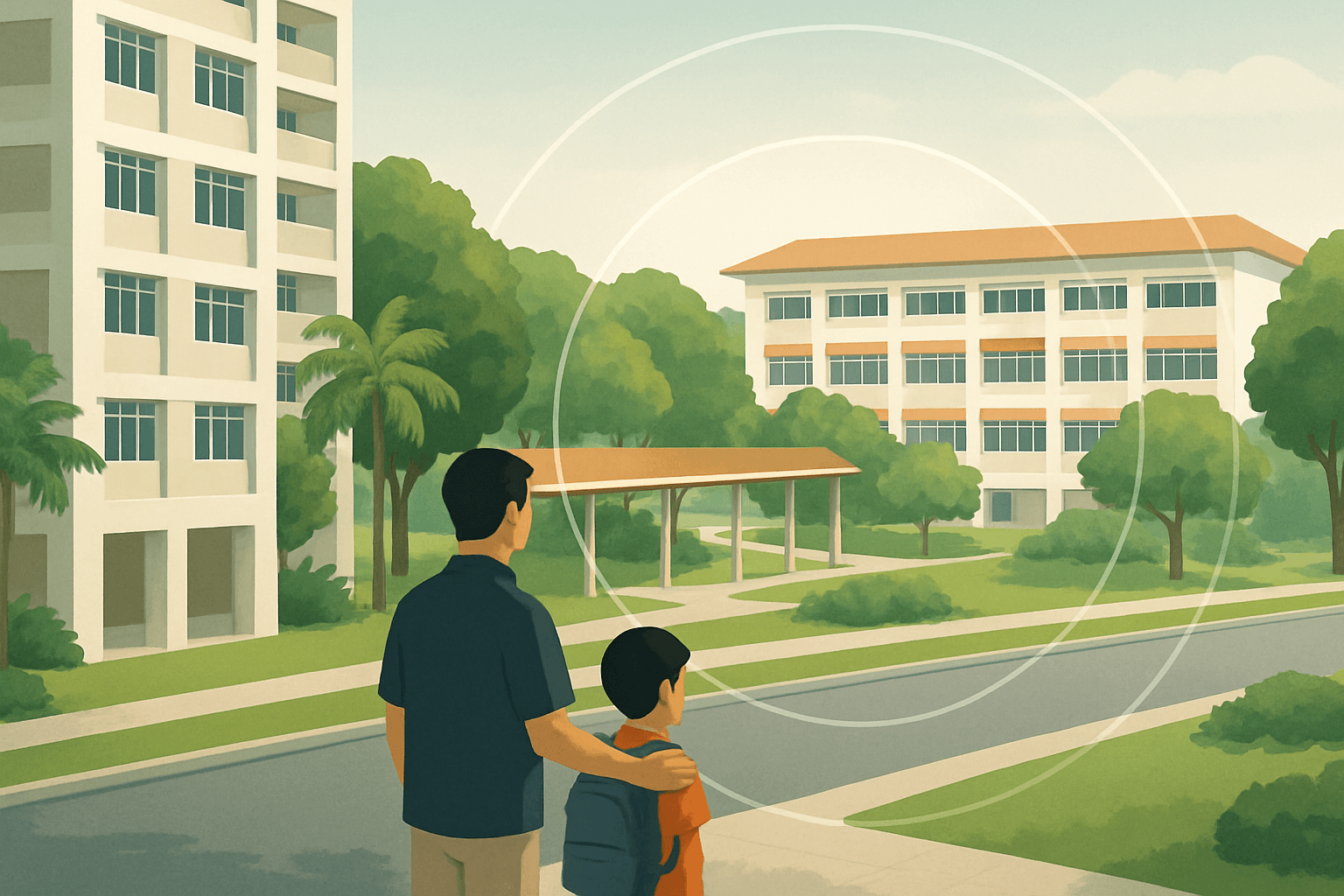
Yes, living 1km to 2km from a primary school can be good enough for P1 registration in Singapore, but it is not equally strong for every school. For a neighbourhood school with steady demand, this band may be perfectly workable. For a highly popular school, the same address may still leave you exposed to balloting pressure. The simplest way to think about it is this: distance helps, but school demand decides how much that help is worth.
Short answer: is 1km to 2km good enough for P1 registration?
Yes, 1km to 2km can be enough for P1 registration, but it is usually a middle band rather than a safe band. For popular schools, treat it as helpful, not protective.
Yes, it can be good enough, but it is not a secure position for every school. If the school is not heavily oversubscribed, a home in the 1km to 2km band may be completely workable. If the school is very popular, the same address can still leave you facing ballot pressure.
The most useful way to think about it is simple: 1km to 2km is often workable for moderate-demand schools, but it is usually a weaker position for high-demand schools. A family targeting a practical neighbourhood school may have a reasonable chance. A family targeting a school that many parents chase every year should usually assume more uncertainty.
If you are planning broadly, start with our Primary 1 Registration in Singapore guide, then assess a specific school rather than the distance band on its own.
*** READ ME FIRST !!! - P1 Registration FAQ ***
P1-IS is now offered for ALL participating Primary schools (see the http://www.moe.gov.sg/education/admissions/primary-one-registration/phases/ under \"Registration Procedures\" and \"Phase 2C/Phase 2C Supplementary\"). However, please note that 8 out of the past 9 years, Kong Hwa school required balloting for Singaporean Citizens under 1km in Phase 2C. I suggest that you work on an alternative school for Phase 2C instead, given that you are between 1km and 2km.
*** READ ME FIRST !!! - P1 Registration FAQ ***
2A need to apply at school , so withdrawal also need to be at school. Then go over to school B for registration. Consider time for travel, withdrawal take 5-10min. Buffer 1.5 hours would be safe if driving. If you can let us know your 2C choice , we can tell you the risk. It might be worth just to go 2C
How does MOE treat the 1km to 2km distance band in P1 registration?
Distance matters, but it does not guarantee a place. Also, Phase 1 is not distance-based at all; it is based on whether your child has an older sibling in the school.
MOE treats distance as one factor in registration, not as a stand-alone promise of admission. One important point many parents miss is that Phase 1 is sibling-based, not distance-based. Living near a school does not help in Phase 1 unless your child already has an older sibling studying there.
Distance becomes more relevant in later phases when applicants are competing for limited places. Even then, it does not work on its own. The outcome still depends on the phase, the number of applicants, and how many places remain when your band is considered.
The practical takeaway is straightforward: do not ask only, "Are we within 2km?" Ask, "Will our distance still matter once this school's demand is counted?" For the broader rules, see Primary 1 Registration Phases in Singapore and Primary 1 Registration Distance Priority: How Home-School Distance Works.
Share with us your kid's P1 registration experience
Funtastic4, RGPS finally had 117 applicants >2km fighting for 51 places under phase 2C (after 26 applicants <2km admitted). For my case, I had a daughter borned in year 2002. From 2005 onwards, we were closely monitoring the P1 registration stats, keeping all the records ourselvs as MOE dont retain them. Since my mil stayed near HPPS, we decided to enrol our child there. We were prepared to move <1km of the school. However after studying the stats, we discovered that HPPS needs balloting under p
Questions on new rules of P1 registration
With the announcement of the new rules of P1 registration - that citizens now have advantage over PRs, I have 2 questions: 1. Does the living distance to the school matter (ie 1 km away)? 2. If the PR has an older child in the school already, is priority given to the child’s younger sibling? Thanks!
Have More Questions?
Get personalized guidance on schools, tuition, enrichment and education pathways with AskVaiser.
Try AskVaiser for Free →When is 1km to 2km still a realistic chance?
1km to 2km is more realistic when the school is not heavily oversubscribed and the competition for remaining places is moderate rather than intense.
The 1km to 2km band is most realistic when the school is not under intense pressure. In practice, that usually means a school with steady local demand rather than one that draws heavy competition from a wider area. It can also be workable when places are still available and applications are not far above supply.
A common real-world example is a family looking at a solid neighbourhood school that is convenient and well regarded locally, but not treated as a prestige target. Another is a family open to two or three nearby schools, so they can choose the one where 1km to 2km still looks realistic instead of forcing one risky choice.
A short way to remember it is this: 1km to 2km works best when demand is manageable. If the school is popular but not heavily chased, this band may be enough. If the school is a magnet for applications, the same distance becomes much less reassuring. For a broader overview, see Primary 1 Registration Phases in Singapore: What Each Phase Means for Your Chances.
2011 P1 Registration Exercise for 2012 In-Take
I was told for some school when you go register for P2C, they will suggest to you to try somewhere if they see that you are outside of 1km. So in theory you can assume whatever the number of applicants to be all within 1km
2021 P1 Registration Exercise for 2022 In-take
Important question would be the \"name of the school\". For a number of schools, 1 to 2km in Phase 2B is as good as no chance, PV, clan or otherwise. For the majority of the clan schools, Phase 2C > 1km is as good as zero chance.
When is 1km to 2km risky?
1km to 2km is risky when the school is very popular, likely to be oversubscribed, or crowded with applicants who have stronger priority.
It becomes risky when the school is popular enough that balloting pressure is likely. In those cases, families within 1km are usually in a stronger position, and the 1km to 2km band is often where parents start to feel the squeeze. This is especially true when a school has a strong reputation, a broad catchment of interested families, or a pattern of registrations that exceed places.
A typical risky scenario is a family targeting the school everyone in the estate talks about, where demand stays high year after year. Another is a school where many places may already be taken up before nearby applicants are even in serious contention. In both cases, being within 2km may sound close enough, but in practice it can still be a weak position.
The key insight is that 1km to 2km is a middle band, not a protected band. It gives you some advantage over living farther away, but it may not be enough when too many families want the same school at once. For a broader overview, see How to Read Past Balloting Data Before Chasing a Popular Primary School.
*** READ ME FIRST !!! - P1 Registration FAQ ***
Phase is Phase. Distance is Distance. The Phase you are in is affected by your eligibility, not by your distance. See MOE for a better idea: https://www.moe.gov.sg/admissions/primary-one-registration/phases
2011 P1 Registration Exercise for 2012 In-Take
Hi, i m moving to haig rd area soon n going to register my son for P1 this yr. I m within 1km from Kong Hwa at guillemard crescent, but understand tat this school always need to ballot for within 1km (phase 2Ca) right? As i m PR n i will have 1 chance only, izit advisable for me to try my luck? Or i shld register at Tanjong Katong Primary as i m within 2km, which no need to ballot judging from the past history. Thank u. :lol:
What most parents misunderstand about distance and balloting
Many parents overestimate the protection of being within 2km. It helps, but it does not make a school safe if too many other families are also applying.
The biggest misunderstanding is thinking that "within 2km" means "safe enough." It does not. Distance improves your chances, but it does not create a place. If there are too many applicants, even a nearby address can still leave a family disappointed.
Another common mistake is treating within 1km and 1km to 2km as almost the same. They are not the same when a school is under pressure. The gap may look small on a map, but it can matter a lot once places become tight.
Parents also often focus too much on geography and not enough on school demand. A school 1.4km away may still be a worse bet than another school 1.8km away if the first school is much more oversubscribed. The smarter question is not just, "Are we close?" It is, "Are we close enough for this school, given how many other families want it?"
A useful rule of thumb is this: distance helps your odds, but demand sets the ceiling. For a broader overview, see Which Home Address Counts for Primary 1 Registration in Singapore?.
[Punggol] Primary Schools
Based on last year's statistics, there was balloting for SCs staying within 1 km during P2C.
[Punggol] Primary Schools
2012 end of Phase 2C (for 2013 P1 intake - born 2006, year of doggie) 1) Mee Toh Balloting was conducted for Singapore citizenship children, residing within 1km of the school. 152 registered, 70 places http://www.meetoh.moe.edu.sg/cos/o.x?c=/wbn/pagetree&func=view&rid=27543 2011 PSLE Quality passes (A/A*) http://www.meetoh.moe.edu.sg/cos/o.x?c=/wbn/pagetree&func=view&rid=25191 2) Horizon \t Balloting was conducted for Singapore citizenship children, residing between 1km and 2km of the school. 23
How should parents judge their chances before registration opens?
Judge your chances by combining school demand, your real priority position, and whether your address is clearly in the 1km to 2km band. Do not assess distance on its own.
Before registration starts, try to label each school as a stretch choice, a realistic choice, or a fallback choice. That sounds basic, but it forces a more honest conversation than simply calling every preferred school a "first choice."
Start with three practical checks. First, is the school usually seen as hard to get into, or does it generally have more manageable demand? Second, does your family have any stronger priority that matters apart from distance? Third, is your address firmly within the 1km to 2km band, or are you relying on a borderline estimate that could create false confidence?
Past patterns usually help more than parent chatter. If a school has a history of strong pressure, assume your 1km to 2km position is weaker than it looks. If demand has been steadier, your odds may be more reasonable. Our guide on how to read past balloting data can help you assess that more calmly.
It also helps to compare the target school with one or two nearby alternatives. Parents get into trouble when they evaluate one school in isolation. A better comparison is, "Is this school worth the extra admission risk compared with another school we would also be comfortable with?" If you are unsure which address will count, read Which Home Address Counts for Primary 1 Registration in Singapore? before making assumptions.
2011 P1 Registration Exercise for 2012 In-Take
Hi Keywa, You might want to check your home address again from the school as many parents use the distance travelled to calculate the distance, not realising that can be calculated via the circumference: Quoted from MOE website: Parents may check the home-school distance category from the Singapore Land Authority’s (SLA) OneMap SchoolQuery Service. Please refer to the following on how to use OneMap: Go to the OneMap website. http://www.onemap.sg/index.html Select the SchoolQuery service. Click o
2011 P1 Registration Exercise for 2012 In-Take
http://www.kiasuparents.com/kiasu/content/singapore-primary-1-registration-school-balloting-history To know your chances, you can make calculated guesses using the link above. The min distance is within 1km so even if you live next door to the school it is still considered within 1km. Don't think they will release info about nationality of applicants - how many locals, how many PRs. My guess only. For this year's info, I am not sure if the school will reveal. Some school seem more willing than o
If you are only in the 1km to 2km band, how should you rank your schools?
Treat a very popular school as a stretch option, not as your assumed outcome. Build your shortlist around at least one school with stronger odds that your family would still be comfortable choosing.
P1 registration is not a single ranked-list exercise, but parents should still mentally rank their options before the process starts. If you are only in the 1km to 2km band, the safest mindset is to separate schools into stretch, realistic, and fallback options.
A very popular school should usually be treated as a stretch choice unless your family is genuinely comfortable with uncertainty. A school with more moderate demand may be your realistic choice. A nearby school with a stronger admission outlook should be your fallback, not an afterthought. This keeps you from building your entire plan around a school that only works if several things go your way.
Many families make better decisions when they stop asking, "Which school do we want most?" and start asking, "Which school plan can we live with if the first option does not work out?" If you are weighing ambition against stability, our article on whether to pick a popular dream school or a safer nearby school is a useful next read.
[Punggol] Primary Schools
dear parents, my daughter born on 2009 and looking to P1 register few months later. I am staying within 1km to MT, Horizon and PV, history show all school required ballot for SC within 1km in phase 2c. Dun think I will register MT as chance is low, any idea/comment/advise to choose between Horizon and PV?
[Punggol] Primary Schools
similar predicament as mine, i stay at SK, already brought punggol new flat ready only in 2015, but my child is need to enrol in 2014? So can i apply for punggol school within 1km? showing proof of purchased address?
What are sensible backup plans if your preferred school is only in the 1km to 2km band?
Choose backup schools that are still convenient and acceptable, but not exposed to the same level of competition as your first choice.
A sensible backup plan is not just "any school with a vacancy." It should still work for daily life and still be acceptable to your family. Good backups are usually schools with a manageable commute, a learning environment you can live with, and a registration profile that is less intense than your first choice.
For example, if your preferred school is a heavily chased one at 1.6km, your backup should usually not be another equally competitive school at 1.9km unless you are comfortable with the same risk twice. A stronger backup might be a nearby school with a similar morning routine but less admission pressure. In practice, the best backup is often the school that gives you a calmer plan, not the one that looks closest in prestige.
Parents sometimes resist backup planning because it feels like settling too early. In reality, it prevents last-minute panic. If you want help thinking through that trade-off, see Popular Primary School vs Neighbourhood School in Singapore and what happens if you do not get your preferred school.
Share with us your kid's P1 registration experience
P1 registration experience… On the 1st day, went to the 1st choice school in the morning of 2/Aug to register… Actually I wanted to go on the last day to better gauge the chances as I was staying between 1-2km but the other half keep pestering me to go early… many parent still don’t understand the concept of balloting and priority and 3 days registration period… no sure why they always have the belief of 1st-come-1st-serve go later no place misconception even after much much explanation… No choi
[Punggol] Primary Schools
Need advise from all experience parents here, if u are staying at another district but moving to punggol in 2 years time.will you register your kid into a school at punggol or the district you currently lives. Plus if both parents are working and main care giver are their grandparents staying outside Punggol, what will you choose? School in punggol or current location nearer to grandparents lives?
Important nuance: address planning is not the same as securing admission
Living nearby or changing address does not secure admission. Any declared address should be genuine and able to stand up to MOE verification.
If you are thinking about moving, renting, or using a different address mainly for school admission, be careful. A nearby address does not guarantee a place, and MOE has said it takes address verification seriously under the proximity policy, including action on false declarations in its replies on address verification and non-compliance.
In practice, parents usually need to ask whether they will genuinely live at the new address, whether the housing timeline matches registration timing, and whether the address would be defensible if MOE asks for verification. These are practical examples, not an official checklist. If you are weighing an address change, our guide on Primary 1 Registration After Moving House: Should You Use Your Old or New Address? can help you think it through more carefully.
*** READ ME FIRST !!! - P1 Registration FAQ ***
Can someone tell me if this rule is new starting from this year or was it around before? Extracted from MOE FAQ under Proximity to School FAQ 4. How long do we need to stay in the address used to register our child during the P1 Registration Exercise? In a small number of cases, there may be situations where the families are unable to remain at the address for the entire duration of the primary school studies. Even so, a child who gains priority admission into a school through his/her distance c
For Reference for P1 registration: MOE Official Letters
http://www.kiasuparents.com/kiasu/forum/viewtopic.php?p=293646#p293646 Dear Sir/Madam, Thank you for writing to us on 12 November 2010. We wish to clarify that parents using address of rented apartment will not be at a disadvantage if the school should conduct balloting. We would like to share with you that the registration is done based on the NRIC address that is reflected on the parents' NRIC at the time of registration and the address used for the registration of a child (assuming Singapore
If we live 1km to 2km away, can we still get in ahead of other applicants?
Yes. A 1km to 2km address can still lead to a place if enough places remain and the school is not heavily oversubscribed.
Yes, that can still happen. If there are enough places when that distance band is considered, a family living 1km to 2km from the school can still get a place without trouble. This is more plausible when the school is not heavily oversubscribed and the pressure from higher-priority applicants is manageable.
But it does not mean the 1km to 2km band automatically beats everyone else. The result still depends on how many places remain and how strong demand is that year. A moderate-demand school may still admit children in this band comfortably, while a high-demand school may leave families in the same band facing much tighter odds.
That is also why nearby families sometimes still end up appealing. MOE has said it receives around 300 appeals a year on average from parents seeking admission to schools near home in this parliamentary reply. The practical takeaway is not that appeals are a strategy. It is that proximity helps, but nearby does not always mean successful.
*** READ ME FIRST !!! - P1 Registration FAQ ***
Yes, but that presupposes that there are seats left in the school for P2A2. Your NRIC must show the registration address. Otherwise, you must show documentary proof that your property will be ready for occupancy by the time your child starts P1.
2021 P1 Registration Exercise for 2022 In-take
Last year 70 schools needed to ballot for those within 1km. This year: A few schools have more vacancies, namely Canberra, will be a better year for those staying within 1km. A few schools may join in the foray for <1km, like Punggol Primary, St Andrew Junior (borderline between 1-2km and <1km) and Valour. Not posting stats specifically as seem little interest for that (based on forum postings or enquiry). Either parents are well informed of what is coming or are well prepared for battle.
Have More Questions?
Get personalized guidance on schools, tuition, enrichment and education pathways with AskVaiser.
Try AskVaiser for Free →