
Should PR Families Move House for Primary 1 Registration in Singapore?
When moving nearer a school can improve your odds, and when it is just an expensive gamble.
Sometimes, yes. A move can help a PR family if it genuinely improves the child's home-school distance position, the target school is still realistic, and the home remains a good family decision even if the school outcome goes another way. If the move is mainly to chase one very competitive school, it is usually an expensive gamble rather than a reliable Primary 1 plan.
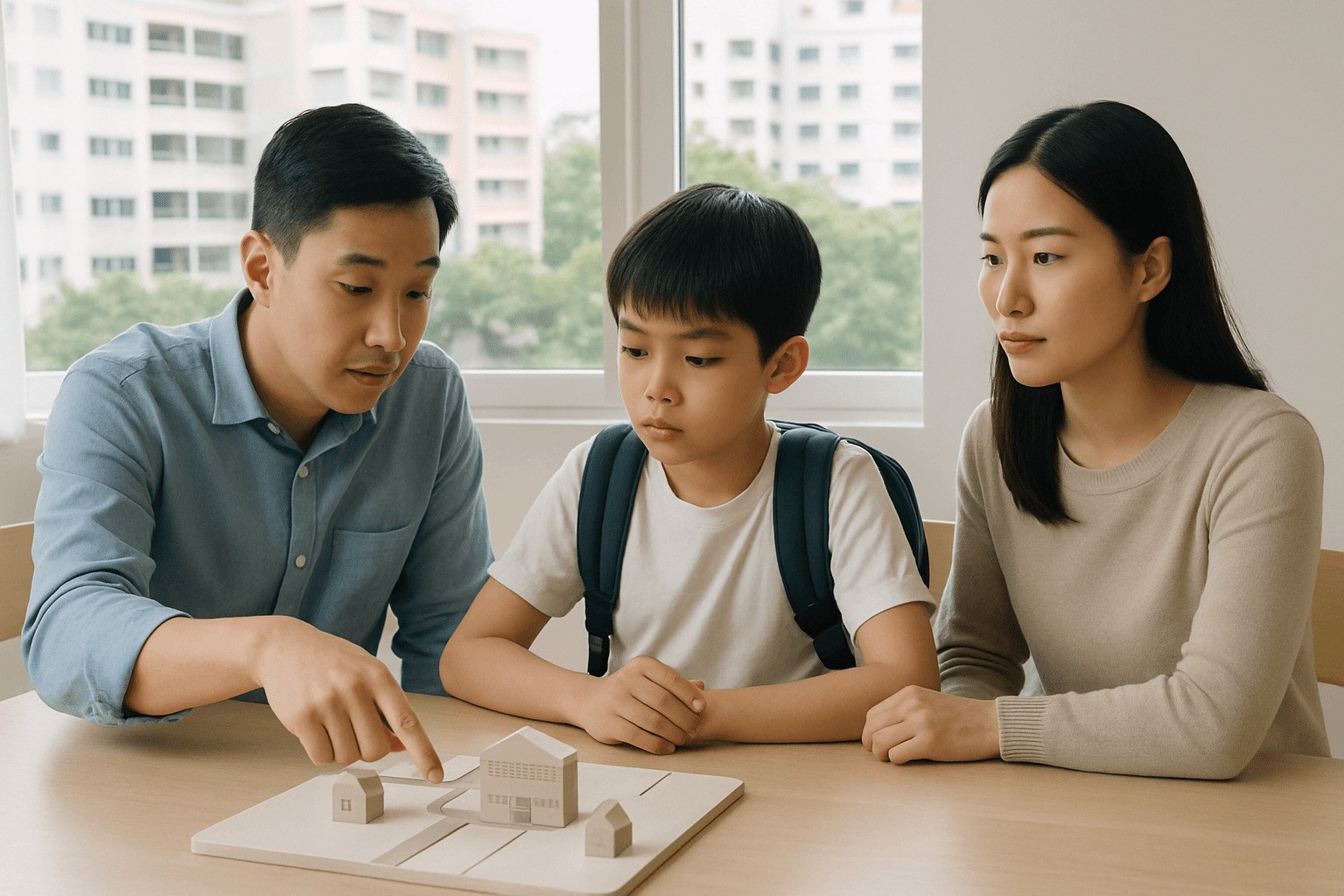
Many parents ask the same question: should we choose a home to improve Primary 1 registration chances, or choose a home first and work with the schools around it? For PR families, the safest answer is usually to treat a move as a support strategy, not the whole strategy. Distance can matter in MOE's registration process, but only within the wider competition for that school. The real decision is not whether moving helps in theory. It is whether the move improves your options enough to justify the cost, disruption, and risk.
Short answer: should PR families move house for Primary 1 registration?
Sometimes, but only when the move meaningfully improves your distance position and the school is still realistic. If you are moving mainly to chase one very popular school, it is usually an expensive gamble.
Sometimes, yes, but only in a narrow set of situations. Moving house can help if the new address gives your child a meaningful distance advantage and you are still targeting a school that is realistically within reach. If the move only improves your position on paper, or the school remains heavily oversubscribed, the relocation is usually not worth the money or disruption.
The most useful way to think about this is simple: moving house can improve odds, but it does not secure admission. A family that is already planning to move for work, budget, or childcare reasons may sensibly choose a home that also puts several acceptable schools nearby. That is very different from stretching your budget mainly to chase one famous school.
For PR families, caution usually beats aggression. If a school already looks hard to access, paying more to live nearby can still leave you with the same uncertainty, just at a higher housing cost. Before deciding, it helps to understand the bigger process through our full Primary 1 registration guide.
All about Transferring to Other Primary Schools
I suppose before august, u will still be living in Punggol? Perhaps you still need some time to renovate, move/pack or settle down. Think it’s easier to transfer to TPY schools when your new premise is ready and settled.. perhaps register your child where your p2 is first and apply for transfer later. Better to start in a fresh year, say p3 and p1. If you have a caregiver for your p1 near TPY, u can try register p1 under that address...
All about Transferring to Other Primary Schools
https://www.moe.gov.sg/primary/transfers “You can apply to transfer your child to a primary school nearer to your new residential address if your child is: - A Singapore Citizen (SC) or Permanent Resident (PR). - Currently in Primary 1 to 5. We will offer your child a school nearer to your new residential address which has available vacancies. Your child will have to report to the new school by the end of the reporting period to complete the school transfer. Your NRIC must be updated with your n
How does home address affect Primary 1 registration in Singapore?
Your address can affect Primary 1 registration when a school is oversubscribed, because MOE uses home-school distance in the process. It helps only within the wider competition for that school, not as a guaranteed advantage.
Home address matters because MOE uses home-school distance when a school has more applicants than places. Parents can still register for any school they choose, even if it is more than 2km away. The practical issue is what happens when demand is high. In those cases, distance can affect how applicants are grouped and whether balloting becomes a risk.
That is why moving house sometimes matters and sometimes does not. If a school is not under pressure, living closer may not change anything. If a school is very heavily oversubscribed, living closer may still leave you in a ballot. Distance is useful only when it changes your position in a school where proximity still has practical value.
MOE advises parents to use the OneMap School Query Service via its FAQ guidance because the calculation is based on the shortest distance from the school boundary to the home address. It is not based on driving time, walking convenience, or what a property listing says. MOE also notes that parents should verify the result again in the actual registration year, since mapped building outlines and school boundaries can change.
Just as important, the address must be the real residential address where the registering parent and child are actually living. If admission priority was gained through distance, the family is expected to continue residing there. For a fuller explanation, see how home-school distance works and which home address counts for P1 registration.
All about Transferring to Other Primary Schools
To add, In this link https://va.ecitizen.gov.sg/cfp/customerPages/moe/explorefaq.aspx?Category=3645&utm_source=moe-corp-site&utm_medium=referral Look for Q. I have purchased a yet-to-be completed property and should be moving in after the property is completed. Can I make use of the new home address for Primary One (P1) registration?
[Punggol] Primary Schools
hi hi my understanding is can use the new address, but i think must provide HDB documentation. It is good to check on during P1 registration. BTW Meetoh is a very popular sch. If u r the ex-student, it should not be a prob to get a seat. But if u r under phase 2C, please prepare for balloting. This sch practically every yr needs balloting.
Have More Questions?
Get personalized guidance on schools, tuition, enrichment and education pathways with AskVaiser.
Try AskVaiser for Free →When does moving house actually improve a PR child's chances?
Moving helps most when it clearly improves your distance position for a school that is still within reach, and when the new home also improves daily family logistics. The safest move usually gives you better options across several schools, not just one.
A move helps only when it changes your child's position in a meaningful way and the school is not so oversubscribed that the benefit disappears. In practice, this usually means the new home places you in a clearly better distance band for a school that still looks realistically reachable.
One common sensible case is when the family already plans to move anyway. If your new home improves access to a few acceptable schools, not just one, the move can strengthen your options without making everything depend on a single result. For example, moving from a location clearly farther from your preferred schools to one where you are meaningfully nearer may reduce risk across your shortlist, not just for one school.
Another sensible case is when the move improves daily life whether or not you get the first-choice school. If the new area also makes morning travel easier, places you nearer grandparents, or gives you better student-care logistics, the home decision still has value even if registration does not go your way.
What usually works best is a cluster strategy, not a single-school strategy. If one neighbourhood gives you a stronger distance position for two or three schools you would genuinely accept, that is far safer than paying a premium to be near one school with intense demand. Parents still deciding between aspirational and realistic choices may find this comparison of dream schools versus safer nearby schools helpful, along with this practical read on how to choose the best primary school near you. For a broader overview, see Which Home Address Counts for Primary 1 Registration in Singapore?.
All about Transferring to Other Primary Schools
Hi Friends, I am Lakshmi residing in Singapore for the past 17 years as PR and my child who is 10 years old is holding a student pass and studying P4 at Boonlay garden primary school. On his P1 registration 2018 (Born 2012 - Dragon year) he didnt get through MOE school admission even though one of the parents is SPR. In 2020, when P2 i attained AEIS exam and successfully placed at Boon Lay garden primary school (MOE) but distance is far from our own house (at Choa Chu kang) . Since then I keep a
Give citizens priority in Primary 1 registration
http://www.guidemesingapore.com/permanent-residence/singapore-pr-pros-and-cons.htm Quote from above : If your children are school-aged, they are high on the priority list, behind citizens, to enter public schools of your own choosing. Non PRs are at the bottom of the list and are often left with no choice when it comes to schools.
Important warning: a closer address does not beat heavy demand on its own
Proximity is an edge, not a shortcut. If demand is extremely high, a closer home may still leave you in ballot territory.
Distance can improve your position, but it cannot make a high-demand school low risk. Before paying more for rent or a property purchase, compare the school's demand pattern with your backup options using past balloting data. A better address helps only if the school is still realistically accessible. For a broader overview, see Primary 1 Registration After Moving House: Should You Use Your Old or New Address?.
Questions on new rules of P1 registration
With the announcement of the new rules of P1 registration - that citizens now have advantage over PRs, I have 2 questions: 1. Does the living distance to the school matter (ie 1 km away)? 2. If the PR has an older child in the school already, is priority given to the child’s younger sibling? Thanks!
Give citizens priority in Primary 1 registration
Ha.ha. maybe next time the P1 registration phase can propose like that, just a suggestion: Phase 1 – Existing siblings in the Primary school except PR siblings. Phase 2A(1) – No Change Phase 2A (2) – No Change Phase 2B – No change Phase 2C – Singapore Citizenship Only. Phase 2C Supplementary - Singapore Citizenship Only Phase 3A – Permanent Residents Phase 3A Supplementary - Permanent Residents Phase 4 – Non Citizen.
When is moving house mostly an expensive gamble?
Moving is usually a bad bet when you are paying mainly for one high-demand school, assuming proximity guarantees admission, or relying on an address that is not your genuine home.
It is usually a gamble when the housing decision makes sense only if one school works out. That includes stretching your budget mainly for a well-known school, assuming a nearer address makes the result safe, or having no clear fallback if your child still does not get in.
A common mistake is confusing school reputation with school accessibility. Some schools attract so much demand that even families living nearby still face uncertainty. In that situation, the housing premium does not buy certainty. It buys a better shot at a still-uncertain result.
Another warning sign is treating address as paperwork rather than real residence. MOE's rules are tied to genuine residency, not just a convenient address for registration. There has also been public scrutiny around false-address cases, as reported by The Straits Times. If your situation involves a recent or planned move, read whether to use your old or new address after moving house before assuming the answer is straightforward.
A practical stress test is this: if you would still choose the home even with a different school outcome, the move may be sensible. If the home feels overpriced, inconvenient, or temporary unless one exact school works out, the plan is too fragile. For a broader overview, see How to Read Past Balloting Data Before Chasing a Popular Primary School.
All about Transferring to Other Primary Schools
Hi, my son is going to p1 in 2022. We currently live in Boonlay. We have a HDB in Geylang that was delayed to first half of 2022. During the p1 registration exercise, we didn’t get into any school within 2km in Geylang and is assigned to one 2-3km away. Should we register our child to a school in Boonlay. Then transfer him to Geylang in the middle of his p1 year? Additional info: 1. No car 2. One parent working overseas 3. No grandparents to take care of child
All about Transferring to Other Primary Schools
It's tough and I don't envy you. Is your child capable to taking the bus/mrt by himself? Is the school easily accessible by these means of transport? Maybe get him used to travelling by himself and making use of the travel time to read/study. The top boy in my primary school stayed in Pulau Ubin and takes the sampan to school every day!
Should you rent near the school or buy a home for registration purposes?
For most families testing a school strategy, renting is safer because it preserves flexibility. Buying should be driven by long-term housing needs first, not one uncertain P1 outcome.
If the move is mainly a school strategy, renting is usually the safer option. It gives you flexibility, limits long-term financial commitment, and makes it easier to change course if the registration result is not what you hoped for.
Buying is a much bigger decision and usually makes sense only when the home already fits your broader family plans. That means the location should still work for work commute, budget, caregiving support, and everyday routines even if your child ends up in a different school. If you would hesitate to stay there for several years without that one school outcome, buying is probably too aggressive.
Either way, the address must reflect where the registering parent and child are actually living. This is not a matter of using whichever address is most convenient on paper. For a secondary perspective on how some parents think about school-related property moves, this KiasuParents article on property and registration planning is useful, but it should be read as background context, not as a shortcut or guarantee.
[Pasir Ris] Primary Schools
Hi, I am a newbie here. I require some advice on the P1 registration for 2014 intake and I hope you guys can assist me I just paid an booking fee for a HDB resale unit, and the OTP is due to be signed in 14 days time. I will be registering my daughter under Phase 2C 1st Question: Will MOE base the proximity of the school I choose on my current residence or the "new"residence which I am buying. I do not expect the lease of agreement to be signed anytime now, but at least in 3rd or 4th quarter 201
[Punggol] Primary Schools
My place in Punggol will also be ready in 2015 (hopefully earlier) and my DS will be in P1 in that year too. I will be using my sales agreement as proof that I will be staying there is it is still not ready for move-in by then. My PIL are staying in Serangoon so I will put DS in the in-house after-school student care as both me and DH are working.
What should parents check before deciding to move?
Before moving, check school realism, verified distance, genuine residency, full housing cost, daily logistics, and your fallback plan.
- ✓Check whether the target school is realistically reachable for your family, not just desirable, and compare it with at least one safer option through [our Primary 1 registration guide](/primary-1-registration-singapore-guide).
- ✓Verify the home's likely distance position using the OneMap School Query guidance in MOE's FAQ, not by walking time, agent claims, or rough map estimates.
- ✓Recheck the distance result in the actual registration year because mapped boundaries and building outlines can change.
- ✓Confirm that the address will be the real residence of the registering parent and child, not just a useful address for paperwork.
- ✓Compare the full cost of renting versus buying, including moving expenses, furnishing, deposits, renovation, and the cost of being wrong.
- ✓Test the daily routine from that home, including school drop-off, work commute, student care, sibling logistics, and help from grandparents or caregivers.
- ✓Shortlist several schools around the new home so the move improves your overall options, not just one target school.
- ✓Decide in advance what your fallback plan is if your child does not get the preferred school, so the housing decision does not become a last-minute crisis.
What costs and trade-offs do PR families often overlook?
The real cost includes commute changes, childcare disruption, routine stress, and reduced flexibility, not just housing payments. A move should ideally improve daily life as well as registration odds.
The biggest hidden cost is often not the rent or mortgage. It is the way one school decision can reshape the family's daily life. A home that looks ideal for registration may create a worse work commute, weaker childcare support, or more tiring school mornings once the child actually starts Primary 1.
Parents often underestimate the cost of routine disruption. One family may move closer to a school but add an hour of commuting for both parents. Another may lose the convenience of nearby grandparents who used to help with pickup. A third may pay a rental premium for a year or two, then discover that the child is posted elsewhere and the extra housing cost bought very little practical benefit.
There is also a planning trap that many parents miss: a school-focused move can narrow your choices later. If the home strains the budget, you may feel pressured to accept a less suitable childcare arrangement, a longer commute, or a school outcome you had not planned for.
The strongest housing decision is one that still improves family life if the first-choice school does not happen. If you are weighing school reputation against convenience, this piece on popular versus neighbourhood schools can help you think more clearly about what actually matters day to day.
Give citizens priority in Primary 1 registration
hello everyone, I am new to this website & a PR at that. this discussion is quite interesting & a lot of bashing of PR's all around. I would like to put up few points inthe defence of the PR's 1. in not all cases it is true that wife will not be working, & as some have said that if both are working then grand parents will be here to take care of the kids. It is too generalised a statement & may not be true for more than 80% of times. 2. A new PR doesnt have a family Support or the contacts which
All about Transferring to Other Primary Schools
My son is P1 next year. So registration this year. However he is foreigner status so won’t qualify till phase 3. I will be applying for pr for him as I am Singaporean. Hubby is old boy of acs too, but again we don’t qualify for 2a as not SC or PR. Wondering if we can start off in international sch (P1) and then transfer later (maybe p2).[/quote] Transfer from International schools to local schools happen quite frequently. However, transfer tend to be for less popular local schools since they hav
If we do not move, what is the most sensible fallback plan?
Do not make this a one-school strategy. The safest fallback is a realistic shortlist and a housing decision that still works even if your preferred school does not.
The best fallback plan is not to build everything around one school. Instead, create a realistic shortlist of schools you would genuinely accept, including at least one option that is less exposed to heavy competition, and make sure your housing decision still works for family life regardless of the result.
This matters even more for PR families because the biggest planning mistake is often overcommitting to a single outcome. A stronger plan is to understand the registration process, compare nearby schools honestly, and decide in advance what outcomes you can live with. That way, if your preferred school does not work out, you are disappointed but not scrambling.
A useful next step is to read what happens if you do not get your preferred school and how the P1 registration phases work. Fallback planning is not pessimism. It is what keeps one uncertain school application from becoming a family housing mistake.
[Punggol] Primary Schools
Need advise from all experience parents here, if u are staying at another district but moving to punggol in 2 years time.will you register your kid into a school at punggol or the district you currently lives. Plus if both parents are working and main care giver are their grandparents staying outside Punggol, what will you choose? School in punggol or current location nearer to grandparents lives?
[Punggol] Primary Schools
Hi, does anyone know if the new 30 months ruLe mean that parents should register using their addresses of their new flats? It already looks like there are not enough places for primary schools in punggol and so many flats going to TOP
Have More Questions?
Get personalized guidance on schools, tuition, enrichment and education pathways with AskVaiser.
Try AskVaiser for Free →