
What Are My Chances If I Live 1 to 2km from the School for P1 Registration?
How to tell whether the 1 to 2km distance band is workable, or too risky to rely on, for Primary 1 registration in Singapore.
If you live 1 to 2km from the school, your chances are possible but not secure. This band is stronger than being beyond 2km, but weaker than being within 1km, and it can still face balloting when a school is crowded. In practice, 1 to 2km is often realistic for calmer schools or phases where vacancies usually remain, but it is usually too risky to rely on for schools that repeatedly ballot in the phase you need.
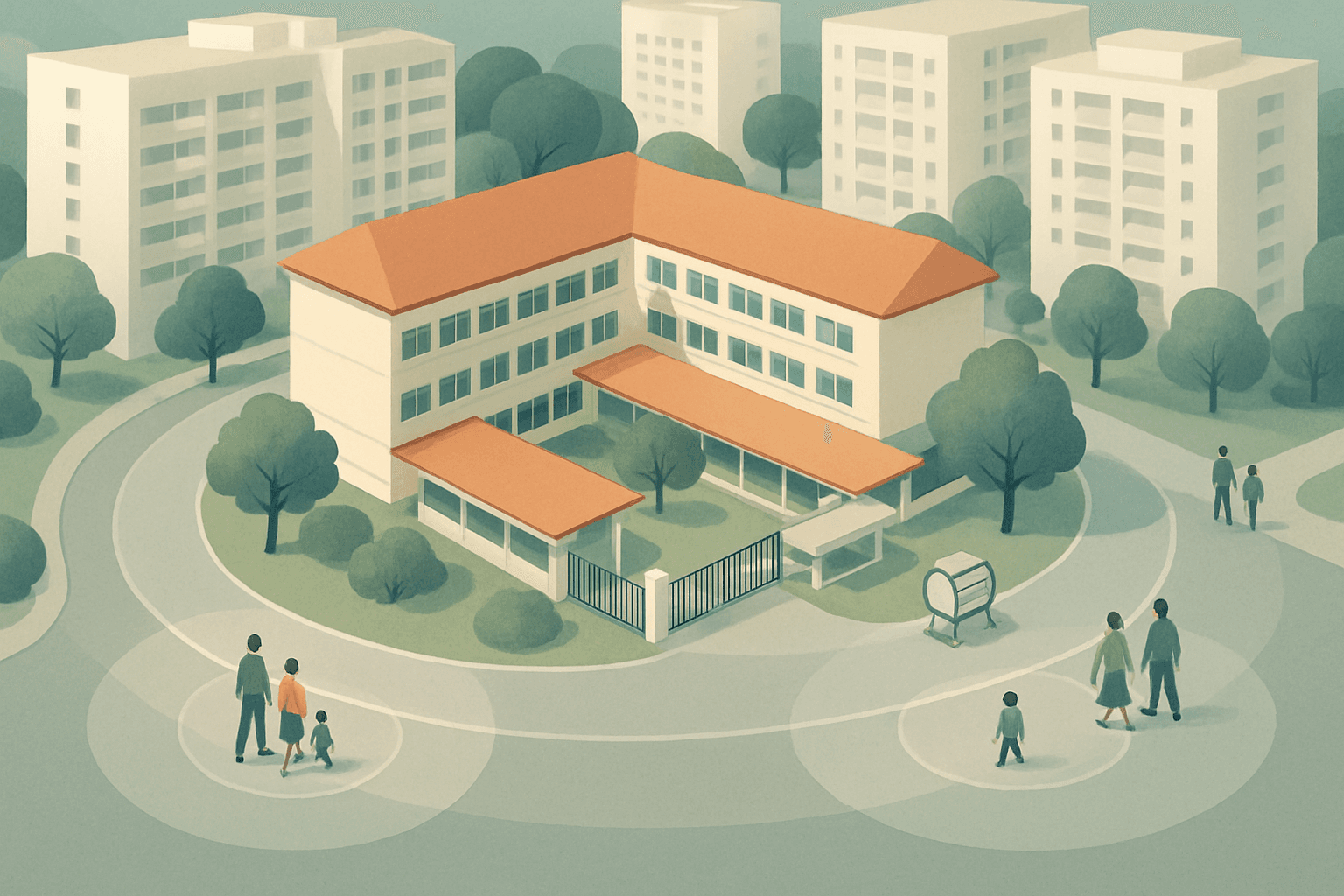
If you live 1 to 2km from a school, your child still has a meaningful distance advantage over families living farther away. But that alone does not make the school a safe choice. The real issue is whether there will still be enough places left when your phase and distance band are considered. For less crowded schools, 1 to 2km can be perfectly workable. For schools that repeatedly face heavy demand, it is often a stretch choice, not a dependable plan. This guide shows you how to judge the difference before you commit.
Short answer: what are my chances if I live 1 to 2km from the school?
1 to 2km can be enough, but it is not safe on distance alone. Your real chances depend on whether the school still has places left in your phase when your band is considered.
Your chances are real, but they are not secure. Living 1 to 2km away gives your child a better position than families living farther away, but it does not guarantee a place. If the school is popular, or if many seats are already taken before your distance band is considered, you can still face balloting or miss out.
A useful way to think about this band is simple: 1 to 2km is a middle position, not a comfort zone. It can be good enough for a school that usually still has room in your target phase. It is often not good enough for a school that regularly becomes oversubscribed. If you want the wider process first, start with our Primary 1 Registration in Singapore guide.
Share with us your kid's P1 registration experience
Funtastic4, RGPS finally had 117 applicants >2km fighting for 51 places under phase 2C (after 26 applicants <2km admitted). For my case, I had a daughter borned in year 2002. From 2005 onwards, we were closely monitoring the P1 registration stats, keeping all the records ourselvs as MOE dont retain them. Since my mil stayed near HPPS, we decided to enrol our child there. We were prepared to move <1km of the school. However after studying the stats, we discovered that HPPS needs balloting under p
Questions on new rules of P1 registration
With the announcement of the new rules of P1 registration - that citizens now have advantage over PRs, I have 2 questions: 1. Does the living distance to the school matter (ie 1 km away)? 2. If the PR has an older child in the school already, is priority given to the child’s younger sibling? Thanks!
How does the 1 to 2km band work in MOE Primary 1 registration?
Distance matters only when a school is oversubscribed. The 1 to 2km band helps, but only within your phase, the available vacancies, and the registered home address used for the application.
Parents can apply to any primary school, but distance becomes important only when demand is higher than the number of places available. If a school is oversubscribed in a phase and distance category, balloting can happen. That means the 1 to 2km band is one layer of priority, not an automatic pass.
The registered home address matters because it determines the home-school distance category. MOE explains this in its FAQ on home-school distance and registration. Parents often use OneMap School Query before the exercise to get an indicative distance band, which is sensible. But MOE also says to check again in the actual registration year because mapping or building-outline updates can affect the result.
Practical takeaway: first confirm that you are truly in the 1 to 2km band, then ask whether that band is likely to matter for your school and phase. Our guides on distance priority and which home address counts cover those details in more depth.
[Punggol] Primary Schools
Based on last year's statistics, there was balloting for SCs staying within 1 km during P2C.
[Punggol] Primary Schools
dear parents, my daughter born on 2009 and looking to P1 register few months later. I am staying within 1km to MT, Horizon and PV, history show all school required ballot for SC within 1km in phase 2c. Dun think I will register MT as chance is low, any idea/comment/advise to choose between Horizon and PV?
Have More Questions?
Get personalized guidance on schools, tuition, enrichment and education pathways with AskVaiser.
Try AskVaiser for Free →Why can 1 to 2km be realistic for one school but a long shot for another?
School demand often matters as much as distance, and sometimes more. A calmer school may be realistic from 1 to 2km, while a heavily oversubscribed one may not be.
Because distance is only part of the decision. Two families can both live 1.5km from their chosen schools and still face very different odds. One school may still have healthy vacancies when that band is considered. Another may already be under pressure because earlier demand has taken up most of the intake.
This is why parents sometimes overestimate what distance alone can do. A neighbourhood school with steady vacancies in your target phase may still be very reachable from 1 to 2km. A high-demand school can make even under-1km families nervous, so 1 to 2km becomes a genuine gamble. Intake size can matter too. A larger school may feel more workable because there are more seats overall, while a school with strong sibling or other priority demand may leave fewer places than parents expect.
Memorable rule: do not compare your distance to a general rule. Compare your distance to that specific school's demand pattern. For a broader overview, see Primary 1 Registration Phases in Singapore: What Each Phase Means for Your Chances.
2021 P1 Registration Exercise for 2022 In-take
Important question would be the \"name of the school\". For a number of schools, 1 to 2km in Phase 2B is as good as no chance, PV, clan or otherwise. For the majority of the clan schools, Phase 2C > 1km is as good as zero chance.
2021 P1 Registration Exercise for 2022 In-take
Last year 70 schools needed to ballot for those within 1km. This year: A few schools have more vacancies, namely Canberra, will be a better year for those staying within 1km. A few schools may join in the foray for <1km, like Punggol Primary, St Andrew Junior (borderline between 1-2km and <1km) and Valour. Not posting stats specifically as seem little interest for that (based on forum postings or enquiry). Either parents are well informed of what is coming or are well prepared for battle.
What usually makes 1 to 2km chances better or worse?
Repeated oversubscription, heavy demand in your target phase, and fewer remaining vacancies make 1 to 2km riskier. Stable vacancies and quieter demand make it more realistic.
Your chances usually look better when the school often still has vacancies in the phase you plan to enter, when past years do not show repeated balloting at that stage, and when the school is not known for unusually heavy demand. Your chances usually look worse when the school often fills early, when it has a pattern of balloting in the same phase, or when many places are likely to be taken before distance becomes the deciding factor.
The best quick check is MOE's past vacancies and balloting data. Do not treat it as a prediction. Treat it as a risk signal. If a school repeatedly looks tight in the phase you need, 1 to 2km should be treated cautiously. If it usually still has room, the band may be more workable than parents assume. Community strategy write-ups such as this Phase 2C article can help you understand how parents read crowded phases, but the official MOE data should carry more weight.
Insight line: distance helps only if seats are still available when your band is reached. For a broader overview, see How to Read Past Balloting Data Before Chasing a Popular Primary School.
2011 P1 Registration Exercise for 2012 In-Take
This is quite common. if there are already more people (staying within 1km) than the available vacancies have registered, there is really zero chance of getting. You are wasting your chances for another school.
2011 P1 Registration Exercise for 2012 In-Take
Usually, the number of applicants under P2B would be lesser than the number of applicants under P2C........so althouth still staying within 1km, chances of being successful during balloting would be higher due to the relatively lesser number of total applicant under this distance category.
How do I judge whether a school is realistic or too risky from 1 to 2km?
Classify the school as safer, stretch, or high risk. It is realistic only if past demand suggests there are usually still places left when your phase and 1 to 2km band are considered.
Use a simple three-way label: safer, stretch, or high risk. Combine two inputs only: your confirmed distance band and the school's past vacancy and balloting pattern in the phase you are likely to enter.
A safer choice is a school where you are clearly in the 1 to 2km band and the school often still has places in that phase. A stretch choice is a school where seats sometimes remain, but the school also shows occasional crowding or balloting pressure. A high-risk choice is one that repeatedly looks tight before your distance band becomes meaningful.
This is where many parents ask the wrong question. Instead of asking, "Am I within 2km?" ask, "Does this school usually still have room when 1 to 2km families are considered?" That is the question that helps you decide whether to rely on the school or keep it as an aspiration. If you want help interpreting the patterns, our guide on how to read past balloting data breaks down what to look for without over-reading the numbers. For a broader overview, see Primary 1 Registration Unsuccessful: What Happens If You Do Not Get Your Preferred School.
2021 P1 Registration Exercise for 2022 In-take
Balloting at the NYPS has been more than 30 years. If I don't remembered wrongly, I bumped into an article stating NYPS need balloting in some 1980++ in a particular phase 2 or 3 or the already changed 2C category. That's the history. Forward going, MOE (or the then Minister) mentioned they look into reviewing the increasing the number in 2C, maybe it will increase to 30 or more in the future that will be applicable to you. Unsure if the 30 month rule will change as a result to balance things up
2021 P1 Registration Exercise for 2022 In-take
The problem is, if you are in Phase 2A2, and have chosen not to join their association (for Phase 2A1 eligibility), moving to within 1km may not help you much for these schools (PCPS still safe lah). They are very likely to join the ranks of schools that ballot in Phase 2A1.
What parents often misunderstand about "1 to 2km"
Being within 2km is helpful, but it is not a shield against oversubscription. The band matters only if places are still available when your turn comes.
The biggest mistake is assuming that "within 2km" means "close enough to be safe." It does not. The 1 to 2km band helps only if the school still has vacancies when your application is considered. Parents also sometimes forget that the registered address matters, and that the indicative distance band should be checked again in the actual registration year. If you are moving or planning around an address change, read our guide on Primary 1 registration after moving house before you assume your distance band is settled.
Share with us your kid's P1 registration experience
P1 registration experience… On the 1st day, went to the 1st choice school in the morning of 2/Aug to register… Actually I wanted to go on the last day to better gauge the chances as I was staying between 1-2km but the other half keep pestering me to go early… many parent still don’t understand the concept of balloting and priority and 3 days registration period… no sure why they always have the belief of 1st-come-1st-serve go later no place misconception even after much much explanation… No choi
Share with us your kid's P1 registration experience
Pardon me if this question has been answer before. If we registered in P2B and given a place, can we still withdraw at P2C to register at the 1st choice school if chances are very high? :?
When is 1 to 2km worth trying, and when is it not?
1 to 2km is worth trying when the school still tends to have room in your target phase. It is usually not worth relying on when the school repeatedly ballots or fills early.
It is usually worth trying when the school tends to remain manageable in your target phase and does not show a repeated pattern of balloting there. In that situation, 1 to 2km can be a sensible, realistic choice even if it is not the strongest band.
It is usually not worth relying on when the school repeatedly looks crowded in the phase you need. For example, if a well-known school regularly shows pressure before many distance-based applicants are meaningfully in play, then 1.3km away is not a safe plan. It may still be worth attempting if your family accepts the risk, but it should be treated as a stretch choice, not your main bet.
There is also a common middle case that parents overlook: the same school can feel manageable in one phase and much riskier in another. So a school can be near, familiar, and still be a poor choice if you are entering at a crowded point of the exercise. If you are trying to identify a realistic fallback, this piece on choosing a good safety school can be a useful supplement to official vacancy data.
2021 P1 Registration Exercise for 2022 In-take
Just sign up and ballot lor. Fernvale and Anchor Green for Phase 2CS ain’t so bad distance wise also.
2021 P1 Registration Exercise for 2022 In-take
Ultimately, you have choices. There are still schools between 1km and 2km, as well as schools > 2km. Don't get fixated with 1 school. Most importantly, you need to have a back-up plan and a clear assessment of the options available to you. If you are balloted out of the popular school, do you have a back-up plan for Phase 2CS? In some places, e.g. Punggol, Yishun, Sengkang, it's ok to ballot at the popular schools even if the odds (3:1) seem daunting. You know you have other options available <
Before you rely on a 1 to 2km school, what should you check first?
Check demand, distance, address, and backup options before treating a 1 to 2km school as realistic.
- ✓Check whether the school has a history of oversubscription in the phase you plan to enter.
- ✓Check MOE's past vacancies and balloting data for that school and phase.
- ✓Confirm that the home address you plan to use is the one that should count for registration.
- ✓Use OneMap School Query to verify your indicative distance band, then recheck it in the actual registration year.
- ✓Consider whether sibling or other priority demand may leave fewer places than you expect.
- ✓Decide in advance whether your family can accept balloting or an unsuccessful outcome.
- ✓Shortlist at least one backup school with better distance odds or lower historical demand.
What should I do if the school is only a stretch choice?
Treat stretch schools as optional, not dependable. If you try one, pair it with a backup school you would actually be willing to accept.
If your preferred school looks like a stretch from 1 to 2km, the smartest move is not automatically to give it up. The smarter move is to stop treating it like a likely outcome. A stretch choice is reasonable if your family can live with the downside. It becomes a bad choice only when it is your only plan.
In practice, pair it with a backup school you would genuinely accept. Compare likely distance band, commute, and whether the backup school usually looks calmer in your likely phase. If your backup is a school you would be upset to end up with, you probably do not have a real fallback yet. Our guides on what happens if you do not get your preferred school and whether to pick a dream school or a safer nearby school can help you think through that tradeoff.
Useful family rule: aspiration is fine, but only after safety is planned.
Does school conduct test before allow the kid to reg Pri 1?
Hi ChiefKiasu, my child is in P1 this year and I would be shifting nearby to Kong Hwa Pri. What do you think my chances to secure a transfer into this school for next yr?? I’m considering for PV to this school for my younger child now in Nursery. Is it difficult to get PV with this school? thks!
2B Primary one registration question
Hi, Hope all is well. I have been serving as an active community leader in one GRC for over 2 years. Just before primary one registration, if we move to a new address, are we able to register the child in 2B phase for schools within 2km in the new address?
Should I pick a school that is 1 to 2km away, or a different school within 1km?
If you want the safer registration path, the school within 1km is usually stronger. A 1 to 2km school can still be worth trying if it is a better fit and the demand looks manageable.
If your main goal is to reduce risk, the school within 1km is usually the safer choice. That does not automatically make the 1 to 2km school the wrong choice. It just means the under-1km option generally gives you a stronger distance position if the school is oversubscribed.
The better decision depends on the tradeoff you are making. If the under-1km school is a reasonable fit and you want a calmer registration plan, it is often the practical answer. If the 1 to 2km school is meaningfully better for your family and its past data looks manageable, it may still be worth trying. The mistake is choosing the farther school based on aspiration alone while ignoring demand and backup options. If this is the choice you are weighing, our comparisons on popular primary school vs neighbourhood school and dream school vs safer nearby school may help.
2021 P1 Registration Exercise for 2022 In-take
1. Parents nationality is not as important as the child’s nationality. 2. If there are more applicants than places in the phase, distance would be considered. Hence, within 1km is still important cos if there’s balloting for < 1km for HPPS in Phase 2B, all those living outside 1km would not be considered. For reference, HPPS balloted for SC outside of 2km in Phase 2B last year. If I have to take a chance, within 2km should still be safe. 3. An important consideration if you have to move. You wil
2023 P1 Registration Exercise for 2024 In-take
I'll look only at schools closest to you, ie. <1km. The hottest school would be Frontier Primary, followed by Westwood and then Jurong West. These schools will definitely require balloting within 1km. As your daughter is SPR, there is no way she can even get a chance to ballot in these schools, even though you are within 1km. Your only real options are Boon Lay Garden Primary and West Grove Primary. I would strongly recommend West Grove Primary to you. You should be able to get in via Phase 2C.
Have More Questions?
Get personalized guidance on schools, tuition, enrichment and education pathways with AskVaiser.
Try AskVaiser for Free →