
When Should New PR and Non-Citizen Families Start Planning for P1 Registration in Singapore?
A practical timeline for newcomers to shortlist schools, map commute options, align housing, and prepare documents before registration opens.
Start planning before the registration year, not during it. For most newcomer families, a good rule of thumb is to work about a year ahead so you can shortlist realistic schools, test the commute, decide how much housing should be shaped by school choice, and prepare commonly needed documents early. Families who leave everything to the registration window can still act, but they usually have fewer practical options and more stress.
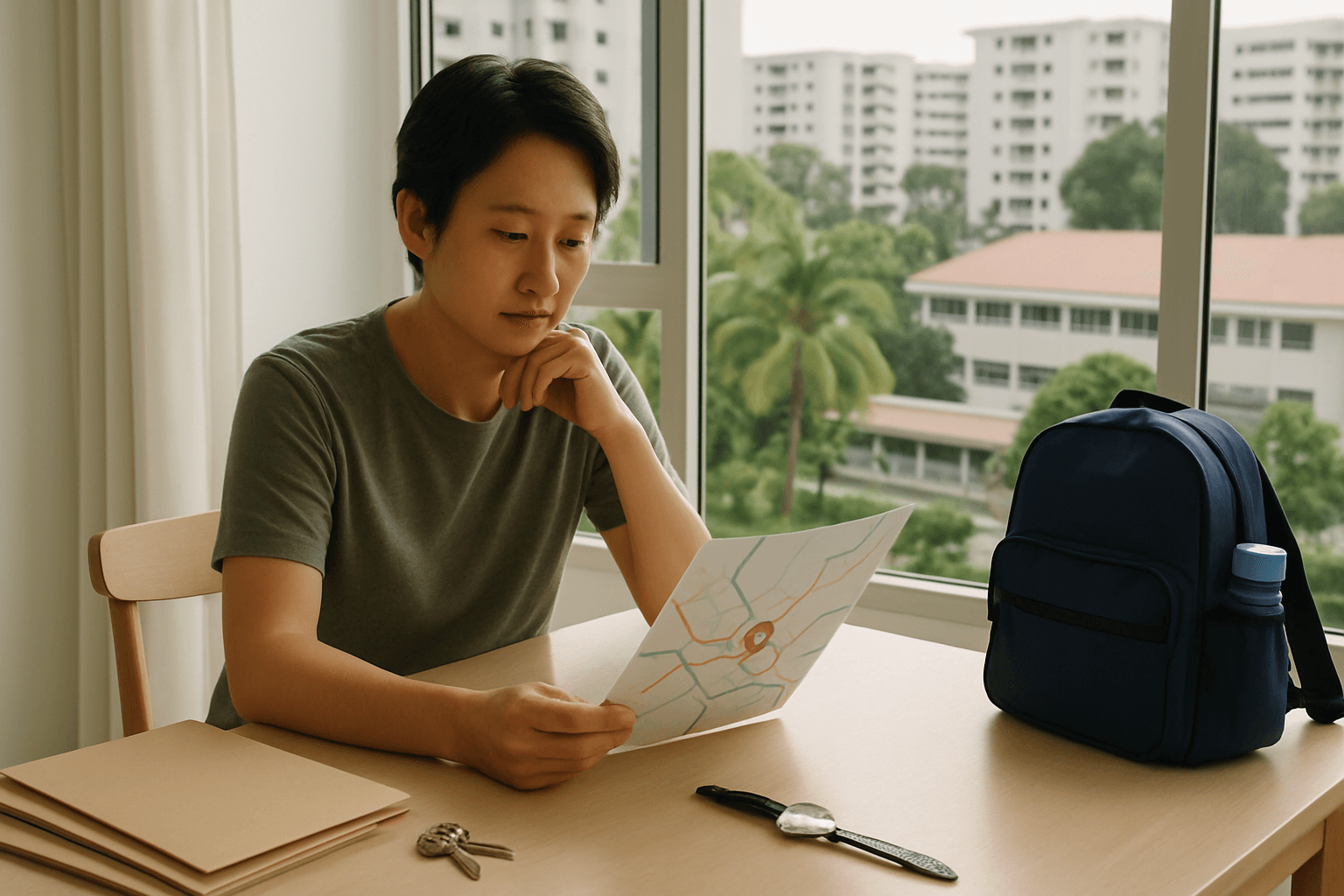
New PR and non-citizen families should start planning for Primary 1 well before the registration year, ideally about one school year ahead. For newcomer families, the main challenge is rarely just the form itself. You are usually making several linked decisions at once: which schools are realistic from your likely address, whether housing should follow school choice, and which family documents should already be organised.
When should new PR and non-citizen families start planning for P1 registration in Singapore?
Start planning as soon as you know your child will likely enter Primary 1 in Singapore, ideally about one school year ahead. Waiting until the registration year usually means less time for school comparison, housing decisions, commute checks, and document preparation.
Start as soon as you know your child is likely to enter Primary 1 in Singapore, ideally about one school year ahead. For newcomer families, P1 registration is usually not just a form-filling exercise. It sits together with housing, transport, settling-in timelines, and document preparation, so leaving everything to the registration year compresses too many decisions into one short period.
The practical difference is simple. A family already settled in Singapore may only need to compare schools. A new PR or non-citizen family often has to compare schools while also deciding where to live, how the child will travel each morning, and which documents are ready. If you arrive early, you can visit neighbourhoods, test routes at school-start timing, and keep more than one area open. If you arrive late, you may still manage, but your school list will usually need to be narrower and more realistic.
A useful way to plan is to work backward from your child's P1 year. Ask three questions first: where are we likely to live, which schools are workable from that area, and what documents do we not want to scramble for later? That is usually more useful than trying to memorise the full process too early. For a fuller overview, start with our Primary 1 Registration in Singapore guide. If you need the official starting point for current MOE pages, use the MOE sitemap. If you are still clarifying status-related basics, our guide on who is eligible for Primary 1 registration in Singapore helps separate eligibility questions from planning questions.
2023 P1 Registration Exercise for 2024 In-take
A gentle reminder for International Students : From MOE https://www.moe.gov.sg/primary/p1-registration/international-students International students (IS) can only register for P1 during Phase 3 of the P1 Registration Exercise, after all Singapore Citizens and Permanent Residents have been allocated a place under the earlier phases. Prior to Phase 3, ISes must go through a 2-step process: 1. Submit an online indication of interest form, available here from 9am on Tuesday, 30 May 2023 to 4.30pm on
Give citizens priority in Primary 1 registration
Ha.ha. maybe next time the P1 registration phase can propose like that, just a suggestion: Phase 1 – Existing siblings in the Primary school except PR siblings. Phase 2A(1) – No Change Phase 2A (2) – No Change Phase 2B – No change Phase 2C – Singapore Citizenship Only. Phase 2C Supplementary - Singapore Citizenship Only Phase 3A – Permanent Residents Phase 3A Supplementary - Permanent Residents Phase 4 – Non Citizen.
What should families do first: shortlist schools, check transport, or decide on housing?
Begin with a rough school shortlist and a commute reality check, then decide how much housing should be shaped by school choice. If your home is not settled yet, school planning and housing planning should happen together.
Start with a rough school shortlist and a real commute check, then let that shape your housing decision. In practice, many newcomer families run into trouble when they choose a home first and only later ask which schools are workable. That often leaves them with a narrow shortlist and a daily travel routine that looks acceptable on a map but feels tiring in real life.
A rough shortlist does not mean choosing one dream school immediately. It means identifying a small group of schools or school areas that your family could genuinely live with. Once you have that, test the morning routine honestly. A route that looks like 20 minutes on an app may still mean an earlier wake-up time, more transfers, or a very tight handover before work. For a six- or seven-year-old, that difference matters more than many parents expect.
The order can vary slightly by family situation. If you already live in Singapore and are likely to stay put, begin with nearby schools and see whether your current address gives you enough acceptable options. If you are renting short term, school choice and housing should usually be planned together. If you are still overseas, it is safer to shortlist two or three areas rather than one school name, so your lease discussions stay flexible.
A useful rule is this: start with a school area, not a single school. If you are torn between a highly sought-after choice and a more stable option, our guide on whether to pick a popular dream school or a safer nearby school can help you think more realistically. For a broader overview, see Who Is Eligible for Primary 1 Registration in Singapore?.
*** READ ME FIRST !!! - P1 Registration FAQ ***
For Singaporean - The child’s Singapore Birth Certificate - The child’s Singapore Citizenship Certificate for those who are not Singapore Citizens at the time of birth - Singapore NRIC of both parents or Entry / Re-entry Permits of parents if they do not possess Singapore NRIC - The child’s Immunisation Certificates For PR - The child’s Birth Certificate - The child’s Entry/Re-entry Permit - Singapore NRIC of both parents or Entry/Re-entry Permits of parents if they do not possess Singapore NRIC
*** READ ME FIRST !!! - P1 Registration FAQ ***
2A need to apply at school , so withdrawal also need to be at school. Then go over to school B for registration. Consider time for travel, withdrawal take 5-10min. Buffer 1.5 hours would be safe if driving. If you can let us know your 2C choice , we can tell you the risk. It might be worth just to go 2C
Have More Questions?
Get personalized guidance on schools, tuition, enrichment and education pathways with AskVaiser.
Try AskVaiser for Free →How should newcomers shortlist primary schools in Singapore?
Shortlist schools using commute, realistic access from your address, school environment, language needs, and backup options. Do not build your list around reputation alone.
Use practical filters first and reputation second. The best shortlist for a newcomer is usually not the list of schools other parents mention most. It is the list your family can actually live with every weekday.
Start with commute, not prestige. Think about travel time, whether one parent will be doing most drop-offs, and whether the route still works on a difficult day. Then look at the school environment you want. Some families care most about a short commute because both parents work full time. Others care more about language exposure, school culture, or keeping siblings in the same broad area later on. Those are all reasonable filters, but they work best together.
It also helps to shortlist in tiers. You may have one or two strong preferences, but you should also have one or two schools you would genuinely accept if your first choice becomes unrealistic. That matters even more if your address is not fully settled. A good shortlist is not one famous school plus a last-minute fallback. It is a small set of workable options you can picture saying yes to.
One practical test is this: if your first-choice school does not work out, would the rest of your shortlist still give your child a manageable daily routine? If the answer is no, your shortlist is probably too narrow. For help reading competition signals without treating them as a guarantee, see our guide on how to read past balloting data before chasing a popular primary school. Community resources such as this KiasuParents article on balloting probability can also show how parents think about competition, but use them as context rather than policy. For a broader overview, see Primary 1 Registration Phases in Singapore: What Each Phase Means for Your Chances.
Share with us your kid's P1 registration experience
First thing to do after being balloted out, is to put your child's name under the school's wait list. After then, I've wrote in to MOE, called/met the school's Principal for discussion. Telling them all my problems and how the registration system had affected us (because I have only 1 school within 2km and NO school within 1km). With this factual, MOE has verified and consulted the school. My son was then placed on the highest priority in the waiting list .. and fortunately by early Nov, we were
Seeking advice for P1 registration for daughter and son
Hi all, seeking advice Daughter born on 1st Jan 2021, by default will enter P1 when she’s 6yrs old in 2027. She’s in N2 this year. Younger son will be born in Oct 2024. initial plan to aim for St Nic for daughter, before younger son come into the picture. So now plan to aim for Ai Tong, hoping both children can get in. But only realized in early Jul 2024 that to be eligible for Hokkien Huay Kuan Phase 2B recommendation for Year of Registration 2026, must be of min 2 consecutive years of membersh
What timeline should parents follow before Primary 1 registration?
Plan in three stages: early research, shortlist narrowing, and final readiness. The aim is to avoid making school, housing, and document decisions all at once near registration.
The most useful timeline is early research, shortlist narrowing, and final readiness. For newcomer families, that is usually more practical than chasing exact dates too early, because your move, lease, or work arrangements may still change.
In the early stage, roughly a year or more before your child's P1 year, learn how the process works and test areas rather than fixating on one school. This is the time to explore neighbourhoods, estimate travel time, think about whether your likely address supports enough school options, and decide whether renting or buying would reduce flexibility.
In the narrowing stage, move from possibilities to decisions. Confirm which schools still make sense from your likely home, decide which ones are genuine backups, and gather your family documents in one place. This is also when many parents realise that a stable routine often matters more than a school name they liked at the start.
In the final readiness stage, get operational. Make sure your address details are consistent across documents, keep clear digital copies ready, and decide which adult will monitor official instructions when the registration exercise approaches. If you need a clearer picture of the process structure, our guide to Primary 1 registration phases in Singapore explains how parents usually think about the sequence. One common point of confusion is transfers: MOE's FAQ on primary school transfers is for children already in Primary 1 to Primary 5 after a move, not for new P1 entrants. For a broader overview, see Which Home Address Counts for Primary 1 Registration in Singapore?.
*** READ ME FIRST !!! - P1 Registration FAQ ***
GENERAL 0. This Forum will only allow you to post REPLIES to existing threads. You will NOT be able to create New Topics. If you think you cannot find a relevant thread to post your query to, please use this http://www.kiasuparents.com/kiasu/forum/viewtopic.php?t=31485 . We seek your understanding on this matter. Thank you. 1. Bookmark this: http://www.moe.gov.sg/education/admissions/primary-one-registration/ . All you need to know about the P1 Registration Exercise for next year's P1 going chil
*** READ ME FIRST !!! - P1 Registration FAQ ***
Hi! This is extracted from MOE's website: \"Under the Compulsory Education Act, Singapore Citizens born after 1 January 1996 and residing in Singapore are required to attend national primary schools regularly. Thus, a child who is at least 6 years old on 1 January of the year of admission to Primary One has to register at the Primary One Registration Exercise the preceding year. If a child is assessed as being not ready or suitable for Primary One on medical grounds, a parent may seek approval f
What documents should PR and non-citizen families prepare early?
Prepare common identity, family, and address documents early, but treat the final list as dependent on current MOE instructions and your family's situation.
- ✓These are common examples parents often prepare early, not an official fixed or exhaustive MOE checklist.
- ✓Your child's passport or other identity document.
- ✓Your child's birth certificate.
- ✓Parents' identification and immigration status documents, such as passport, FIN, PR card, or NRIC where applicable.
- ✓Current proof of residential address, such as a tenancy agreement or another document that clearly matches the family's present home details.
- ✓Family documents that help explain name differences, guardianship, or custody arrangements if relevant.
- ✓Supporting records some families also keep ready, such as previous school records or immunisation records, if their situation makes them useful.
- ✓Clear digital scans saved in one folder so registration preparation is not spread across phones, email threads, and messaging apps.
- ✓Original hard copies and backup copies kept separately in case both are needed later.
What do parents often misunderstand about address and school proximity?
Living near a school may help planning, but it does not guarantee admission. A home that keeps several workable schools open is usually the safer choice.
Many newcomer parents assume that living near a school is enough to secure a place. It is not. Proximity can matter in planning, but it should not be treated as a guarantee. The safer mindset is to choose an address that leaves you with several acceptable schools, not to build your whole plan around one gate. If you are working through address questions, our guides on home-school distance, which home address counts, and what to think about after moving house can help. For a broader overview, see Primary 1 Registration Unsuccessful: What Happens If You Do Not Get Your Preferred School.
Questions on new rules of P1 registration
With the announcement of the new rules of P1 registration - that citizens now have advantage over PRs, I have 2 questions: 1. Does the living distance to the school matter (ie 1 km away)? 2. If the PR has an older child in the school already, is priority given to the child’s younger sibling? Thanks!
*** READ ME FIRST !!! - P1 Registration FAQ ***
P1-IS is now offered for ALL participating Primary schools (see the http://www.moe.gov.sg/education/admissions/primary-one-registration/phases/ under \"Registration Procedures\" and \"Phase 2C/Phase 2C Supplementary\"). However, please note that 8 out of the past 9 years, Kong Hwa school required balloting for Singaporean Citizens under 1km in Phase 2C. I suggest that you work on an alternative school for Phase 2C instead, given that you are between 1km and 2km.
How should families think about housing decisions if school choice is a priority?
Housing and school choice should be planned together. Renting usually gives newcomers more flexibility, while a long-term housing decision makes more sense only when your stay and school plan are fairly stable.
Treat housing as part of school planning, not as a separate lifestyle decision. For newcomer families, this is often the biggest tradeoff. A home near a preferred school may make mornings easier, but it can also reduce flexibility if your school plan changes, your lease ends at an awkward time, or work arrangements shift.
Renting usually gives more room to adjust than buying, especially if you are still learning which part of Singapore fits your routine. A family staying only one or two years may prefer an area that keeps several schools open rather than paying more to be near one sought-after school. A family expecting to stay much longer may be more willing to choose housing with school access in mind, but even then, it is usually wiser to choose an area with multiple acceptable options rather than a single narrow target.
What many parents overlook is that a school-driven housing choice affects more than registration. It affects wake-up times, childcare logistics, younger siblings, and whether one parent ends up carrying an unsustainable daily commute. A better question is not just, "Can we live near this school?" It is, "Will this address still work for our family if our first school choice changes?"
A useful way to remember it is this: do not choose a postcode for one school name. Choose a base that gives your family both a workable routine and enough school flexibility.
*** READ ME FIRST !!! - P1 Registration FAQ ***
You will feel you are kiasu until you realise that for anyone to get Phase 2B priority and living <1km, you must perform PV duties or be a clan member for at least 1 or 2 years, and plan to move just in time for P1. So actually, you are just in time. Some people call it prudence. Sour grapers call it kiasu. Does it really matter?
*** READ ME FIRST !!! - P1 Registration FAQ ***
Yes, but that presupposes that there are seats left in the school for P2A2. Your NRIC must show the registration address. Otherwise, you must show documentary proof that your property will be ready for occupancy by the time your child starts P1.
What should families do if they are not sure they will qualify for their preferred school?
Have a backup plan from the beginning and shortlist at least one or two realistic alternatives. Do not build your whole move around one school if the outcome is uncertain or the daily travel would be hard to sustain.
Build a backup plan from the start. That is not pessimistic planning. For newcomer families, it is the normal way to avoid letting one uncertain school outcome drive every housing and work decision.
The strongest backup plans are specific, not vague. Keep at least one or two realistic alternatives that you would genuinely accept, and make sure they also work from your likely address. For example, one family may keep a preferred school plus two alternatives in the same broader area so the morning routine stays manageable. Another family may keep two possible housing areas open until they are clearer about which schools are realistic.
What most parents misunderstand is that a backup school is not only an academic backup. It is also a logistics backup, a stress backup, and sometimes a housing backup. If your first choice is uncertain, your second choice should still be somewhere your child can travel to comfortably and your family can sustain for years.
A useful planning line is this: your backup is part of the first plan, not a plan for later. If you want to think through the downside scenario calmly, our guide on what happens if you do not get your preferred school can help.
2023 P1 Registration Exercise for 2024 In-take
For referral, here are all the articles on the 2022 P1 Registration articles: https://www.kiasuparents.com/kiasu/article/2022-p1-registration-starts/ https://www.kiasuparents.com/kiasu/article/2022-p1-registration-vacancies-for-each-school/ https://www.kiasuparents.com/kiasu/article/2022-p1-registration-phase-1/ https://www.kiasuparents.com/kiasu/article/2022-p1-registration-in-progress/ https://www.kiasuparents.com/kiasu/article/2022-p1-registration-phase-2b/ https://www.kiasuparents.com/kiasu/
2023 P1 Registration Exercise for 2024 In-take
https://www.channelnewsasia.com/news/singapore/p1-registration-phase-2c-places-primary-schools-moe-14322230 hopefully this wont affect 2023's registration exercise
Can we wait until the registration year if we moved to Singapore late?
Yes, but waiting usually means less time, more stress, and fewer practical choices. If you moved late, shift quickly from broad research to a realistic shortlist, document prep, and a backup plan.
You can, but it is usually the more stressful route. By the registration year, you may still be able to complete the process, but you will have less time to compare schools properly, understand commute tradeoffs, prepare family documents, and decide whether your current housing is helping or limiting your options.
If that is your situation, do not try to perfect everything at once. Focus on the decisions that change outcomes most. Narrow your list quickly to schools you can genuinely manage from your current or likely address. Get your core identity and address documents organised now. Decide which school or area is your realistic backup. If needed, use our Primary 1 registration documents guide and the main Primary 1 registration guide as your practical starting points.
The key point is simple: earlier planning gives you more choice, but late planning can still work if it becomes focused planning. A solid realistic plan is usually better than a last-minute chase for one ideal school.
2020 P1 Registration Exercise for 2021 In-take
Your post is not so clear. You will need to take note of a couple of things: 1. Resale or new 2. Purchase date 3. Move in date If you have purchased a resale and move in, as well as update the address at a NPP, before 31 May, you should be able to register online via the normal process without a hitch. If you have purchased a resale before registration date and only intend to move in after 31 May (but not after 2 Jan next year), you will need to register via P1-IS. If you have bought a new prope
2013 P1 Registration Exercise for 2014 In-Take
P1 registration begin on 4 July :- http://www.channelnewsasia.com/news/singapore/primary-one-registration/719642.html
Have More Questions?
Get personalized guidance on schools, tuition, enrichment and education pathways with AskVaiser.
Try AskVaiser for Free →