
Is Walking Distance the Same as 1km for P1 Registration in Singapore?
No. A school can be easy to reach and still fall outside MOE's official distance band.
No. Walking distance is not the same as MOE's 1km band for P1 registration. A school can be close enough to walk to and still sit outside the official band that affects registration priority, so parents should verify the official result for their address before treating proximity as an advantage.
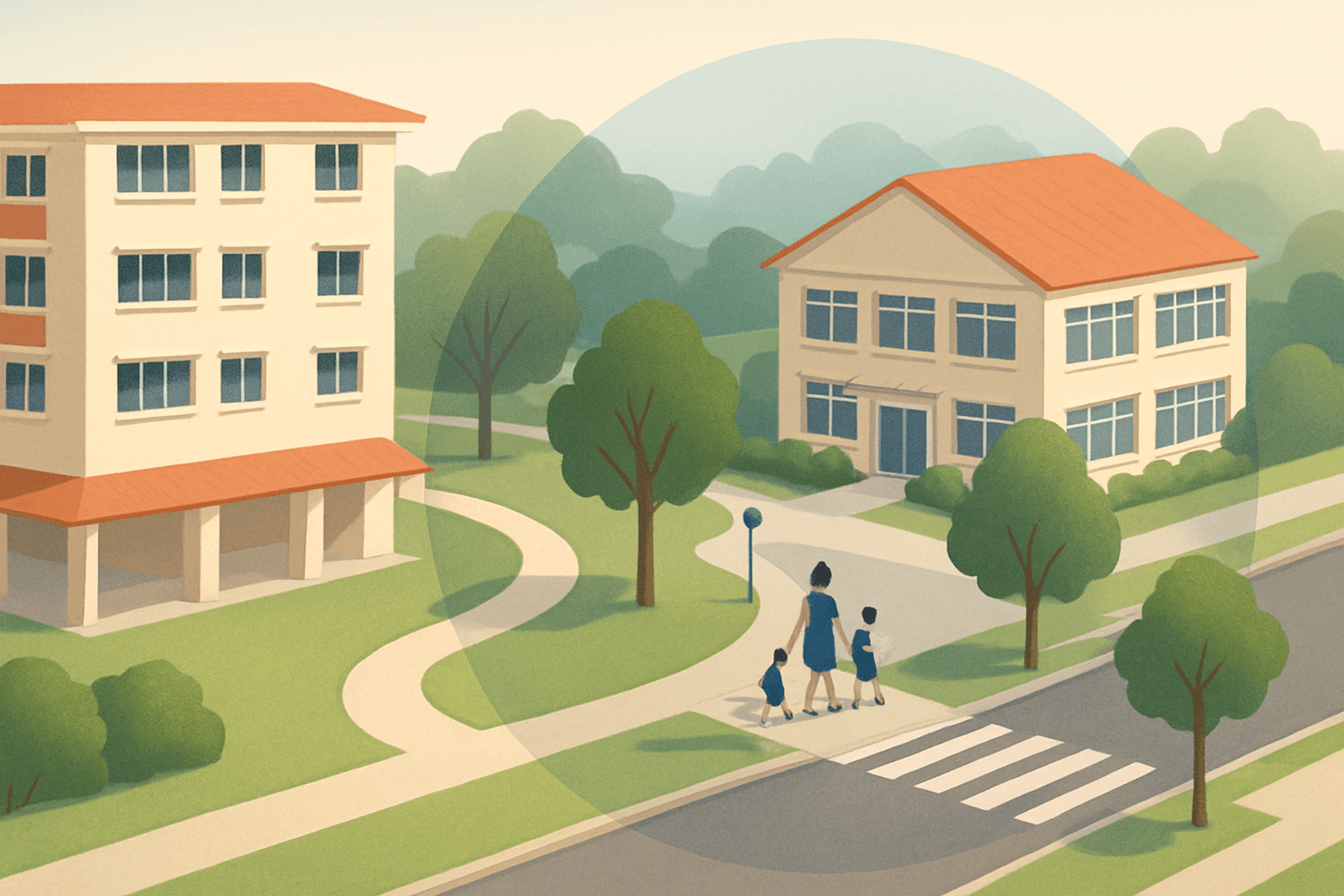
No. For P1 registration, a school being walkable does not mean your home is within MOE's official 1km band. What matters is the official band linked to your declared home address, not how near the school feels in daily life.
Short answer: is walking distance the same as 1km for P1 registration?
No. A school can be walkable and still fall outside MOE's official 1km registration band.
No. A school can be a short, easy walk from home and still not count as being within MOE's official 1km band.
This is a common parent mistake: if the school is only 8 to 10 minutes away on foot, it must be within 1km. That is not a safe assumption. For registration, the real question is not "Can we walk there comfortably?" but "Does our declared home address fall within the official band used for priority?"
Think of it this way: walkability is a family convenience question. The 1km band is a registration rule. They are related, but they are not the same thing. For a broader overview, see Primary 1 Registration in Singapore: How It Works, Balloting Risk, and How to Choose a Realistic School Plan.
*** READ ME FIRST !!! - P1 Registration FAQ ***
P1-IS is now offered for ALL participating Primary schools (see the http://www.moe.gov.sg/education/admissions/primary-one-registration/phases/ under \"Registration Procedures\" and \"Phase 2C/Phase 2C Supplementary\"). However, please note that 8 out of the past 9 years, Kong Hwa school required balloting for Singaporean Citizens under 1km in Phase 2C. I suggest that you work on an alternative school for Phase 2C instead, given that you are between 1km and 2km.
*** READ ME FIRST !!! - P1 Registration FAQ ***
Phase is Phase. Distance is Distance. The Phase you are in is affected by your eligibility, not by your distance. See MOE for a better idea: https://www.moe.gov.sg/admissions/primary-one-registration/phases
How does MOE decide whether a home is within 1km of a primary school?
MOE uses its official address-based distance check, not a parent's own estimate of the route to school.
MOE uses its own official registration distance check based on the home address declared for P1 registration. Parents should plan around that official result, not around memory, guesswork, or a route they measured themselves.
The practical takeaway is simple: if a school matters to your admission strategy, verify the band linked to the address you plan to declare. Do not assume a map app, a familiar walking route, or a short drive gives you the same answer.
For the broader registration process, our guide to Primary 1 Registration in Singapore explains how distance fits into the bigger picture, and our article on home-school distance priority shows how parents should think about proximity. MOE's own P1 registration FAQ is the safest starting point when distance affects your decision.
[Ang Mo Kio] Primary Schools
@boyz Do take note that if you are using a caregiver's address to register, you will be considered to be in the 1 - 2 km category, even if the actual distance is within 1km. Taken from http://www.moe.edu.sg/education/admissions/primary-one-registration/statutory-declaration/ : If statutory declaration is used, children who are registered using either the grandparent’s or the parent’s sibling’s address and residing within 1 km or between 1 km and 2 km of the school of choice are balloted together
*** READ ME FIRST !!! - P1 Registration FAQ ***
Can someone tell me if this rule is new starting from this year or was it around before? Extracted from MOE FAQ under Proximity to School FAQ 4. How long do we need to stay in the address used to register our child during the P1 Registration Exercise? In a small number of cases, there may be situations where the families are unable to remain at the address for the entire duration of the primary school studies. Even so, a child who gains priority admission into a school through his/her distance c
Have More Questions?
Get personalized guidance on schools, tuition, enrichment and education pathways with AskVaiser.
Try AskVaiser for Free →Why can a school feel close but still not count as "within 1km"?
Because "nearby" in daily life is not the same as an official P1 distance band.
Because daily life uses a human idea of "near," while registration uses an official classification.
Parents often judge closeness by what feels easy. The school may be in the same estate, visible from the block, or reachable through a route the family already knows well. That may be true for your morning routine and still tell you nothing definite about the official band.
A few common examples make this clearer. A school may look nearby but sit across a major road, behind other blocks, or beyond estate boundaries that change the official result. Another school may be visible from your window yet still not fall into the band parents assumed. The mistake is not preferring a nearby school. The mistake is treating that feeling of nearness as proof of registration priority. For a broader overview, see Which Home Address Counts for Primary 1 Registration in Singapore?.
*** READ ME FIRST !!! - P1 Registration FAQ ***
Hi, For those staying within 1km of school but no sibling or parents as old boy/girl, this falls under which phase? I looked through the MOE ‘Registration Phases and Procedures’ but no mention of this. Only when it comes to balloting does the 1km comes in?
*** READ ME FIRST !!! - P1 Registration FAQ ***
2A need to apply at school , so withdrawal also need to be at school. Then go over to school B for registration. Consider time for travel, withdrawal take 5-10min. Buffer 1.5 hours would be safe if driving. If you can let us know your 2C choice , we can tell you the risk. It might be worth just to go 2C
What do parents often get wrong about maps and walking routes?
Parents often confuse a short route or map result with MOE's official distance classification.
The most common mistake is using Google Maps, a familiar shortcut, or a quick drive as if it proves priority. It does not.
Map tools are useful for planning the school run. They are not the registration rule. A school that is eight minutes away on foot may still be outside the band that matters for admission. A school that is a fast drive away tells you even less, because driving time depends on roads and traffic, not on the official registration classification.
Use maps for logistics, not for admission strategy. If a school is central to your plan, do not let a screenshot or a route estimate replace the official distance check. That is especially important if you are choosing between two schools and one only looks closer on your phone. For a broader overview, see Primary 1 Registration Phases in Singapore: What Each Phase Means for Your Chances.
For Reference for P1 registration: MOE Official Letters
http://www.kiasuparents.com/kiasu/forum/viewtopic.php?p=293646#p293646 Dear Sir/Madam, Thank you for writing to us on 12 November 2010. We wish to clarify that parents using address of rented apartment will not be at a disadvantage if the school should conduct balloting. We would like to share with you that the registration is done based on the NRIC address that is reflected on the parents' NRIC at the time of registration and the address used for the registration of a child (assuming Singapore
*** READ ME FIRST !!! - P1 Registration FAQ ***
Your child will receive a brochure containing information like the schools available in Singapore and their niche areas, etc. Within the brochure, there will be registration dates. No other letters from MOE.
Why does the 1km band matter more than "nearby" when choosing a school?
Because a school can be convenient for family life without being strong for registration priority.
Because school fit and registration chance are two different decisions.
A school may be convenient for grandparents, easy for your child to reach, and sensible for your daily routine. All of that matters. But convenience does not replace the admission rules used in each phase. MOE states in its P1 registration FAQ that Phase 1 is for children whose older siblings are already studying in the school. Living nearby does not substitute for that requirement.
This is where parents often mix up two separate questions. First, is this school workable for our family? Second, is this school realistic for our registration chances? A school can score well on the first question and still be uncertain on the second. Our guides on P1 registration phases and whether an older sibling already in the school changes your chances help parents separate those two decisions properly. For a broader overview, see How to Read Past Balloting Data Before Chasing a Popular Primary School.
2013 P1 Registration Exercise for 2014 In-Take
Hi, I’m new here and am in a dilemma for P1 registration for my 2007 DD and would love to hear from fellow kiasu parents how I should strategize for P1 registration next year. I am staying <1km from MGS and 1-2km from Pei Hwa, but looking at the historical trends & esp from this year’s registration, both are very popular schools & would require balloting even within 1km. I am also an old girl of St Margaret’s but it’s really far from where I stay. Should I just send my DD back to my alma mata or
2013 P1 Registration Exercise for 2014 In-Take
Hi, You can proceed to SLA website http://www.onemap.sg/index.html to perform the followings: 1) Estimate your competition for the P1 registration using PopulationQuery feature. http://www.kiasuparents.com/kiasu/files/u59212/PopulationQuery.jpg\"> 2) Estimate the distance from the school to your residential address using the SchoolQuery feature. The use of PopulationQuery is not accurate due to the fact that distance is not a factor that Singaporean would consider when it comes to school registr
What should you do if the school is close but you are unsure about the distance band?
Verify the official band early and treat the school as uncertain until you do.
Check early and treat the school as uncertain until you confirm the official band.
In practice, that means being clear about which address you plan to declare, reading the rules that apply to that address, and not building your whole strategy around a school that only seems near. If your family has moved, is about to move, or is choosing between addresses, read which home address counts for P1 registration and how moving house affects the address used before assuming the distance will help.
This matters because address declarations are not a casual detail. MOE has publicly addressed address verification under the primary school registration proximity policy and action taken on fraudulent declarations and Primary 1 registration non-compliance. The practical parent lesson is simple: use the correct address, verify early, and keep at least one backup school in view while you confirm the details.
2013 P1 Registration Exercise for 2014 In-Take
Hi all, quite nervous on this year’s P1 registration. Living in Jurong, fall in 1-2 km from Rulang PS, do you think any chance for P2B within 1-2 Km? Or I should forget about it as I see last year even within 1km need ballot? Headache…
2013 P1 Registration Exercise for 2014 In-Take
Seems like you have already answered your own question. Anyway, no harm monitoring the situation. Have a backup plan.
If you are just outside the band, how should you think about that school?
If you are outside the official band, think of the school as a stretch option rather than a likely one.
Treat it as a stretch choice, not a safe choice.
That does not mean you must rule it out. If your family strongly prefers the school, you may still decide it is worth trying. But if distance was the main reason you thought you had an edge, being outside the official band changes the risk. For a heavily subscribed school, being just outside can matter much more than parents expect.
The practical rule is this: one close school is not a plan on its own. Pair any stretch choice with alternatives you would genuinely accept. If you are trying to judge risk, it is often more useful to study past balloting patterns and compare them with a popular dream school versus safer nearby school mindset than to keep debating whether the walk feels short.
2013 P1 Registration Exercise for 2014 In-Take
Hi mummies, I just checked on MOE website with regards, to the registration phases and am confused that in phase 2C and 2Cs, the website merely described that those in these phases are for students who haven’t register as yet and no mention on the distance of home from respective schools. Does the distance 1km, 1-2km etc still be counted during balloting? For example, they won’t factor in the differences in distance anymore? Please help! Thanks!
2013 P1 Registration Exercise for 2014 In-Take
refer Balloting rules confirmed by MOE. There are only 3 different type of distance range(s) specified :- -\twithin 1 km -\tbetween 1 km and 2 km -\toutside 2 km \"With effect from the 2012 Primary One Registration Exercise, should the total number of applications exceed the number of vacancies for each phase from Phase 2A(1) to 2C Supplementary , priority will be given in the order of (1) children who are Singapore Citizens (SCs), followed by (2) children who are Singapore Permanent Residents (
What are the most common real-world scenarios parents misread?
A school can be walkable, visible, or convenient by transport and still not improve your priority.
One common case is the walkable school. The family has done the route before, it feels easy, and the school is clearly part of the same neighbourhood. That tells you the commute may be manageable. It does not prove your address is in the band that matters for registration.
Another is the visible school. Parents can point to the campus from a corridor, playground, or nearby block and assume that visual closeness must translate into priority. It may not. Being able to see the school and being officially within the distance band are not the same thing.
A third is the transport-friendly school. Maybe it is a quick bus ride, simple by car on the way to work, or close to a grandparent's home. Those are valid family reasons to like the school, but they are logistics, not priority. MOE's forum reply on easing school congestion is a useful reminder that how children travel to school and how proximity is used in registration are separate issues.
The last common case is the recently moved family. Parents assume the new place automatically makes the school a safer choice. The real question is not whether the move feels like it should help. It is which address counts for registration and what official band that address falls into.
Questions on new rules of P1 registration
With the announcement of the new rules of P1 registration - that citizens now have advantage over PRs, I have 2 questions: 1. Does the living distance to the school matter (ie 1 km away)? 2. If the PR has an older child in the school already, is priority given to the child’s younger sibling? Thanks!
*** READ ME FIRST !!! - P1 Registration FAQ ***
GENERAL 0. This Forum will only allow you to post REPLIES to existing threads. You will NOT be able to create New Topics. If you think you cannot find a relevant thread to post your query to, please use this http://www.kiasuparents.com/kiasu/forum/viewtopic.php?t=31485 . We seek your understanding on this matter. Thank you. 1. Bookmark this: http://www.moe.gov.sg/education/admissions/primary-one-registration/ . All you need to know about the P1 Registration Exercise for next year's P1 going chil
The simplest way to remember the rule
Walkable is not the same as eligible.
Walkable is not the same as eligible.
Before you ask how long it takes to walk to the school, ask whether your declared home address falls within MOE's official band for the phase that matters to you. Commute convenience is a family decision. Registration priority is a rules decision.
2013 P1 Registration Exercise for 2014 In-Take
For those using grandparents address, like staying together with grandparents but grandparents are not the main care taker, got maid to take care the child, is registration under within 1 km or 1-2km?
2013 P1 Registration Exercise for 2014 In-Take
http://www.moe.gov.sg/education/admissions/primary-one-registration/allocation/ taken from above link Example 1: School A has 50 vacancies in a specific phase and 61 children applying, based on the table below. Home-School Distance Singapore <1km Citizen / Permanent Resident 38 / 3 Between 1km and 2km Citizen / Permanent Resident 10 / 1 >2km Citizen / Permanent Resident 8 / 1 SCs / PRs Total 56 / 5 As the total number of SC applications exceeds the number of vacancies, not all SC applicants will
Have More Questions?
Get personalized guidance on schools, tuition, enrichment and education pathways with AskVaiser.
Try AskVaiser for Free →