
Can Singapore PR Children Register for Primary 1? What Parents Should Know
Yes, PR children can register for Primary 1. The bigger issue is how much priority they get when places are tight.
Yes. A PR child can participate in Singapore's Primary 1 registration exercise. But PR children are generally not in the same priority position as Singapore Citizen children when places are limited, so school demand matters a lot. If a school has enough vacancies, a PR child may get in without much difficulty. If the school is oversubscribed, PR families are often competing for whatever places remain after higher-priority applicants are placed.
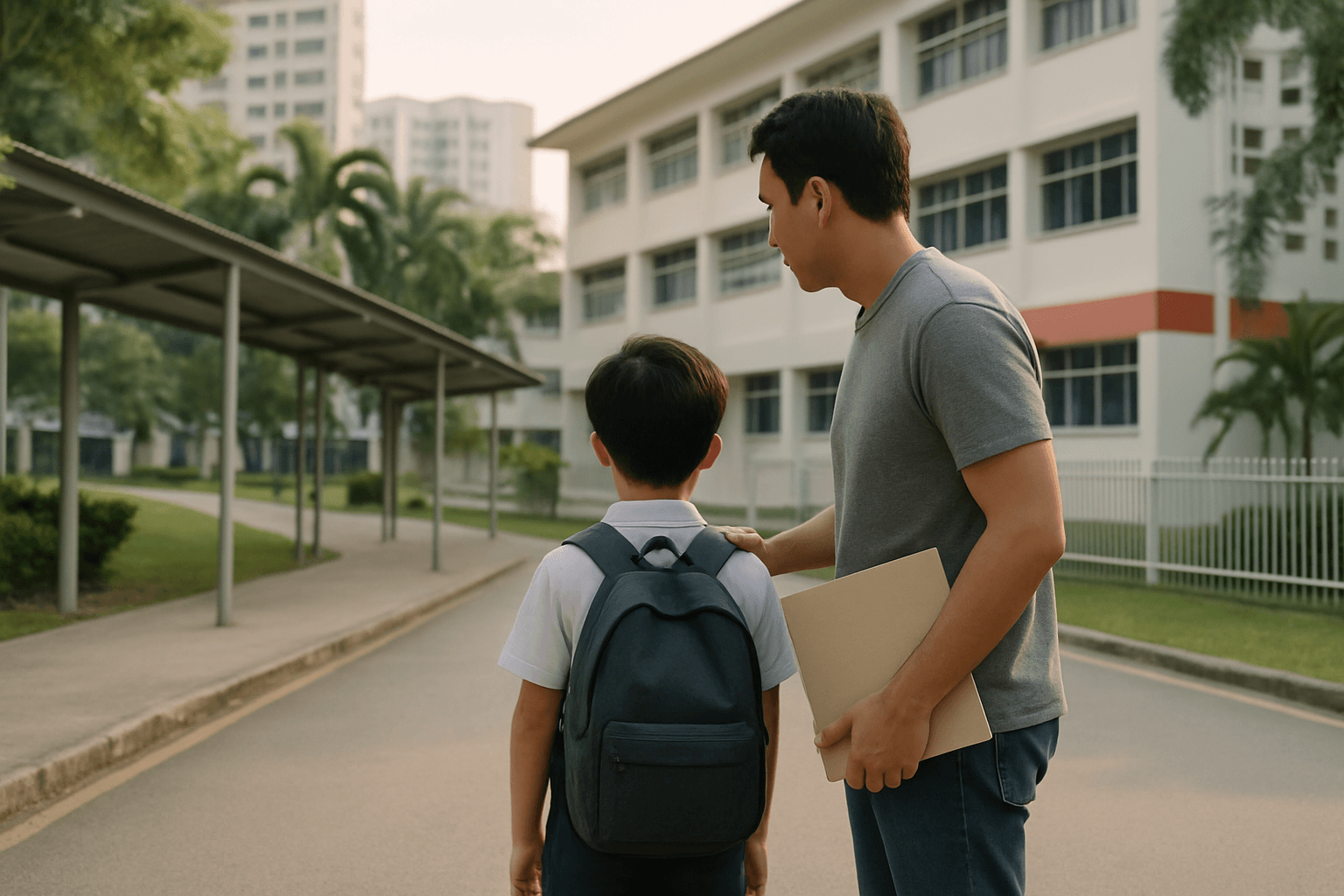
Yes. A Singapore Permanent Resident child can take part in Singapore's Primary 1 registration exercise. The more important question for most parents is not whether the child can register, but how realistic the chosen school is once priority groups and limited vacancies are taken into account. In plain terms: a PR child may be allowed to register, yet still face a much harder path into a popular school than a Singapore Citizen child.
Can a Singapore Permanent Resident child register for Primary 1?
Yes. A PR child can register for Primary 1 in Singapore.
Yes. A Singapore PR child can take part in Singapore's Primary 1 registration exercise. That is the direct answer many parents need first. The part to plan carefully is admission chance, because being allowed to register is not the same as having a strong chance at every school.
A useful way to think about it is this: PR families can participate in the process, but they should judge each school by how full it is likely to be, not just by whether registration is open. A less competitive neighbourhood school and a heavily sought-after school can feel like completely different exercises for the same child. If a school still has vacancies when your child is considered, PR status may not be a major barrier. If the school fills up early, the competition becomes much tougher. For the wider process, see our Primary 1 Registration in Singapore guide.
Give citizens priority in Primary 1 registration
http://www.guidemesingapore.com/permanent-residence/singapore-pr-pros-and-cons.htm Quote from above : If your children are school-aged, they are high on the priority list, behind citizens, to enter public schools of your own choosing. Non PRs are at the bottom of the list and are often left with no choice when it comes to schools.
Give citizens priority in Primary 1 registration
Ha.ha. maybe next time the P1 registration phase can propose like that, just a suggestion: Phase 1 – Existing siblings in the Primary school except PR siblings. Phase 2A(1) – No Change Phase 2A (2) – No Change Phase 2B – No change Phase 2C – Singapore Citizenship Only. Phase 2C Supplementary - Singapore Citizenship Only Phase 3A – Permanent Residents Phase 3A Supplementary - Permanent Residents Phase 4 – Non Citizen.
How are PR children treated in the Primary 1 registration process?
PR children can apply, but they are generally lower priority than Singapore Citizen children when places are tight.
The practical rule of thumb is simple: PR children are generally not in the same priority position as Singapore Citizen children when places are limited. Think of the process as a queue, not a flat pool of applicants. If a school has enough vacancies for everyone, that difference may not matter much. If the school is oversubscribed, it matters a lot.
This is why two PR families can have very different outcomes. One may secure a place at a school with steady vacancies, while another struggles at a popular school even if the home is nearby. Many parents focus only on whether they are eligible to register. A better question is: how many places are likely to remain by the time lower-priority applicants are considered? Insight line: eligibility gets you into the process; priority decides what happens when the school fills up. For a broader overview, see Primary 1 Registration Phases in Singapore: What Each Phase Means for Your Chances.
Give citizens priority in Primary 1 registration
Not sure if this has been mentioned in KSP forum? From 2010, Singapore Citizens (SCs) will be given an additional ballot slip (i.e. two chances instead of one), while Permanent Residents (PRs) will retain one ballot slip whenever balloting is conducted by any school during the P1 Registration Exercise. SCs will therefore have a higher chance of securing a place for their child in a school of choice when there is balloting. Giving Singaporeans two chances during balloting will retain the underlyi
Give citizens priority in Primary 1 registration
BTW I wrote ths to ST but it never got posted: In her letter, Mrs Agawal have hit the gist of why PR students should not be given equal chance for Primary 1 registration. She says that if her children were unable to secure a place in a good public school, why would her family to stay? A Singpore citizen will never be able to say that. We are here to stay and as such deserve the right to choose before a permanent resident. My son, a 4th generation Singaporean, was not able to secure a place in a
Have More Questions?
Get personalized guidance on schools, tuition, enrichment and education pathways with AskVaiser.
Try AskVaiser for Free →Which Primary 1 registration phases matter most for PR families?
Focus less on phase names and more on how many places are likely to remain when your child is considered.
The phases that matter most are the ones where your child is competing for places that are still left after higher-priority applicants have been placed. You do not need to memorise every phase name first. You need to understand vacancy flow.
When MOE publishes the current year's registration details, focus on two practical questions: when your child is likely to be considered, and how many places are usually left at that point. That is more useful than treating all schools the same. A school with spare capacity can still be realistic for a PR child even if the family is not in the strongest priority group. A school that is often full early is a much riskier choice. If you want the official starting point for current-year materials, MOE's site map is a safe place to navigate from. For a parent-friendly explanation of the process, read our guide to Primary 1 registration phases in Singapore. For a broader overview, see Primary 1 Registration: Should You Pick a Popular Dream School or a Safer Nearby School?.
All About Pri 1 Registration for Foreigners & Phase 3
The child is currently in K1 and going K2 next year as such I have seen that we should indicate interest for primary 1 during next year June or July for the kids.[/quote]There are a couple of things you will need to or can do: 1. Assuming nothing much (as in status) changes, wait for MOE announcement and indicate your interest for participating in Phase 3. Take note that the child will be treated as a foreigner and there is no special privileges given, ie, there’s a possibility that the child wi
Preparing Your Child for Primary School:Parent Seminar - MOE
Preparing Your Child for Primary School: A Parent Seminar by MOE Starting primary school is a big step in your child's life. To help you better understand primary school programmes and enable you to make key education decisions, the Ministry of Education will be conducting a seminar on Primary School Education. At the seminar, parents can look forward to sharing sessions by the school principal and a parent volunteer, as well as view the various programmes our primary schools provide. The Primar
What does 'remaining places' mean for PR children?
It means the vacancies left after higher-priority children have been placed.
"Remaining places" means the vacancies left after children in higher-priority groups have been allocated places. This is the idea many PR parents need to understand early, because it changes how you judge a school's realism.
A simple example helps. Imagine a school starts with 100 available places. If earlier groups take 90, later applicants are effectively competing for the last 10. If earlier groups take all 100, there may be no room left for lower-priority applicants at that school. The point is not that PR children are shut out everywhere. The point is that at some schools, the contest begins only after many seats are already gone.
That is why past demand matters. Historical patterns do not guarantee this year's outcome, but they can warn you when a school regularly becomes tight early. If you want to pressure-test a shortlist, compare current hopes against past competition patterns using our guide on how to read past balloting data before chasing a popular primary school and this community reference on past balloting probability trends. For a broader overview, see Primary 1 Registration Unsuccessful: What Happens If You Do Not Get Your Preferred School.
School Placement Exercise for returning S'porean children
Singaporean children returning from overseas and wishing to join secondary schools and junior colleges at the start of the academic year in 2010 can register for the School Placement Exercise from August 3. http://www.moe.gov.sg/education/admissions/returning-singaporeans/
Give citizens priority in Primary 1 registration
Sharing with you the below blog entry from http://mrwangsaysso.blogspot.com/ on the same topic. Education, and Even More Discrimination Against Citizens ST Aug 20, 2009 Thanks, being a PR is good enough IN RESPONSE to letters by Mr Jimmy Loke ('The PR difference', last Saturday) and Mr Chia Kok Leong ('No school, no Singapore', last Saturday), I would only ask them to refer to Minister Mentor Lee Kuan Yew's speech reported last Friday ('MM: Foreign talent is vital'), where he gave an idea of the
Why a popular school may still be a weak plan for a PR child
A popular school can be a reasonable hope, but usually not a safe only plan for a PR family.
A famous school may still be worth trying, but it is usually a weak single-plan strategy for a PR family if demand is consistently high. School reputation does not improve admission priority. If your whole plan depends on one oversubscribed school, you are not really making a school choice. You are accepting a high-uncertainty outcome.
Treat a popular school as a stretch option, not your only option. If you are weighing aspiration against security, this comparison can help: Should you pick a popular dream school or a safer nearby school?. For a broader overview, see How to Read Past Balloting Data Before Chasing a Popular Primary School.
All About Preparing For Primary One
the standard of kindergarten and child care centres in SG varies from one another. Some kindy prepare kids well for P1, but other kindy not sufficient. The standard varies. moreover, P1 standard is getting higher and higher, each year. that is why some parents still prefer to send kids for P1 Prep course. if you think you come from a kindy where then standard is reasonable, then ok.
All About Preparing For Primary One
Starting primary school? This is a big milestone. Do enjoy the journey with your child! :rahrah: https://www.straitstimes.com/singapore/education/the-st-guide-to-preparing-your-child-for-primary-1 Parents often confuse being ready for school with being academically capable in skills like reading and counting. Instead of focusing solely on academic progress, it is more important to make learning an enjoyable process, and help your child have a swift and happier adjustment to primary school. Here
What should parents consider before choosing a Primary 1 school for a PR child?
Choose based on both admission realism and everyday family logistics, not school reputation alone.
Start with realistic admission odds, then look at daily life. Many parents reverse that order. They fall in love with a school's name first, then discover later that the chance of getting in is weak and the commute is punishing.
A useful way to shortlist schools is to think in three buckets: one stretch option, one realistic option, and one safer option. Then compare not just reputation, but also travel time, morning routine, after-school logistics, and how the school has tended to perform under registration pressure. A nearby school with stable vacancies can be the stronger family choice than a famous school that is far away and regularly tight.
Also check any factors that may affect your position, such as whether an older child is already in the school, whether your home address is clear and supportable, and whether distance could still matter if places are tight. Parents often underestimate how much admin details and daily travel shape the real outcome. These guides can help you test your shortlist more realistically: distance priority, which home address counts, popular versus neighbourhood schools, and whether an older child in the school helps the younger one.
All About Preparing For Primary One
You should have seen the way the mum drilled the poor child, depriving him of food till he completed his revision. Obviously, an uninterested child will only retain the information into his short term memory. Preparing a child for primary 1 is more than just the academics. There are several areas that parents have to take note of. Does your child know how to clean up after himself if he does a big business in the toilet? Does your child know how to wash his hands correctly and rinsed his hands p
All About Preparing For Primary One
Was surfing around on understanding if I am well prepared on behalf of my DD1 for Primary 1 Chanced upon a few websites, thought to share though it could have been mentioned before Tips For Parents ◦Work on independent reading skills. ◦Set up a study area and regular study times that are not interrupted. ◦Learn to follow a routine with a lot of sleep and early mornings. ◦Practice organisation and planning by packing a daily bag with essentials for the day. ◦Talk about social skills and communica
How should you plan if your preferred school is oversubscribed?
Have a backup school and a clear fallback plan before registration starts.
Prepare your backup before registration opens, not after disappointment. For most PR families, the safest plan is not "one dream school and hope for the best." It is a clear decision tree made early.
A practical example: one family may try for a sought-after school near grandparents because childcare support would be useful, but keep a nearer neighbourhood school as the realistic fallback. Another family may decide the uncertainty is not worth it and lead with the safer school from the start. Both are reasonable. The common mistake is entering the exercise without deciding what matters more to you: prestige, proximity, support network, or certainty.
Insight line: do not let oversubscription make the decision for you. Choose your fallback while you are calm, compare travel time honestly, and decide in advance whether a low-probability school is still worth the risk. If you want to think through the fallback scenario, read what happens if you do not get your preferred school.
All About Preparing For Primary One
Dear parents, I hope parents could share your experience regarding the preparation for primary school and time schedule spend with your kids everyday. I have a son of 6 this year going to P1 next year. I would like to find out with parents things that you are doing with your child prior going P1, cos I do not want to react too kan-jiong or too relax in front of my child. I am particularly concerned about the 3 main subjects being taught in P1 and wonder should I expect him to be able to do the a
All About Preparing For Primary One
Isn’t pre-school and kindergarten is prep for P1? Or are there still many in SG who donch go to kindy?
What should parents prepare before Primary 1 registration?
Prepare identity, PR, parent, and address information early, plus a realistic school shortlist.
- ✓Prepare the child's identity details and PR-related records early. These are common examples parents keep ready, not an official exhaustive checklist.
- ✓Prepare both parents' particulars and working contact details so you are not scrambling during the registration window.
- ✓Prepare address proof and make sure the address you plan to use is consistent across your records.
- ✓Prepare any school-specific forms or supporting documents if a school or process asks for them.
- ✓Prepare a simple shortlist with a first-choice school and at least one realistic backup.
- ✓Prepare for address questions early if you have moved recently or expect to move soon.
- ✓Prepare by reviewing our guide on [commonly prepared registration documents](/blog/primary-1-registration-documents-checklist-what-singapore-parents-commonly-prepare) and our guide on [using your old or new address after moving](/blog/primary-1-registration-after-moving-house-old-or-new-address).
- ✓Prepare by not confusing first-time Primary 1 admission with transfer routes for older primary pupils; MOE's primary school transfer FAQ covers a different process.
Will my PR child have the same chance as a Singapore Citizen child?
No. In oversubscribed schools, PR children generally do not have the same chance as Singapore Citizen children.
No. When places are limited, a PR child is generally not in the same priority position as a Singapore Citizen child. That difference may not matter much in a school with enough vacancies, because both children may still secure a place. But in a popular school, the priority gap becomes much more important because places may be filled before lower-priority applicants are considered.
The practical takeaway is simple: compare schools by likely availability, not just desirability. If you are still checking the basics, our guide on who is eligible for Primary 1 registration in Singapore is a useful next step.
Give citizens priority in Primary 1 registration
An example of PRs having priority over citizens (in a way): De La Salle Primary school does not accept PVs, and I know of Catholic PRs who got in under Phase 2B whilst Singaporeans (non Catholics) don’t even have a chance at phase 2B!!
Give citizens priority in Primary 1 registration
2nd generation PRs need to serve NS so their kids and our kids are sort of on equal stand on this point. We do have families who give up citizenship and move to another country because of NS too. Yes, the PRs may not stay…the citizens may not stay too. If you are the government, you just got to try your best to make your citizens happy(tough challenge) and yet not penalise the PRs too much Let say we don’t have many ‘foreign talents’…our birth rates are impressive…and our children are balloted o
Have More Questions?
Get personalized guidance on schools, tuition, enrichment and education pathways with AskVaiser.
Try AskVaiser for Free →