
Is Living Within 1km Enough for PR Families in P1 Registration?
Usually not on its own. For PR families, 1km helps only when the child is eligible for the right phase and the school still has places left.
No. For PR families, being within 1km can strengthen a Primary 1 application, but it does not guarantee admission. Distance is only one factor; phase eligibility, remaining vacancies, school demand, and a genuine address all matter.
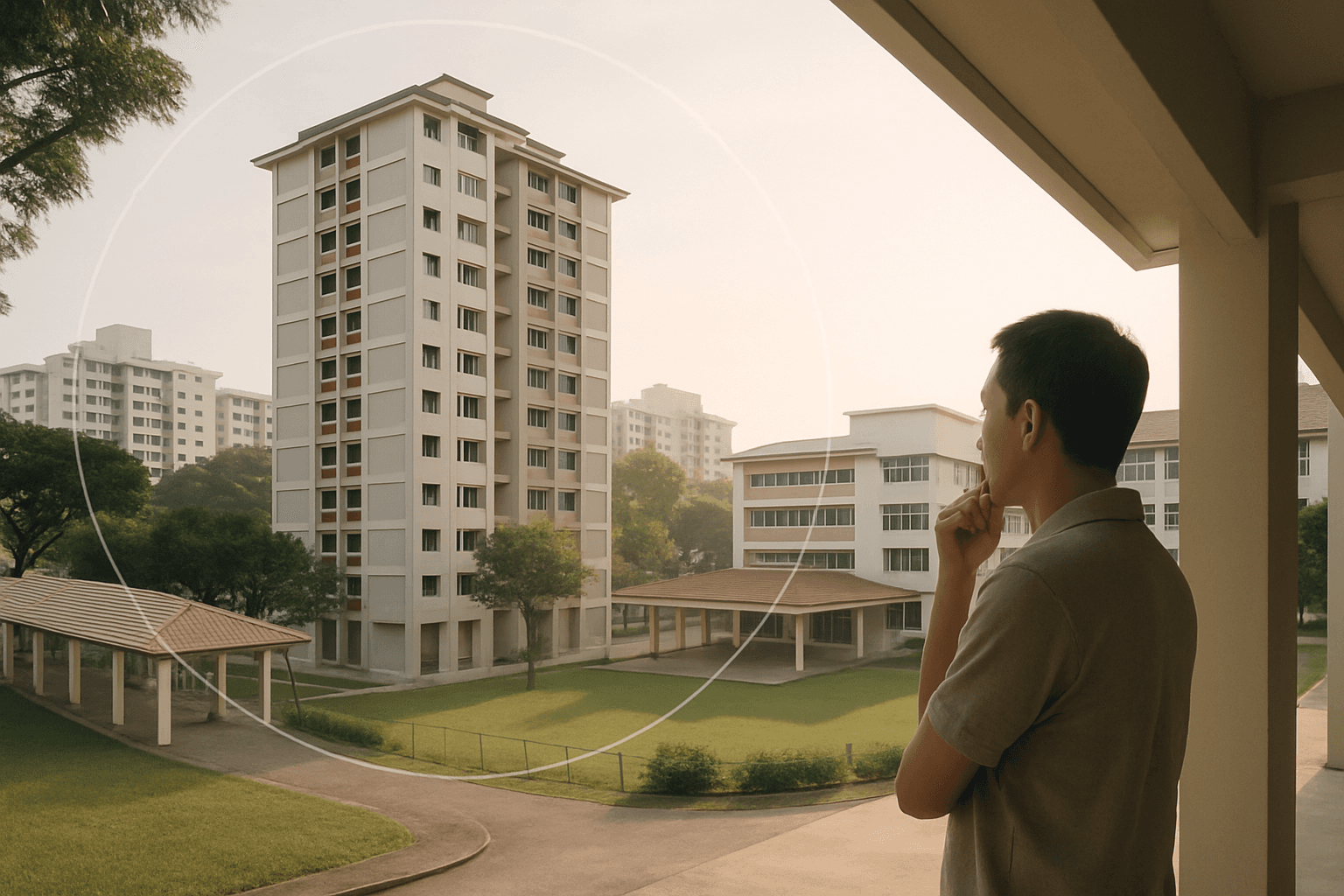
No. Living within 1km is helpful, but it is usually not enough on its own for a PR family to secure a Primary 1 place. What matters is the full picture: which phase your child can enter, whether the school still has vacancies at that stage, and how many other nearby families are competing for the same places.
Short answer: is living within 1km enough for PR families in Primary 1 registration?
No. A 1km address can help a PR family, but it is not enough on its own to make a school a safe bet.
Usually no. For PR families, living within 1km is a useful advantage, but it is not a promise of a seat.
The practical question is not just whether your child is close to the school. It is also whether your child can enter at the right phase, whether the school still has vacancies by then, and how many other families are in the same distance band. At a school with manageable demand, a 1km address can improve your chances. At a very popular school, it may only place you among many equally close applicants.
A simple way to think about it is this: distance can help you compete, but it cannot create places that are already full. If you want the broader picture first, start with our Primary 1 Registration in Singapore guide and then read how home-school distance works.
Questions on new rules of P1 registration
With the announcement of the new rules of P1 registration - that citizens now have advantage over PRs, I have 2 questions: 1. Does the living distance to the school matter (ie 1 km away)? 2. If the PR has an older child in the school already, is priority given to the child’s younger sibling? Thanks!
*** READ ME FIRST !!! - P1 Registration FAQ ***
Can someone tell me if this rule is new starting from this year or was it around before? Extracted from MOE FAQ under Proximity to School FAQ 4. How long do we need to stay in the address used to register our child during the P1 Registration Exercise? In a small number of cases, there may be situations where the families are unable to remain at the address for the entire duration of the primary school studies. Even so, a child who gains priority admission into a school through his/her distance c
How does MOE Primary 1 registration work for PR families?
P1 registration is phase-based. Distance helps only within the phase your child can actually enter; it does not create eligibility by itself.
Primary 1 registration is organised in phases, so entry is not decided by distance alone. That is the first thing many parents overlook when they start planning around a nearby home.
MOE states in its FAQ that living within 1km does not qualify a child for Phase 1. Phase 1 is for children whose older siblings are already studying in the school. MOE also says that if you miss the phase your child was eligible for, you may still register in the next eligible phase, but you do not keep the earlier priority.
For parents, the key takeaway is to identify your child’s real entry point before looking at the map. Once you know that, ask whether the school usually still has places at that stage. A nearby address only helps within the phase and competition level that actually apply to your family. For a fuller refresher, see our guides to Primary 1 registration phases and who is eligible for Primary 1 registration.
*** READ ME FIRST !!! - P1 Registration FAQ ***
P1-IS is now offered for ALL participating Primary schools (see the http://www.moe.gov.sg/education/admissions/primary-one-registration/phases/ under \"Registration Procedures\" and \"Phase 2C/Phase 2C Supplementary\"). However, please note that 8 out of the past 9 years, Kong Hwa school required balloting for Singaporean Citizens under 1km in Phase 2C. I suggest that you work on an alternative school for Phase 2C instead, given that you are between 1km and 2km.
*** READ ME FIRST !!! - P1 Registration FAQ ***
Phase is Phase. Distance is Distance. The Phase you are in is affected by your eligibility, not by your distance. See MOE for a better idea: https://www.moe.gov.sg/admissions/primary-one-registration/phases
Have More Questions?
Get personalized guidance on schools, tuition, enrichment and education pathways with AskVaiser.
Try AskVaiser for Free →Why 1km can help, but still not be enough
1km matters most when the school still has places in your child’s phase and demand is not extreme.
Distance is most useful when there are still enough vacancies left in the phase your child can join. In that situation, being within 1km can move your application ahead of families who live farther away.
But that advantage shrinks when the school is very popular. A well-known school in a dense estate may attract many families who are also within 1km, so your address does not separate you from the crowd. Timing matters too. If most places are already taken before your child’s realistic phase, proximity cannot do much.
Distance helps most when it narrows a small pool of applicants, not when it drops you into a crowded one. That is why parents should look at past demand patterns, not just the map. Our guide on how to read past balloting data can help you judge that more calmly. For a broader overview, see Primary 1 Registration Distance Priority: How Home-School Distance Works.
Share with us your kid's P1 registration experience
Funtastic4, RGPS finally had 117 applicants >2km fighting for 51 places under phase 2C (after 26 applicants <2km admitted). For my case, I had a daughter borned in year 2002. From 2005 onwards, we were closely monitoring the P1 registration stats, keeping all the records ourselvs as MOE dont retain them. Since my mil stayed near HPPS, we decided to enrol our child there. We were prepared to move <1km of the school. However after studying the stats, we discovered that HPPS needs balloting under p
*** READ ME FIRST !!! - P1 Registration FAQ ***
2A need to apply at school , so withdrawal also need to be at school. Then go over to school B for registration. Consider time for travel, withdrawal take 5-10min. Buffer 1.5 hours would be safe if driving. If you can let us know your 2C choice , we can tell you the risk. It might be worth just to go 2C
When living within 1km is more meaningful for a PR child
1km is more useful when the school is not heavily oversubscribed and your child is applying in a phase where vacancies still remain.
A 1km address is more meaningful when the school has steady demand rather than extreme oversubscription. In that setting, proximity can be a real advantage instead of just a reassuring detail.
A common example is a neighbourhood school that parents like for convenience, routine, or school culture, but which is not among the few schools almost every nearby family targets. Another example is a school where places have historically still been available by the time your child’s eligible phase comes around. In those cases, distance can genuinely strengthen your plan.
This is also where practical family life matters. A school that fits your morning routine, caregiver support, and transport pattern is often a better choice than a more famous school that is both harder to enter and harder to manage. If you are weighing that trade-off, our piece on popular primary school vs neighbourhood school in Singapore may help. For a broader overview, see How to Read Past Balloting Data Before Chasing a Popular Primary School.
*** READ ME FIRST !!! - P1 Registration FAQ ***
Hi, For those staying within 1km of school but no sibling or parents as old boy/girl, this falls under which phase? I looked through the MOE ‘Registration Phases and Procedures’ but no mention of this. Only when it comes to balloting does the 1km comes in?
*** READ ME FIRST !!! - P1 Registration FAQ ***
Yes, a new rule. last year (2014) P1 registration : no mention of 30 months only this year (2015) : then, start mention Once 30 months limit been announced : many people may start to use this new rule, in whichever Phase they are in that involve balloting. Example Suppose parents staying outside 2 km need to ballot in Phase 2A2 (old girls) With this new rule kicked in : these affected parents (outside 2 km) can now start to rent houses within 1 km, for 30 months (middle of Primary 3) This way, t
When 1km may not be enough even if you are close
At very popular schools, a 1km address may still leave a PR family with a real risk because too many nearby applicants are competing for limited places.
At highly popular schools, being close may still not be enough. The simple reason is that many other families want the same school, and many of them may also live nearby.
This is where parents sometimes overestimate what distance can do for a PR child. If a school is usually oversubscribed, a 1km address does not remove the fact that competition is happening inside a phase-based system and among a large pool of close applicants. In practical terms, some schools are so contested that even living a few blocks away still leaves a real risk of not getting in.
The school being near your home does not automatically make it a realistic choice. The better question is whether your child is entering at a point where proximity still has a strong effect on the outcome. If not, the school remains a risk choice even if you can see it from your window. For a broader overview, see Which Home Address Counts for Primary 1 Registration in Singapore?.
*** READ ME FIRST !!! - P1 Registration FAQ ***
Yes, but that presupposes that there are seats left in the school for P2A2. Your NRIC must show the registration address. Otherwise, you must show documentary proof that your property will be ready for occupancy by the time your child starts P1.
Give citizens priority in Primary 1 registration
Why should PRs compete equally with citizens in phase 2C? For some parents, they may want to do PV with their choice school, but in certain schools, it is very hard to be PV unless they have something which the school is looking for. Also, there are schools which do not have the PV scheme. These parents would have no choice but go to phase 2C. Under 2C, can you imagine if the child is staying near a school that happens to be very popular, and there are no other good schools nearby, or maybe all
What parents often misunderstand about distance priority
The common mistake is treating 1km as a guaranteed entry ticket instead of a limited advantage.
Two mistakes come up often. First, living within 1km does not qualify a child for Phase 1. MOE says in its FAQ that Phase 1 is for children whose older siblings are already in the school. Second, not every 1km case is equally strong. A 1km address at a school with steady demand can be useful, while the same 1km address at a very crowded school may still be shaky.
Nearby is helpful, not decisive.
All About Getting Priority Registration
1st time Pri 1 application for 2021. Does proximity count for affiliated primary school registration? I am getting clarifications from the SMPS if I qualified under 2(A)2 and using a new property address. If I qualify for 2(A)2, then it will be 1-2km for St Margaret’s Pri School. Or should I try for 2C <1km for Holy Innocents Primary School? Which has a better chance? Please share your opinions. Thank you.
All About Getting Priority Registration
http://www.straitstimes.com/BreakingNews/Singapore/Story/STIStory_579675.html \"THE current Primary 1 registration process will not be changed to give higher priority to children living very near to their school of choice - even if they live right across the street from it.\" :stupid: :stupid: :stupid: :stupid: Sad lah....
What should I do if the school is within 1km but highly contested?
If the school is within 1km but very popular, treat it as a risk choice and line up a realistic fallback before registration opens.
Treat it as a risk school, not a safe school. That mindset helps parents plan more realistically.
Start by looking at whether the school has historically been tight in registration exercises and whether that pattern seems repeated rather than occasional. Then separate preference from necessity. If the school is five minutes away and fits your daily routine, you may still decide the risk is worth taking. But if it is mainly a prestige choice, a second school that is slightly farther away but much more realistic may be the better family plan.
Most parents regret not preparing a backup early. If you are comparing a dream school with a steadier option, our guides on popular dream schools versus safer nearby schools and what happens if you do not get your preferred school can help you think through the trade-off. MOE does receive appeals for P1 registration, but an appeal should never be the main plan.
Share with us your kid's P1 registration experience
P1 registration experience… On the 1st day, went to the 1st choice school in the morning of 2/Aug to register… Actually I wanted to go on the last day to better gauge the chances as I was staying between 1-2km but the other half keep pestering me to go early… many parent still don’t understand the concept of balloting and priority and 3 days registration period… no sure why they always have the belief of 1st-come-1st-serve go later no place misconception even after much much explanation… No choi
*** READ ME FIRST !!! - P1 Registration FAQ ***
You will feel you are kiasu until you realise that for anyone to get Phase 2B priority and living <1km, you must perform PV duties or be a clan member for at least 1 or 2 years, and plan to move just in time for P1. So actually, you are just in time. Some people call it prudence. Sour grapers call it kiasu. Does it really matter?
How should I think about a backup school plan?
Build your backup school plan early, and choose a school that works for real weekday life, not just registration-day anxiety.
A backup school is not the school you settle for. It is the school your family can genuinely live with on an ordinary Tuesday morning.
That means thinking beyond reputation. Can your child get there without an exhausting commute? Does it work with sibling drop-off, grandparent help, or before-school care? Would you still feel comfortable if your first choice does not work out? For many families, the best backup is not the second-most-famous school nearby. It is the school that keeps daily life manageable.
Choose that backup before registration starts, not after your first choice becomes unrealistic. If your address may change because of a move, use only a genuine address that reflects where your family is actually living or will be living in a supportable way. MOE has said it takes a serious view of Primary 1 registration non-compliance. If this applies to you, read our guides on which home address counts, whether to use your old or new address after moving house, and our documents checklist that parents commonly prepare. The documents article covers common examples, not an official exhaustive MOE list.
*** READ ME FIRST !!! - P1 Registration FAQ ***
Can someone advise me? I am living within 1km of a school i hope to register my kid in, but i have no PV, clan, church, sibling etc. Which phase do I fall under? Phase 2C? Do I only go down to the school to register when Phase 2C starts?
Give citizens priority in Primary 1 registration
Ha.ha. maybe next time the P1 registration phase can propose like that, just a suggestion: Phase 1 – Existing siblings in the Primary school except PR siblings. Phase 2A(1) – No Change Phase 2A (2) – No Change Phase 2B – No change Phase 2C – Singapore Citizenship Only. Phase 2C Supplementary - Singapore Citizenship Only Phase 3A – Permanent Residents Phase 3A Supplementary - Permanent Residents Phase 4 – Non Citizen.
Practical checklist before you bank on a 1km advantage
Use this checklist to see whether 1km is a real advantage in your case or just a false sense of safety.
- ✓Confirm which registration phase your child can actually enter before assuming distance will help.
- ✓Check whether the school usually still has places around that stage, not just whether the school is popular overall.
- ✓Review recent registration or balloting patterns so you know whether the school looks realistic, risky, or a long shot.
- ✓Make sure the address you plan to use is genuine, current, and supportable if questions are raised.
- ✓If you have moved or may move, compare your situation with our guides on [which home address counts](/blog/which-home-address-counts-for-primary-1-registration-in-singapore) and [whether to use your old or new address after moving house](/blog/primary-1-registration-after-moving-house-old-or-new-address).
- ✓Keep common supporting records ready, such as identity details or housing paperwork that matches your real living situation. These are examples, not an official exhaustive checklist.
- ✓Shortlist at least one backup school that works for travel time, weekday routine, and caregiver arrangements.
- ✓Do not treat 1km as a substitute for phase eligibility, demand checks, or a backup plan.
Have More Questions?
Get personalized guidance on schools, tuition, enrichment and education pathways with AskVaiser.
Try AskVaiser for Free →