
Primary 1 Registration for Foreigners in Singapore: What to Expect and How to Plan
A practical guide for non-citizen, non-PR families planning for MOE Primary 1, likely uncertainty points, and realistic backup options.
If you are a foreign family planning for Primary 1 in Singapore, verify the current MOE rules first before choosing schools or making housing decisions. In practice, that means confirming the live MOE pathway for foreign children, preparing identity and immigration documents, shortlisting schools by practicality rather than prestige, and keeping a backup school route ready because placement certainty is usually lower than it is for citizen or PR families.
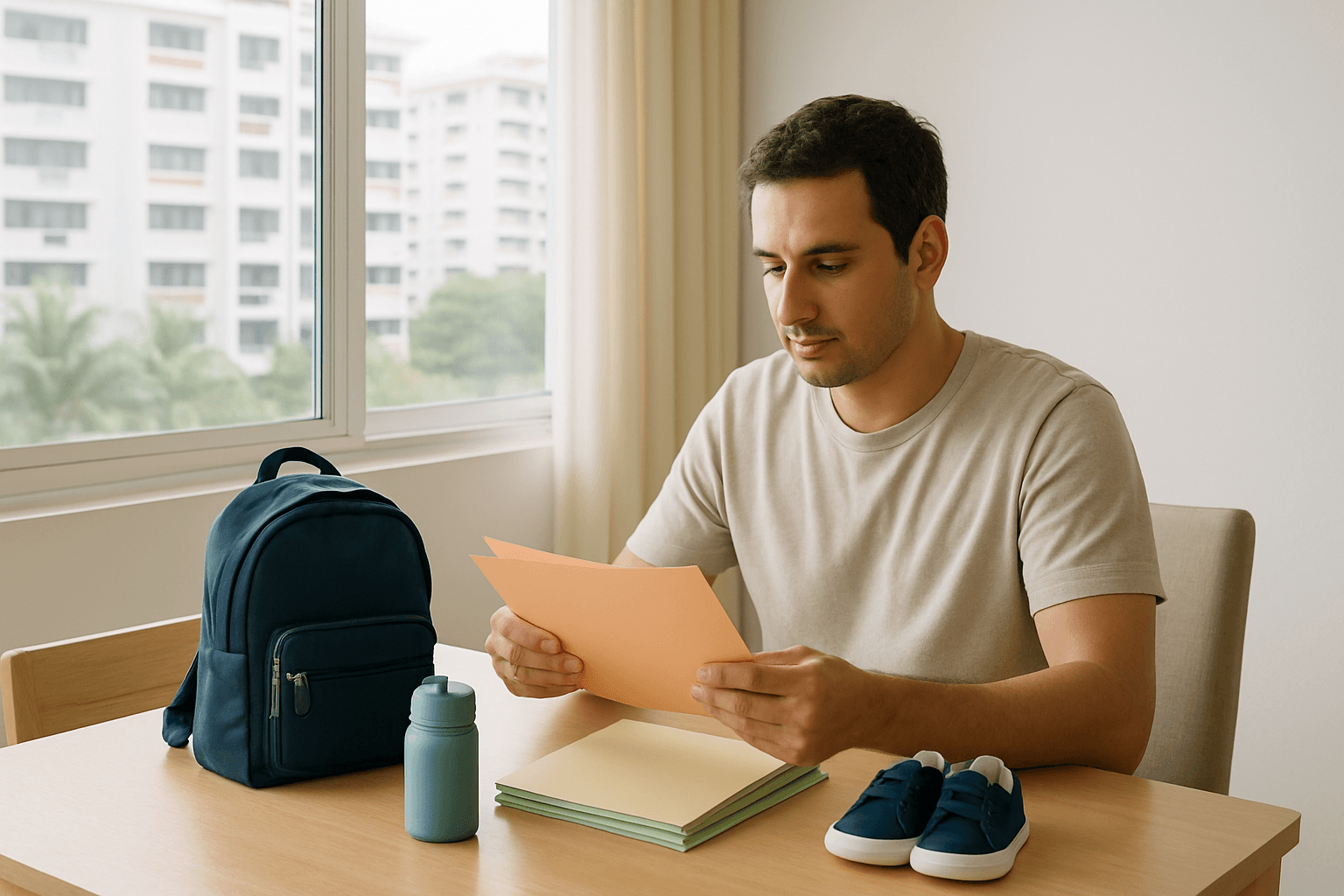
Yes, foreign families may have a route into Singapore's Primary 1 system, but you should not assume it works like the standard path used by Singapore citizens and permanent residents. Start by checking the live MOE Primary 1 guidance through the MOE sitemap, then plan around documents, realistic school choices, and a backup option if a government school place is not certain.
For many foreign parents, the biggest mistake is treating Primary 1 registration as a simple admin task. In reality, it often sits together with visa status, housing, commute, and how long your family expects to stay in Singapore. The school decision is only one part of the plan.
Can foreigners apply for Primary 1 registration in Singapore?
There may be a route for foreign children, but parents should not assume it matches the standard citizen or PR pathway. Check the current MOE Primary 1 guidance first before planning around any school.
Possibly, but do not assume the process is the same as it is for Singapore citizens or permanent residents. MOE has an official Primary 1 route, and the safest place to start is the live MOE admissions guidance accessible from the MOE sitemap. The source material here does not confirm the current exact eligibility pathway for foreign children, so parents should treat the live MOE page as the source of truth before making school, housing, or work plans.
This is the first check, not the last one. Many parents begin by comparing school reputations or commute times, then discover later that their child's status, application route, or timing is not what they assumed. If your child is not a Singapore citizen or PR, confirm the current MOE rule first, then build your shortlist around what is actually open to your family.
A simple way to think about it: eligibility comes before preference. If you want a broader overview of the local system first, start with our Primary 1 Registration in Singapore guide and our article on who is eligible for Primary 1 registration in Singapore, then compare that context against the current MOE instructions for foreign families.
All About Pri 1 Registration for Foreigners & Phase 3
The child is currently in K1 and going K2 next year as such I have seen that we should indicate interest for primary 1 during next year June or July for the kids.[/quote]There are a couple of things you will need to or can do: 1. Assuming nothing much (as in status) changes, wait for MOE announcement and indicate your interest for participating in Phase 3. Take note that the child will be treated as a foreigner and there is no special privileges given, ie, there’s a possibility that the child wi
Give citizens priority in Primary 1 registration
Ha.ha. maybe next time the P1 registration phase can propose like that, just a suggestion: Phase 1 – Existing siblings in the Primary school except PR siblings. Phase 2A(1) – No Change Phase 2A (2) – No Change Phase 2B – No change Phase 2C – Singapore Citizenship Only. Phase 2C Supplementary - Singapore Citizenship Only Phase 3A – Permanent Residents Phase 3A Supplementary - Permanent Residents Phase 4 – Non Citizen.
What does the Primary 1 process usually look like for foreign families?
In practice, foreign families usually need to confirm eligibility first, understand the current MOE cycle, prepare documents, shortlist practical schools, and keep a backup plan ready.
For foreign families, it helps to think of Primary 1 planning as a sequence of decisions rather than a single form. First, confirm whether your child can use the current MOE route. Next, understand the current registration cycle and instructions. Then prepare the documents you are likely to need, shortlist schools you can realistically live with, and keep a non-MOE backup option ready in case your preferred plan does not work out.
This sequence matters because different families face different constraints. A family on a short work assignment may care more about continuity and whether an alternative school can be arranged quickly if plans change. A family that expects to stay long term may be more willing to invest time in a government-school route, but still needs a fallback if placement is uncertain. A family that has not settled its housing yet should usually pause serious school comparisons until the address question is clearer.
The key mindset is to plan for the whole path, not just the ideal outcome. For foreign families, registration is not only about where you want your child to study. It is also about whether that school plan still works if your address, pass status, or timeline changes. If you need the broader local context, our guides to Primary 1 registration phases and what happens if registration is unsuccessful can help you frame the decision, even though foreign-family rules may not mirror the standard citizen or PR experience exactly. For a broader overview, see Who Is Eligible for Primary 1 Registration in Singapore?.
School Placement Exercise for returning S'porean children
Singaporean children returning from overseas and wishing to join secondary schools and junior colleges at the start of the academic year in 2010 can register for the School Placement Exercise from August 3. http://www.moe.gov.sg/education/admissions/returning-singaporeans/
Preparing Your Child for Primary School:Parent Seminar - MOE
Preparing Your Child for Primary School: A Parent Seminar by MOE Starting primary school is a big step in your child's life. To help you better understand primary school programmes and enable you to make key education decisions, the Ministry of Education will be conducting a seminar on Primary School Education. At the seminar, parents can look forward to sharing sessions by the school principal and a parent volunteer, as well as view the various programmes our primary schools provide. The Primar
Have More Questions?
Get personalized guidance on schools, tuition, enrichment and education pathways with AskVaiser.
Try AskVaiser for Free →What status, documents, or approvals are commonly involved?
The exact checklist is not confirmed here, but foreign families should usually be ready with identity documents, immigration records, and proof of local address if MOE or a school asks for them.
The exact checklist should come from the current MOE instructions, but foreign parents should expect to prepare proof of identity, immigration status, and local living arrangements. Common examples parents often keep ready include the child's passport, birth certificate, and pass details where relevant, as well as the parents' passports or identification, work pass or dependant pass records, proof of a local address such as a tenancy document or bill, and any official emails or notices linked to eligibility or registration. These are practical examples, not an official or guaranteed list.
The more useful preparation step is making sure the documents match each other cleanly. Parents often run into avoidable delays when a child's name is spelled slightly differently across records, when an address on a lease does not line up with what the family intends to use, or when important documents are only in paper form and cannot be uploaded quickly. A short admin check done early is usually more valuable than scrambling to gather extra papers later.
If you want a parent-friendly preparation companion, our article on Primary 1 registration documents parents commonly prepare is useful background. For foreign families, the extra challenge is usually not volume of paperwork. It is making sure identity, pass, and address records are consistent enough for verification if MOE or a school asks.
All About Pri 1 Registration for Foreigners & Phase 3
Firstly, AEIS is not applicable to your daughter this year. AEIS is for international students seeking admissions to Primary 2 to 5 and Secondary 1 to 3 in the following academic year . Given that she’s 6yo this year, you will have to wait till next year to apply. For this year, you have to indicate your interest to participate in Phase 3 of application via MOE. Details will be on their website. Lastly, it doesn’t matter where you going to live. You are at the mercy of the system. No guarantee t
All About Pri 1 Registration for Foreigners & Phase 3
He / she can’t approach school directly. The child is a foreigner, hence, schools will redirect him / her back to MOE. Application for foreign students are directly administered by MOE. What isn’t clear, however, is the level that the child is currently in / expected to join. If the child is Pre-primary, the parent(s) should, hopefully, have indicated to MOE that the child will be participating in Phase 3 this year. If the child is currently in a private school (at any level) and wants to join a
How is the experience different for foreigners compared with citizens and PRs?
Foreign families should usually expect less certainty and less flexibility than citizens and PRs, especially if they hope for a specific government school or a later transfer option.
The main difference is usually not just paperwork. It is certainty. Foreign families should expect less predictability and fewer fallback assumptions than citizen or PR families, especially if they are hoping for a specific government school.
One useful signal comes from MOE's own school transfer FAQ, which states that this transfer service is for Singapore citizens and permanent residents already in Primary 1 to Primary 5. That does not define Primary 1 admissions for foreign children, but it does show why foreign parents should not build their plan around the idea that a later transfer will easily solve an initial placement problem.
A useful insight line is this: for foreigners, the main risk is not just getting in. It is getting a placement you can actually rely on. A citizen family may be choosing between two nearby schools and trying to optimise preference. A foreign family is more likely to be asking whether any government placement is realistic, whether the commute is sustainable, and whether there is a workable second option if the first route does not materialise.
Popular-school competition is still part of the background. Community resources such as this KiasuParents article on balloting probability can help explain why some schools are harder to access, but parents should read that as context rather than current policy. In practice, foreign families usually benefit more from a realistic school plan than from chasing a brand-name school with low confidence. For a broader overview, see Primary 1 Registration Unsuccessful: What Happens If You Do Not Get Your Preferred School.
Give citizens priority in Primary 1 registration
http://www.guidemesingapore.com/permanent-residence/singapore-pr-pros-and-cons.htm Quote from above : If your children are school-aged, they are high on the priority list, behind citizens, to enter public schools of your own choosing. Non PRs are at the bottom of the list and are often left with no choice when it comes to schools.
Give citizens priority in Primary 1 registration
Sharing with you the below blog entry from http://mrwangsaysso.blogspot.com/ on the same topic. Education, and Even More Discrimination Against Citizens ST Aug 20, 2009 Thanks, being a PR is good enough IN RESPONSE to letters by Mr Jimmy Loke ('The PR difference', last Saturday) and Mr Chia Kok Leong ('No school, no Singapore', last Saturday), I would only ask them to refer to Minister Mentor Lee Kuan Yew's speech reported last Friday ('MM: Foreign talent is vital'), where he gave an idea of the
What should parents plan for if their child is not placed in a government primary school?
Prepare a realistic backup school option early. Do not wait for a government-school outcome before exploring alternatives.
Have a backup school path ready before results are known, not after. For many foreign families, that means comparing international schools, private schools, or another education arrangement that fits budget, visa status, and timing. The point is not to assume the backup will be needed. The point is to avoid making housing, job, or relocation decisions based on one hoped-for government school place.
A useful backup plan is concrete enough to act on quickly. That usually means you already know the rough fees, travel time, admissions pace, and whether the option still works if your family's pass or housing situation changes. If cost is a major factor, even a general school fees guide can help you estimate what a fallback route may mean financially. You can also read our guide on what happens if you do not get your preferred school to think through fallback decisions before time pressure takes over.
2013 School Placement Exercise for Returning Singaporeans
School Placement Exercise 1) The 2013 School Placement Exercise for Returning Singaporeans (SPERS) is open for registration from 17 July 2013 for Singaporean children who are returning from overseas and wish to join our secondary schools, junior colleges (JC) or Millennia Institute (MI) at the beginning of academic year 2014. 2) SPERS is a centralised placement exercise held at the end of the year for Returning Singaporeans (RS). With SPERS, Singaporean parents working abroad can look forward to
All About Preparing For Primary One
Starting primary school? This is a big milestone. Do enjoy the journey with your child! :rahrah: https://www.straitstimes.com/singapore/education/the-st-guide-to-preparing-your-child-for-primary-1 Parents often confuse being ready for school with being academically capable in skills like reading and counting. Instead of focusing solely on academic progress, it is more important to make learning an enjoyable process, and help your child have a swift and happier adjustment to primary school. Here
How early should foreign parents start planning for Primary 1 in Singapore?
Start early enough to handle school planning together with housing and pass-status decisions, not just the registration period itself.
Earlier than most parents expect. Foreign families should start planning before the registration window becomes urgent because school decisions often depend on pass renewals, housing stability, and how long the family expects to remain in Singapore. If you start only when registration is close, you may not have enough time to fix document gaps, compare a government route against alternatives, or rethink housing if location matters.
A practical way to judge timing is by milestones rather than exact dates. Start before the current Primary 1 cycle opens, before you sign or renew a lease based on a school assumption, and before any work-pass or dependant-pass change that could affect the schooling route. If your child is approaching the final preschool years and your family expects to stay in Singapore, that is usually the point to move beyond casual research.
School planning starts before registration. If your address may matter to the schools you are considering, our guides on which home address counts and registration after moving house can help you think through the housing side before it becomes a last-minute problem.
All About Pri 1 Registration for Foreigners & Phase 3
Welcome to KiasuParents! Not sure if you can actually apply to International School right now; it'd be odd since your child isn't even in the school at the moment. I'm sure if you call them they will advise you on what to do. Good luck for your P1 registration.
All About Preparing For Primary One
hi, for parents with kids in pre-nursery / nursery, these two initial years are “honeymoon” years, usually quite relaxed. But for parents with kids in k1, k2, where you are stepping on the final last lap accelerator for more oil to speed up momentum, help yr child prepare Pri 1, it is always good to attend - one year ahead in advance, the parents’ briefing on detailed Pri 1 curriculum. do not wait until the year when your child has started Pri 1, then come to attend such parents’ briefing. why ?
What do parents often overlook when applying as foreigners?
Many parents overlook how closely school planning is tied to immigration, housing, commute, budget, and backup-school decisions.
The biggest oversight is treating school registration as separate from the rest of family planning. Parents often focus on school names first and only later realise that address, visa timing, commute, budget, and length of stay all affect whether a school choice is workable.
Another common mistake is waiting for the registration period to start before checking the basics. By then, a family may still be unclear on eligibility, still be deciding whether to renew a lease, or still have no backup school route if the government option does not work out. Parents also sometimes assume that any school placement is automatically a good outcome. In reality, a long daily commute or a school that only works while one parent has unusually flexible hours can become a poor family fit very quickly.
A good reality check is simple: if your school plan falls apart when one part of family life changes, it is not a robust plan yet.
All About Pri 1 Registration for Foreigners & Phase 3
That's a grey area. Similar to application of PR. And there's a good reason for MOE to keep it that way.
Malaysian coming S'pore for Secondary School Education
You can choose to register with MOE, so they’ll conduct a placement test. Be warned: Your child may end up not going to S1 if they do not do well for the test. Or you can choose to go to the school direct to enquire and different schools will have different requirements. Some strictly refer you back to MOE.
What is a realistic way to shortlist schools as a foreign family?
Shortlist schools by practicality first: likely fit, commute, family stability, and whether the plan still works if you do not get your first choice.
Start with practicality, not prestige. A strong shortlist usually includes one or two schools you genuinely prefer, a few options that are less ideal but still workable, and at least one backup path outside the government-school route if needed. That approach protects you from building your entire plan around a single popular school.
The most useful comparisons are usually simple. Would you rather pursue a faraway school that sounds impressive but creates a difficult daily commute, or a nearby school that is easier to manage if work hours, transport, or childcare support change? Can your family accept a school that is not the first choice if it gives you more stability? If the answer is no, your shortlist may still reflect aspiration more than reality.
Think of a shortlist as a family logistics tool. A good shortlist matches your likely registration route, commute tolerance, housing situation, and budget. If a school only works when everything goes perfectly, it is not a strong shortlist choice. If you are tempted to chase only highly sought-after schools, our guides on dream school versus safer nearby school, distance priority, and popular primary school versus neighbourhood school can help you weigh those tradeoffs more realistically.
International students applying to Singapore Pr schools
I'm pretty sure they cannot approach a school/MOE for a place mid-year at this point in time. If arriving March +/-, I think the two options are: a) Get kid and one parent temporarily here in Feb for S-AEIS. If pass, I assume entry starts in Term 3 (after June holidays). If unsuccessful, probably need to enroll in int'l school for Aug-Sept and can try AEIS again in Sept. b) Arrive in March +/- and take AEIS in Sept for entry the following year. Outcome probably won't be known until very late in
All About Preparing For Primary One
Dear parents, I hope parents could share your experience regarding the preparation for primary school and time schedule spend with your kids everyday. I have a son of 6 this year going to P1 next year. I would like to find out with parents things that you are doing with your child prior going P1, cos I do not want to react too kan-jiong or too relax in front of my child. I am particularly concerned about the 3 main subjects being taught in P1 and wonder should I expect him to be able to do the a
When should I stop researching and start preparing seriously for Primary 1?
Move into serious preparation once Primary 1 is close enough that your housing, pass, or school-path choices need real decisions. That is the point to verify MOE rules, organise documents, and build a backup plan.
Start preparing seriously once your child is close enough to the likely Primary 1 planning window that your housing, visa, or school-path decisions could affect the outcome. You do not need perfect certainty before acting, but you do need enough time to verify the current MOE route, prepare documents, compare schools, and line up a backup option.
In practice, serious preparation usually begins when one of three things happens: your family expects to stay in Singapore long enough for local primary school to matter, your housing decision could affect school choice, or you need to choose between a government-school route and an international or private-school route. At that point, move beyond general research. Use the live MOE guidance through the MOE sitemap, organise your identity and pass records, and narrow your shortlist to options your family can actually live with.
A common example is a family whose work-pass renewal looks likely but is not yet final. Research mode is reading generally about the system. Action mode is checking whether the current MOE route is even available to your child, reviewing address documents, budgeting for a backup school, and deciding what you will do if the government-school path does not line up in time. That shift usually reduces stress more than waiting for a perfect answer that may arrive late.
All About Preparing For Primary One
Was surfing around on understanding if I am well prepared on behalf of my DD1 for Primary 1 Chanced upon a few websites, thought to share though it could have been mentioned before Tips For Parents ◦Work on independent reading skills. ◦Set up a study area and regular study times that are not interrupted. ◦Learn to follow a routine with a lot of sleep and early mornings. ◦Practice organisation and planning by packing a daily bag with essentials for the day. ◦Talk about social skills and communica
All About Preparing For Primary One
My girl is in P1 this year. Based on my experience, I think you are doing a fine job so far... As long as kids go to pre school, they are more or less ready for P1 because topics cover in first semester are very similar to what they will be learning in K2... I did buy some assessment books for my girl when she was in K2 because she had so much free time after school. Whether to draw up a time table is subjective... it definitely incultivate good habits which may be ideal when he starts P1. Prepa
Have More Questions?
Get personalized guidance on schools, tuition, enrichment and education pathways with AskVaiser.
Try AskVaiser for Free →