
Preferred Primary School More Than 1km Away? How to Plan a Backup You Can Actually Use
A practical Singapore guide to deciding whether a farther school is still worth trying and how to choose a backup your family can genuinely live with.
If your preferred primary school is more than 1km away, treat it as a stretch choice, not your only plan. It may still be worth trying, but your backup should be a school that is both more attainable and workable for your family’s daily routine.
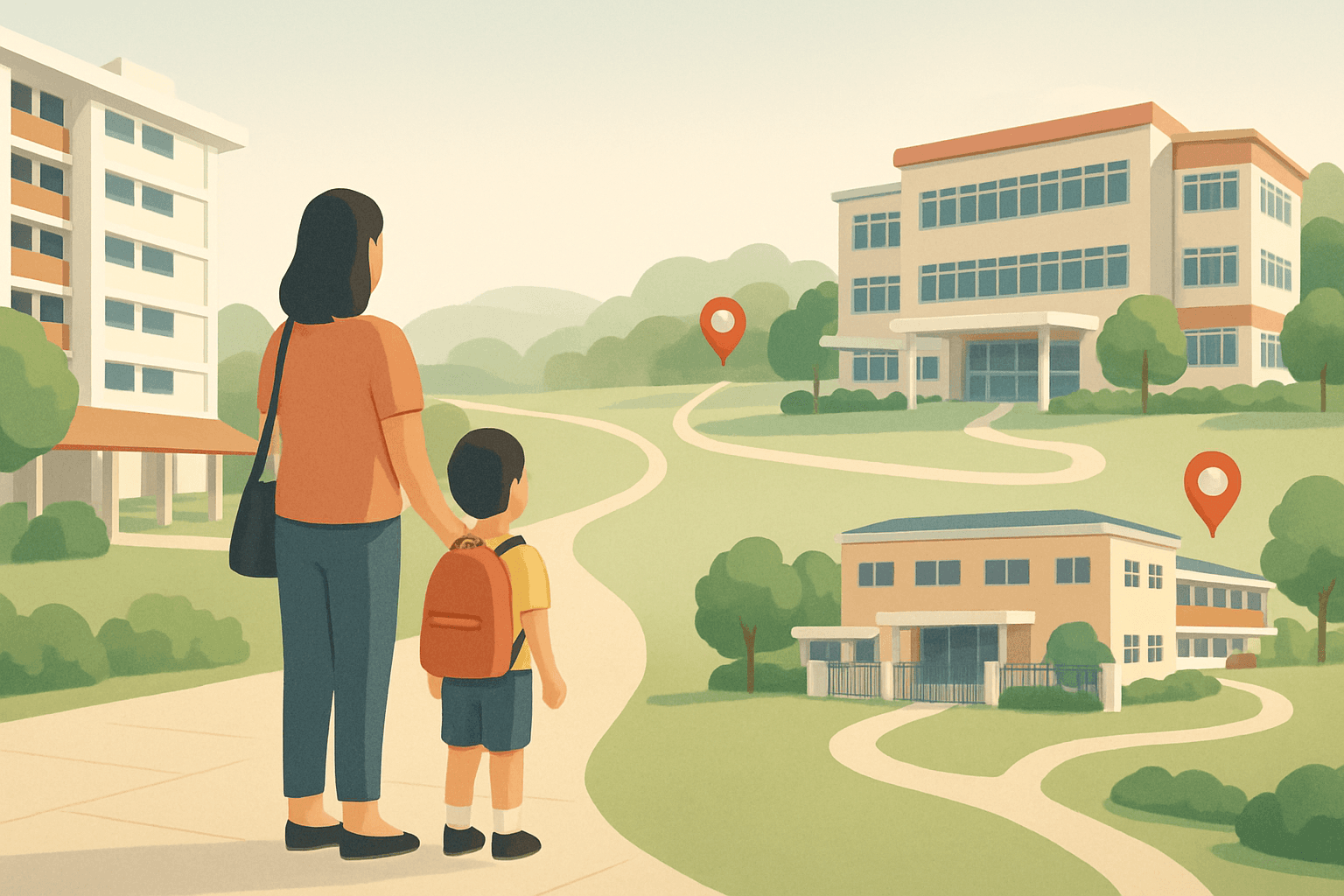
If your preferred school is more than 1km away, you can still try for it, but you should not treat it as a safe bet. In Singapore's Primary 1 registration system, home-school distance becomes important when a school has more applicants than places. When that happens, families living closer are generally in a stronger position.
That does not mean a farther school is out of reach. It means you should think of it as a stretch choice, especially if the school is popular. This guide explains what being more than 1km away means in practice, when a far school may still be worth trying, and how to choose a backup school your family can actually use. If you want the full process first, start with our Primary 1 Registration in Singapore guide.
If my preferred school is more than 1km away, should I still try for it?
Yes, if you can treat it as a stretch choice and you already have a backup you can genuinely accept. If your family needs a safer outcome, a school more than 1km away is usually better treated as an aspiration than a main plan.
Yes, if you are treating it as a stretch choice. No, if your family needs a more predictable outcome and would struggle if the plan fails.
That is the clearest way to think about it. Being more than 1km away does not block your child from getting in. It means distance is less in your favour if the school is oversubscribed. So the real question is not just whether you are allowed to try. It is whether you are comfortable using a riskier Primary 1 registration strategy.
A few common parent situations make this easier to judge. One family may still try for a farther school because they feel strongly about it and already have a nearby backup they respect. Another family may like the same school, but both parents start work early and cannot manage a long morning trip, so even a successful outcome would create strain. A third family may be emotionally attached to the school but has no acceptable fallback at all. That usually means the plan is too fragile.
A useful mindset is this: try for the far school only if both outcomes are livable. If getting in would help and not getting in would still leave you with a workable school plan, applying can be reasonable. If either outcome creates serious stress, the school is probably not your best main plan. For a broader overview, see Primary 1 Registration in Singapore: How It Works, Balloting Risk, and How to Choose a Realistic School Plan.
All about Transferring to Other Primary Schools
Based on MOE guidelines, caregivers within 1km puts you in the 1 to 2km distance. Close, but still not good enough. No one can stop you from applying for transfer or waitlist, but realistically, your chances aren't high. You can always apply and hope. That said, getting your transfer to a popular school done before P2 is unlikely to happen unless you lives < 1km or have been balloted out in one of the previous phases. If you are looking at TP schools, a more realistic option would be Marymount C
Top Primary school?
for me, there is only one school within 1km from my place...it is a good one, but...i don't have any girls. i will need to ballot for a place for one sch within 1-2km from my place (next nearest school). if *touch wood*, balloting is unsuccessful, i will go for the next nearest neighbourhood school. for this, i am wary that this school focus its resources on the 'diamond' class and streaming starts as early as end of P1! getting him into such class will be my next best bet. so neighbourhood scho
What does being more than 1km away actually mean in Primary 1 registration?
Being more than 1km away usually puts your child behind within-1km applicants when a school is oversubscribed. It does not rule the school out, but it does make a popular school harder to secure.
It usually means your child is in a weaker distance band than applicants who live within 1km, but only when the school has more applicants than vacancies. That is the practical point most parents need.
MOE explains on its pages about home-school distance and balloting that children living closer to the school are considered ahead of those living farther away when places run short. So if a school is heavily contested, being beyond 1km reduces your priority compared with families in the nearer band. If the school is not oversubscribed in that phase, distance may matter much less because there are enough vacancies to go around.
A common misunderstanding is to treat the 1km line as a hard yes-or-no rule. It is not. More than 1km does not mean no chance. It means you are relying more on there still being places left after higher-priority and nearer applicants are placed.
If your home looks very close to a cutoff, do not guess based on a casual map check. MOE uses its own distance method based on the registered address, and small differences can matter when a family is near 1km. For a fuller breakdown, see our guide on Primary 1 registration distance priority.
All about Transferring to Other Primary Schools
I suppose before august, u will still be living in Punggol? Perhaps you still need some time to renovate, move/pack or settle down. Think it’s easier to transfer to TPY schools when your new premise is ready and settled.. perhaps register your child where your p2 is first and apply for transfer later. Better to start in a fresh year, say p3 and p1. If you have a caregiver for your p1 near TPY, u can try register p1 under that address...
All about Transferring to Other Primary Schools
Put your kid on waitlist in all the schools first. There is no limit. make a copy of the waitlist (take pic etc) and email to principal cc school admin to tell them you waitlisted and really really hope to join them because of distance. Anywhere in punggol is still nearer than her current school. Explore neighboring towns too. you may need to register on waitlist yearly. movement may only take place in end p3 when students move on to gep and p4 class size increased then have vacancies. Important
Have More Questions?
Get personalized guidance on schools, tuition, enrichment and education pathways with AskVaiser.
Try AskVaiser for Free →How should you judge whether a school is still realistic for your child?
A far school is realistic only if the likely competition, your child’s priority position, and your family’s day-to-day logistics still make the plan workable.
Use a simple three-part test: pressure, priority, and practicality.
First, ask how much pressure the school is likely to face. A school beyond 1km is more realistic if it is not usually crowded in the phase you are applying in. A far school becomes much less realistic when it is a well-known demand magnet and many applicants are likely to be in stronger positions. Our guide on Primary 1 registration phases helps you understand why the same school can feel very different depending on the phase, and our article on how to read past balloting data shows how to use past patterns sensibly. If you want broader context on how families think about balloting risk, this KiasuParents article on 2025 balloting risk can be a useful supplement, but MOE rules should remain your main reference.
Second, ask whether your child has any other valid priority advantage beyond distance. For example, if an older sibling is already in the school, that can materially change how realistic the option is. If that is relevant to you, read If Your Older Child Is Already in the School, Does Your Younger Child Automatically Get In?.
Third, ask whether the school is practical even if you succeed. This is the part parents often skip. A school can be technically possible and still not be a sensible choice if the commute is punishing, pick-up arrangements are weak, or your child will have an exhausting day. Realism is not just about admission. It is about whether the school still makes sense after you get in.
All About Preparing For Primary One
First of all, how far are u from the school? Within 1km or 1 - 2km? If near, don't take school bus, send yourself. Any balloting history for the neighbourhood school under 2C?
[Central] Primary Schools
Hi anyone knows the no. of pple who registered for RV primary are within 1km? I am within 1 to 2 km. Should I try?
What is a sensible backup school if your first choice is far away?
Choose a backup school your family can genuinely live with on commute, care arrangements, and school fit. A placeholder school is not a real backup.
A sensible backup is a school you would be prepared to use for the full six years, not a name you put down just to feel less anxious during registration.
In real family planning, that usually means a school that is easier to reach, easier to organise around, or simply easier to live with. For one family, that may be a nearby neighbourhood school. For another, it may be a school with a direct bus route, reliable student care nearby, or convenient support from grandparents. It does not have to be your dream school. It does have to be a school you can respect and manage.
Parents often make the mistake of choosing a backup that only looks safe on paper. The better test is emotional and practical at the same time: if the backup became your final outcome tomorrow, would you feel disappointed but steady, or disappointed and trapped? If the answer is trapped, it is not a real backup.
A short way to remember this is: a backup should lower stress, not postpone it. If you are deciding between prestige and practicality, our comparison of a popular dream school and a safer nearby school may help.
2B Primary one registration question
Hi, Hope all is well. I have been serving as an active community leader in one GRC for over 2 years. Just before primary one registration, if we move to a new address, are we able to register the child in 2B phase for schools within 2km in the new address?
[Central] Primary Schools
Thanks jacsplace. I will be registering in 2B. so wanted to know which school will be in terms of academics. Distance wise, River valley primary is nearer.
Should your backup be within 1km, or can it also be a stretch school?
Your backup does not have to be within 1km, but it should clearly be more attainable or more manageable than your first choice. If it carries almost the same uncertainty, it is not doing real backup work.
A stronger backup usually improves your position on at least one major factor, and distance is often the easiest way to do that. So yes, a backup within 1km is often safer. But the deeper point is not the exact band. The deeper point is whether the backup clearly reduces risk.
This is where many parents get caught. They pick two aspirational schools, both farther away or both highly competitive, and call one of them the fallback. In practice, they have created two stretch choices. A real backup should make at least one part of the plan calmer, whether that is better distance priority, lower competition, an easier commute, or stronger support from family members.
That means a backup does not always have to be within 1km. A school outside 1km can still be a sensible safety option if it is much less contested and far easier to manage. What matters is whether the second choice genuinely improves your odds or your daily life. If it does neither, it is not functioning as a backup. For a broader overview, see Primary 1 Registration Unsuccessful: What Happens If You Do Not Get Your Preferred School.
All about Transferring to Other Primary Schools
Hi everyone, I need some advice. Currently I’m staying in Jurong and will be shifting to Yishun in April/May next year. My son is in P1 now. I checked the schools nearby our new place and Chongfu is the nearest within 1km but I understand that that is a popular school so chances of getting a transfer there are very slim. There are several other schools within 1-2km but the walking distance is quite far and I would like to avoid having to take the school bus if possible. My main priority when cho
[Central] Primary Schools
During my PV with RVPS, I know the PV list is around 30-35. Those stay more than 2km also the school select them. Maybe now is new Principal where they try to increase PV to 60. Those staying more than 2km better have some backup plan.
What practical factors matter besides distance?
Look beyond the kilometre band and think about commute time, pick-up reliability, student care, sibling logistics, and whether the travel routine is sustainable for your family.
Distance matters during registration, but family routine matters once school starts. MOE's guidance on how to choose a school specifically encourages parents to weigh practical issues such as travel time and how the school fits the child's needs.
For many families, the key question is not whether the school is 1.2km or 1.8km away. It is whether the journey is simple, reliable, and sustainable five days a week. A farther school may still work if a parent already travels that way for work. A nearer school may still be difficult if the route is awkward, pick-up timing is tight, or no one can handle emergencies.
Think through the full weekday, not just the registration form. Who does drop-off. Who handles pick-up if a meeting runs late. Whether student care is near the school or near home. How rainy days will work. Whether a tired six- or seven-year-old can manage the journey after a long day. If siblings may end up in different schools, the transport plan can become far more tiring than parents expect.
A useful reminder is this: a school choice is not just an admission decision. It is a six-year transport decision.
All about Transferring to Other Primary Schools
https://www.moe.gov.sg/primary/transfers “You can apply to transfer your child to a primary school nearer to your new residential address if your child is: - A Singapore Citizen (SC) or Permanent Resident (PR). - Currently in Primary 1 to 5. We will offer your child a school nearer to your new residential address which has available vacancies. Your child will have to report to the new school by the end of the reporting period to complete the school transfer. Your NRIC must be updated with your n
All about Transferring to Other Primary Schools
Given your situation, I don’t think u can be too fussy. Take your pick: Boon Lay Garden Primary / Corporation Primary / Juying Primary. Whichever is easiest for your son to travel to on his own, or for you to drop off before u head to work. Call up those school(s) and ask how to transfer. I’m pretty sure they will have vacancy for your son. Next year, after your new flat is ready, then u can transfer him to a school near Geylang that has vacancies. Likely to be Eunos Primary. Don’t buy too many
When does moving house for a school make sense, and when is it too much?
Moving house only makes sense if it improves your real family situation beyond school admission. A move done purely to chase distance priority is costly, stressful, and still not a guarantee.
Move only if the housing decision makes sense even without the school result. MOE's guidance on home address and its FAQ make clear that the address used for registration must reflect where the family genuinely lives.
A move can be reasonable when it also improves your broader family life, such as reducing work commute time, putting you nearer grandparents, or fitting a long-term housing plan. It is usually too much when the cost and disruption only make sense if one specific school outcome happens. A simple test helps: if you would still feel good about the move even if the school result disappoints you, the move may be rational. If not, you are taking on a lot of housing stress for a school outcome that is still not guaranteed. If you are dealing with an address question, see our guides on which home address counts and what happens after moving house.
All about Transferring to Other Primary Schools
Refer to https://www.moe.gov.sg/primary/transfers “ If you decide not to accept the school offered, or miss the reporting deadline, your child will remain in their current school.” Also, “We will offer your child a school nearer to your new residential address which has available vacancies .” There is no guarantee that the school (< 500m) nearest your house has available vacancies, and if it’s a popular primary school, it’s unlikely to have any available vacancies. Use STEPS if you don’t mind an
All about Transferring to Other Primary Schools
There must be a reason why the kid needs to be with the primary caregiver who is staying near to the preferred school. If the purpose is just for the address, then it is not right no matter if they ask for proof or not. Be truthful in your reasons for transfer (without putting down the current school of course) . There must be something you like about the school that other schools may not offer (all girls, specific programme etc) . Use those reasons instead of trying to build on something that m
How should you plan if you are torn between a far school and a safer one?
Keep the far school as your aspiration only if you would still be okay with the backup becoming real. If the backup feels unacceptable, the safer school is usually the better main plan.
Treat the far school as the aspiration and the safer school as the real plan unless you can comfortably absorb the risk. That framing usually helps parents think more honestly.
If the farther school is a strong fit and your backup is still a school you trust, keeping the far school in play can be reasonable. For example, a family may apply for a farther school because they like its environment, but they stay calm because their backup is nearby, works well with student care, and fits grandparents' help. In that situation, the risk is contained.
The decision looks different when the backup feels like a loss your family would resent from the start. If you know you would be very unhappy with the fallback, and the far school's commute would also be demanding even if you succeeded, the safer school is usually the more coherent choice. It is not just the lower-risk option. It may be the better family plan.
A useful rule is this: choose the dream only if the fallback is still acceptable. If you are still torn, read our articles on popular primary school versus neighbourhood school and dream school versus safer nearby school.
All About Preparing For Primary One
My son is going primary 1 next year and I am eligible for phase 2b under a good school but it took two hours of time of bus transport to n fro from home. The kid have to be at the bus stop at 6am waiting for bus. That school have proven track record for the past many years because of it’s strict standards. Now, my headache is there Is a relatively new school which is only a few years old n has not proven track records n the highest psle scores is 230plus. This school is just downstairs my home b
All About Preparing For Primary One
But how many can \"safely\" get into the affiliated primary school esp via the Phase 2C route? There are not many affiliated primary school and if you are not within that 1km, then chances will be smaller. Look at the following list:- http://www.kiasuparents.com/kiasu/content/affiliated-schools-listing
What is the biggest mistake parents make when planning a Primary 1 backup school?
Parents often treat the far school as impossible or treat it as the only plan. A real backup must be a school you are genuinely prepared to use, not just one that sounds safer on paper.
The biggest mistake is planning emotionally instead of structurally. Some parents assume the far school is impossible and rule it out too quickly. Others treat the far school as if it is the only outcome that matters, then panic when the result does not go their way.
The second mistake is choosing a backup that the family never truly accepted. That often looks sensible early on because the school seems safer, but it creates regret later because nobody actually planned for daily life there. A backup should already be good enough to become the main plan without last-minute scrambling.
A simple self-check works well here: if you found out today that the backup school was the final outcome, would your family feel disappointed but settled, or anxious and unprepared? If the answer is anxious and unprepared, the backup probably needs rethinking. If you want to understand the downside more clearly, our guide on what happens if you do not get your preferred school is the next useful step.
[Central] Primary Schools
@qms : thanks for the advice didn't knew that Primary School registration will be such a stressful and competitive \"game\" for the parents I have heard from other parents in my son's kindergarten with elder siblings that the parents will each station at different Sch to do registration together on P2C and live update each other on the latest \"battle\" status. Then they will choose and withdraw application of their plan B sch should they get into their first choice sch... Something like that ri
All About Preparing For Primary One
Starting primary school? This is a big milestone. Do enjoy the journey with your child! :rahrah: https://www.straitstimes.com/singapore/education/the-st-guide-to-preparing-your-child-for-primary-1 Parents often confuse being ready for school with being academically capable in skills like reading and counting. Instead of focusing solely on academic progress, it is more important to make learning an enjoyable process, and help your child have a swift and happier adjustment to primary school. Here
Have More Questions?
Get personalized guidance on schools, tuition, enrichment and education pathways with AskVaiser.
Try AskVaiser for Free →