
Singapore Citizen and PR Priority in P1 Registration: What It Means for Your Child’s Chances
A practical guide to how citizenship status affects priority, balloting, and realistic school choices in Singapore’s Primary 1 registration.
Singapore Citizen and PR priority affects P1 registration most when demand is higher than supply. In broad terms, Singapore Citizen children usually have better odds than PR children in the same competitive pool, but the final result can still be shaped by school links, home-school distance, remaining vacancies, and balloting. The simplest way to think about it is this: priority improves your odds, but it does not promise a seat.
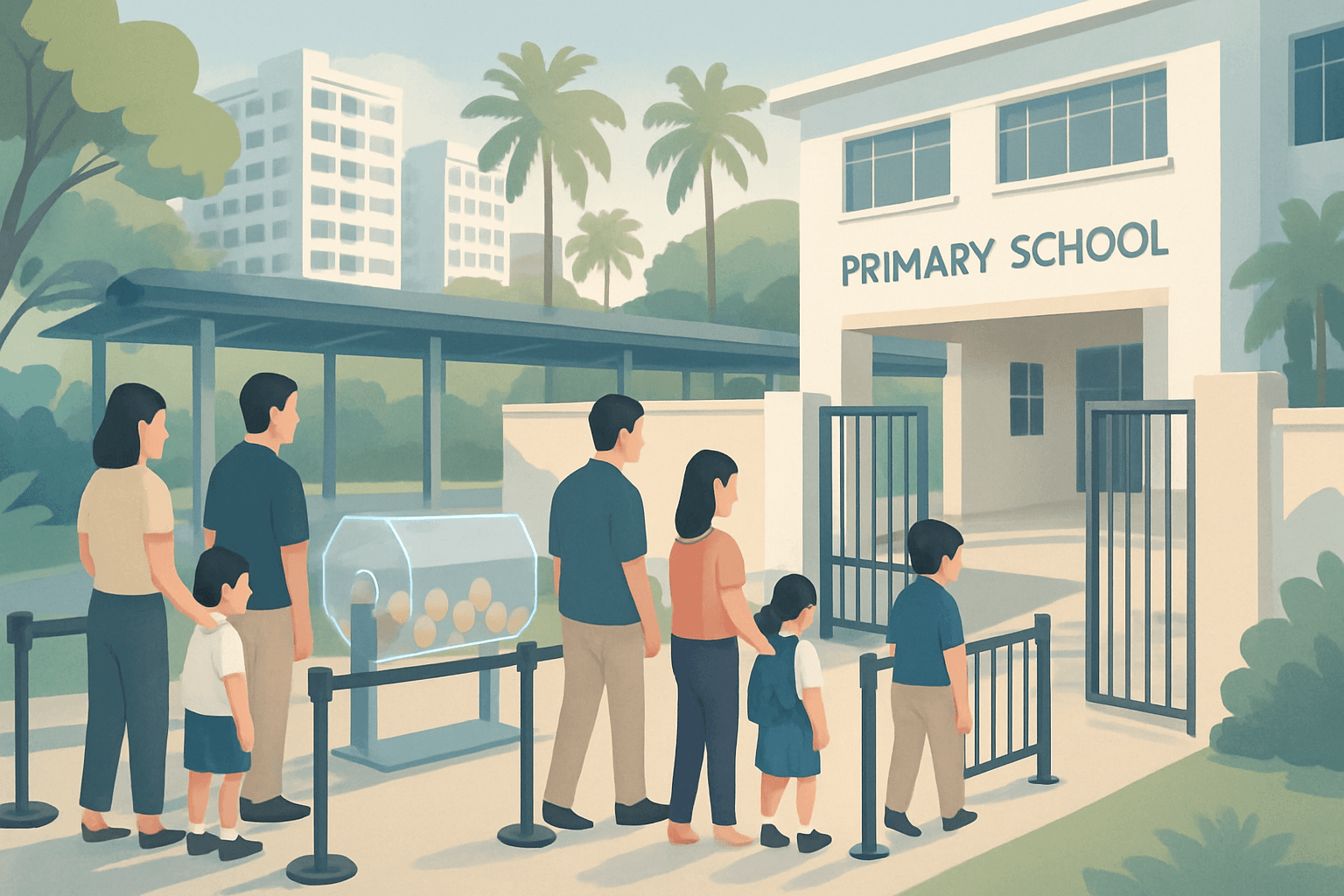
Yes, Singapore Citizen status usually gives a stronger position than PR status in competitive Primary 1 registration situations, but it does not guarantee a place. The difference matters most when a school is oversubscribed, vacancies are tight, or balloting is needed. If a school has enough places for everyone in that phase, you may not feel the difference much at all. For parents, the useful question is not just whether your child can apply, but how likely it is that places will still be available when your child is considered.
What does Singapore Citizen and PR priority actually mean in P1 registration?
Singapore Citizen and PR priority changes your odds when places are tight. SC children usually have a stronger position than PR children in oversubscribed schools, but neither status guarantees admission.
It means citizenship status can change your child’s odds when a school is under pressure, not that it secures a place automatically. In practical terms, Singapore Citizen children are generally in a stronger position than PR children when vacancies are limited, especially at schools that attract many applications.
This matters most when parents are looking at popular schools. If a school has enough places for everyone in that phase, the SC versus PR difference may barely be felt. If the school is oversubscribed, the difference becomes much more visible. That is why parents should read priority as an advantage, not a promise.
A useful mental model is this: priority moves your child further forward in the queue, but it does not guarantee there will still be a seat at the end. If you are still getting familiar with the overall process, start with our broader guide to Primary 1 registration in Singapore and then check who is eligible for Primary 1 registration in Singapore. For official confirmation of the current year’s rules, use MOE’s FAQ page as a starting point and verify any school-specific assumptions before you apply.
All About Singapore Birth Rates
I've a friend who has been a PR for years and converted this year for her girl's P1 registration. Her girl managed to get into the school after phase 2c ballot. Govt gave \"priority\" to citizens over PR when it comes to P1 registration. However, it seems that it's not that difficult for PR to convert to SC at the sametime. My feel is that the pool of SC just got bigger that's all.
Give citizens priority in Primary 1 registration
Not sure if this has been mentioned in KSP forum? From 2010, Singapore Citizens (SCs) will be given an additional ballot slip (i.e. two chances instead of one), while Permanent Residents (PRs) will retain one ballot slip whenever balloting is conducted by any school during the P1 Registration Exercise. SCs will therefore have a higher chance of securing a place for their child in a school of choice when there is balloting. Giving Singaporeans two chances during balloting will retain the underlyi
Priority helps your chances, not your certainty
Eligibility gets your child into the process. It does not guarantee admission when a school is oversubscribed.
Being eligible for a phase does not mean a seat is reserved for your child. At a popular school, the real question is not just "Can we apply?" but "Will enough places still be left when our child’s group is considered?". For a broader overview, see Primary 1 Registration Phases in Singapore: What Each Phase Means for Your Chances.
2023 P1 Registration Exercise for 2024 In-take
A gentle reminder for International Students : From MOE https://www.moe.gov.sg/primary/p1-registration/international-students International students (IS) can only register for P1 during Phase 3 of the P1 Registration Exercise, after all Singapore Citizens and Permanent Residents have been allocated a place under the earlier phases. Prior to Phase 3, ISes must go through a 2-step process: 1. Submit an online indication of interest form, available here from 9am on Tuesday, 30 May 2023 to 4.30pm on
Give citizens priority in Primary 1 registration
http://www.guidemesingapore.com/permanent-residence/singapore-pr-pros-and-cons.htm Quote from above : If your children are school-aged, they are high on the priority list, behind citizens, to enter public schools of your own choosing. Non PRs are at the bottom of the list and are often left with no choice when it comes to schools.
Have More Questions?
Get personalized guidance on schools, tuition, enrichment and education pathways with AskVaiser.
Try AskVaiser for Free →When does citizenship status matter most in P1 registration?
Citizenship status matters most when a school is oversubscribed or vacancies are already tight. If a school has spare capacity, the SC versus PR difference may have little practical effect.
Citizenship status matters most when places are running out. That usually means popular schools, tighter phases, or later points in the process where fewer vacancies remain. Parents often focus too much on the phase label and not enough on a simpler question: by the time your child is considered, how many seats are likely to be left?
If a school is not heavily contested, citizenship may matter much less in practice because there is enough room for the applicant pool. If the school is crowded, citizenship becomes more important because the system needs a way to sort competing applicants when supply is tight.
This is also why old forum advice can be misleading. The broad framework can change over time, as education policy coverage from TODAY shows, so parents should understand the logic of the process and then confirm the current year’s details. If you want the phase structure explained in plain English, our guide on Primary 1 registration phases in Singapore is the best next step.
Insight line: citizenship matters most where competition is highest, not equally across every school. For a broader overview, see Primary 1 Registration Distance Priority: How Home-School Distance Works.
Give citizens priority in Primary 1 registration
Ha.ha. maybe next time the P1 registration phase can propose like that, just a suggestion: Phase 1 – Existing siblings in the Primary school except PR siblings. Phase 2A(1) – No Change Phase 2A (2) – No Change Phase 2B – No change Phase 2C – Singapore Citizenship Only. Phase 2C Supplementary - Singapore Citizenship Only Phase 3A – Permanent Residents Phase 3A Supplementary - Permanent Residents Phase 4 – Non Citizen.
All About Getting Priority Registration
the changes made relates only to SCs over PRs. in each of the particular phase. see below: http://www.moe.gov.sg/media/press/2012/03/seven-new-primary-schools-for-2013-and-further-differentiation-and-outreach-at-p1-registration.php all the best to all for coming year registration.
How do Singapore Citizen children and PR children compare in oversubscribed schools?
At oversubscribed schools, SC children usually have the stronger position and PR children usually face a tighter contest. PR families can still succeed, but the margin for error is smaller.
In an oversubscribed school, Singapore Citizen children usually have better odds than PR children in the same broad competitive pool. That does not mean PR children cannot get in. It means PR families usually have less room for error when the school is in high demand.
Parents often swing to one of two wrong conclusions. The first is that SC status means the school is effectively secured. The second is that PR status means there is no point trying. Both are unhelpful. The more accurate view is that SC status can materially improve your position in a crowded contest, while PR status makes school selection and backup planning more important.
A simple example helps. Imagine two nearby families applying to the same popular school, with no unusually strong extra advantage separating them. If places are tight, the SC family will usually be in the stronger position. But if the PR family applies to a less contested school, or to a school where its other advantages matter more, the outcome can still be positive. The key variable is not status alone. It is status under competition. For a broader overview, see How to Read Past Balloting Data Before Chasing a Popular Primary School.
All About Getting Priority Registration
Daddy D, Govt said not enough babies to replace us, so take in PRs and convert some to SCs. Now enough people, so limit PR application. Already PRs and new SCs are giving born-and-bred Singaporeans like us harder access into nearby schools. What’s next ? Given a ‘hot’ year for P1 registration like 2006, hubby & I were so relieved (very worried then) when son got into Pei Hwa (staying within 1km) but can you imagine those registering in 2012 ?
All About Getting Priority Registration
Well, the straits times reported that the PR represented 10% of each year primary one's intake. The number seems surprisingly small when we see Foreign talent everywhere. So I guess they are really referring to the real PRs. Coz most of our PRs, they may retain their PR status but convert their wife and kids. So the 10% PR doesn't represent all the chineses, Indians, burmanese, thais that we see on the road now as they would be citizen by now. Even if they slow down the granting of PR or citizen
What happens during balloting, and how does priority affect the outcome?
Balloting usually happens only after the priority rules have already narrowed the field. It is a tie-break tool, not pure randomness from the beginning.
Balloting is usually where priority and chance meet. It does not mean the whole process becomes random from the start. A school does not normally place every applicant into one large lucky draw. The relevant priority rules are applied first, and balloting is used only when there are still more applicants than remaining places within the group being considered.
For example, if a school has 40 places left but 70 children remain in the same priority pool, balloting may be used to decide who gets those last places. That is why many parents misunderstand balloting. They hear the word and assume citizenship no longer matters. In practice, citizenship and other priority factors often shape who reaches that ballot stage in the first place.
If you want a more realistic way to judge risk, look at whether the school has a history of tight competition instead of relying on hope. Our guide on how to read past balloting data can help, and historical examples from KiasuParents’ balloting probability article are useful as illustrations of how oversubscription can play out. Use past balloting data as a risk signal, not as a promise of what will happen this year.
Insight line: balloting does not cancel priority. It is what happens when priority alone still cannot separate enough applicants from too few places. For a broader overview, see Who Is Eligible for Primary 1 Registration in Singapore?.
2010 P1 Registration Exercise for 2011 In-Take
Finally, some changes for Singaporean !!! Sun, Dec 20, 2009 AsiaOne More privileges for citizens in P1 registration Parents who are Singapore citizens will now have a higher chance of securing a place for their child in their school of choice during the Primary One (P1) registration exercise. From 2010, parents who are Singapore citizens will be given two ballot slips instead of one, whenever balloting is conducted by any school. According to a statement released by the Ministry of Education (MO
2010 P1 Registration Exercise for 2011 In-Take
Saw this online news today. http://www.straitstimes.com/BreakingNews/Singapore/Story/STIStory_541633.html Pri 1 registration July 6 SINGAPOREANS will get two ballot slips - one more than Permanent Residents - when they have to ballot for a place during the Primary 1 Registration Exercise which starts from July 6 and ends on Aug 30. This change was announced last year as part of the Government's move to enhance the privileges of being a citizen and draw a clearer distinction between between Singa
Does home-school distance still matter if my child is a Singapore Citizen or PR?
Yes. Distance can still shape the outcome within the same phase or competition group, even when citizenship status is already part of the picture.
Yes. Distance still matters, and many parents under-estimate how much it can affect real outcomes. Citizenship does not erase distance, and distance does not erase citizenship. In competitive cases, both can matter together.
A useful way to picture this is to compare two children with the same broad status and school link. Two SC families applying to the same school are not automatically in the same position if one lives much closer. The same idea can matter among PR applicants too. When a school is crowded, address can help separate families within the same competition group.
For parents, this means your address is not a minor administrative detail. It is part of your admissions position. If you are evaluating a school partly because it is near home, read Primary 1 registration distance priority together with which home address counts for Primary 1 registration. If your housing situation is changing, using an old or new address after moving house can also affect how you plan.
The practical takeaway is simple: a nearby address can improve your odds, but it does not make a popular school risk-free.
Questions on new rules of P1 registration
With the announcement of the new rules of P1 registration - that citizens now have advantage over PRs, I have 2 questions: 1. Does the living distance to the school matter (ie 1 km away)? 2. If the PR has an older child in the school already, is priority given to the child’s younger sibling? Thanks!
All About Getting Priority Registration
If your child qualifies under P2B, he or she will still have to wait till all Singaporeans who qualify under P2B get their places in the school.
What are the most realistic scenarios for SC and PR families?
The biggest differences appear when families compare a highly contested school with a safer option. SC families often have more room to take risk, while PR families usually need stronger backup planning.
A common SC scenario is a family aiming for a popular school where the child also has a strong school link, such as an older sibling already studying there. In that situation, the citizenship advantage can help, but parents should still resist the idea that the place is automatic. A linked school can still be competitive, so it is worth reading whether an older child in the school means your younger child gets in automatically.
A common PR scenario is a family targeting a high-demand school because it is well known, nearby, or strongly recommended by friends. This is where many parents get caught out. The child may be fully eligible to apply, yet still face a much tougher outcome if the school attracts heavy demand. In that situation, the smartest move is not to panic and not to assume failure. It is to build a realistic backup plan before registration starts.
Another very common scenario is two families in the same neighbourhood comparing two nearby schools. One school has a long history of balloting and the other is more predictable. The SC family may decide to take on more admissions risk because the odds are more comfortable. The PR family may decide that the more stable school is the better overall choice. That is not settling. It is matching your school ambition to your admissions reality.
The key insight is that the same school can be a calculated risk for one family and an unnecessarily fragile choice for another.
All About Getting Priority Registration
Yes, all phases remain the same. And PRs in earlier phases still get in before SC in subsequent phases. The SC priority over PR only applies within the same phase.
2021 P1 Registration Exercise for 2022 In-take
SC. It's the citizenship of the child that matters, not the parents (similarly, parents who are SC but register their child as PR / foreigner citizen will be categorised as such).
How should parents judge whether a school is a realistic choice?
Judge realism using three things: how competitive the school usually is, what real advantages your child has, and whether your backup option is genuinely acceptable.
A realistic school choice is not just a school you like. It is a school where you understand the admissions risk, your child’s likely position, and what you will do if the result goes against you. The three most useful questions are whether the school is usually oversubscribed, whether your child has any real advantage such as a strong school link or close distance, and whether your family can genuinely accept the backup option.
This is where parents should move from a dream-school mindset to a shortlist mindset. A strong shortlist usually has one higher-risk choice, one more stable option, and a clear fallback that you can live with. If your only acceptable outcome is one famous school, your plan is fragile before registration even begins.
Our article on choosing a popular dream school or a safer nearby school can help you think through that tradeoff, and popular primary school versus neighbourhood school is useful if you are still deciding what matters most for your child.
Insight line: a realistic school choice is a preferred school with an acceptable fallback.
Give citizens priority in Primary 1 registration
An example of PRs having priority over citizens (in a way): De La Salle Primary school does not accept PVs, and I know of Catholic PRs who got in under Phase 2B whilst Singaporeans (non Catholics) don’t even have a chance at phase 2B!!
Give citizens priority in Primary 1 registration
IMO, the real issues are; 1) How we use home-school distnace in allocating priority (the bigger problem, IMO), and 2) How are the incentives/disincentives for PRs to commit to become Singaporeans pitched. Perhaps the question of whether PRs should have equal priority at Phase 2C is a tactic to be employed in point 2) is a pertinent one, but this Phase 2C priority issue is frankly otherwise a sideshow. Of course all families desire to locate their child in a school that is reputable and close to
What mistakes do parents commonly make about SC and PR priority?
The biggest misunderstandings are thinking SC means guaranteed admission, PR means no chance, or distance does not matter. In practice, status matters, but school demand and backup planning matter just as much.
The first mistake is treating SC status as a guarantee. It is not. A child can be in a better position and still miss out if the school is heavily contested. The second mistake is assuming PR status means there is no point trying. That can cause families to rule out reasonable options too early, especially when a school’s reputation sounds scarier than its actual competition level.
Another common mistake is focusing on status alone and ignoring distance. In real outcomes, address can still shape your odds. Parents also sometimes talk about "the P1 phases" as if every phase behaves the same way, when the more useful question is how much competition exists at the point your child enters the process.
The final mistake is choosing based on brand rather than admissions reality. Parents may spend weeks discussing reputation and very little time checking past balloting patterns, sibling links, address implications, or fallback schools. The better approach is calmer and more practical: understand your child’s position, understand the school’s demand, and then choose a plan you can accept even if the result is not ideal.
Insight line: status matters, but demand is what turns status into a real admissions advantage or disadvantage.
All About Pri 1 Registration for Foreigners & Phase 3
For Singaporean with children not born with SC status, might still hv better chance if they appeal to MP. But I guess no obligation if child is born before marriage to a Sporean. However, those on PR status, priority may be much much lower. I’ve a very good friend, attracted to Spore as a research scientist & got his PR together with wife and 2nd child born in Spore. However, elder boy no PR status & application over 3 years failed rendering family forced to adopt a European country with job off
*** READ ME FIRST !!! - P1 Registration FAQ ***
For Singaporean - The child’s Singapore Birth Certificate - The child’s Singapore Citizenship Certificate for those who are not Singapore Citizens at the time of birth - Singapore NRIC of both parents or Entry / Re-entry Permits of parents if they do not possess Singapore NRIC - The child’s Immunisation Certificates For PR - The child’s Birth Certificate - The child’s Entry/Re-entry Permit - Singapore NRIC of both parents or Entry/Re-entry Permits of parents if they do not possess Singapore NRIC
My child is a PR and the school is oversubscribed. Should we still try?
Yes, you can still try, but treat it as a higher-risk choice. Apply with a clear backup plan, not with the hope that eligibility alone will carry you through.
Yes, if you understand that it is a higher-risk choice and you can accept the fallback. PR status does not mean you should automatically rule out a popular school. It does mean you should be more deliberate about judging whether the odds are worth the risk for your family.
Start by checking whether your child has any other meaningful advantage, such as a strong school link or an address that could help in a competitive situation. Then build your backup plan immediately rather than waiting to see what happens. In practice, that means shortlisting one or two schools you would still be comfortable with, getting your documents ready early, and making sure your address details are consistent. Our guide to Primary 1 registration documents parents commonly prepare can help with that preparation.
It also helps to prepare emotionally for balloting or an unsuccessful outcome. If the preferred school does not work out, you will want to move quickly and calmly, which is much easier if you have already read what happens if you do not get your preferred school.
The goal is not to avoid ambitious choices. The goal is to avoid being surprised by a predictable risk.
Give citizens priority in Primary 1 registration
BTW I wrote ths to ST but it never got posted: In her letter, Mrs Agawal have hit the gist of why PR students should not be given equal chance for Primary 1 registration. She says that if her children were unable to secure a place in a good public school, why would her family to stay? A Singpore citizen will never be able to say that. We are here to stay and as such deserve the right to choose before a permanent resident. My son, a 4th generation Singaporean, was not able to secure a place in a
All About Getting Priority Registration
I am a former pupil of a primary school that I am trying to get my son into. However I only studied in that primary school from Primary 1 to 3. Am I still considered a former student of the primary school and qualify for Phase 2A? Also about giving Singapore Citizens priority. If my son is PR, and qualify for Phase 2A. Will he get priority of entry over SC in Phase 2B?
Have More Questions?
Get personalized guidance on schools, tuition, enrichment and education pathways with AskVaiser.
Try AskVaiser for Free →